
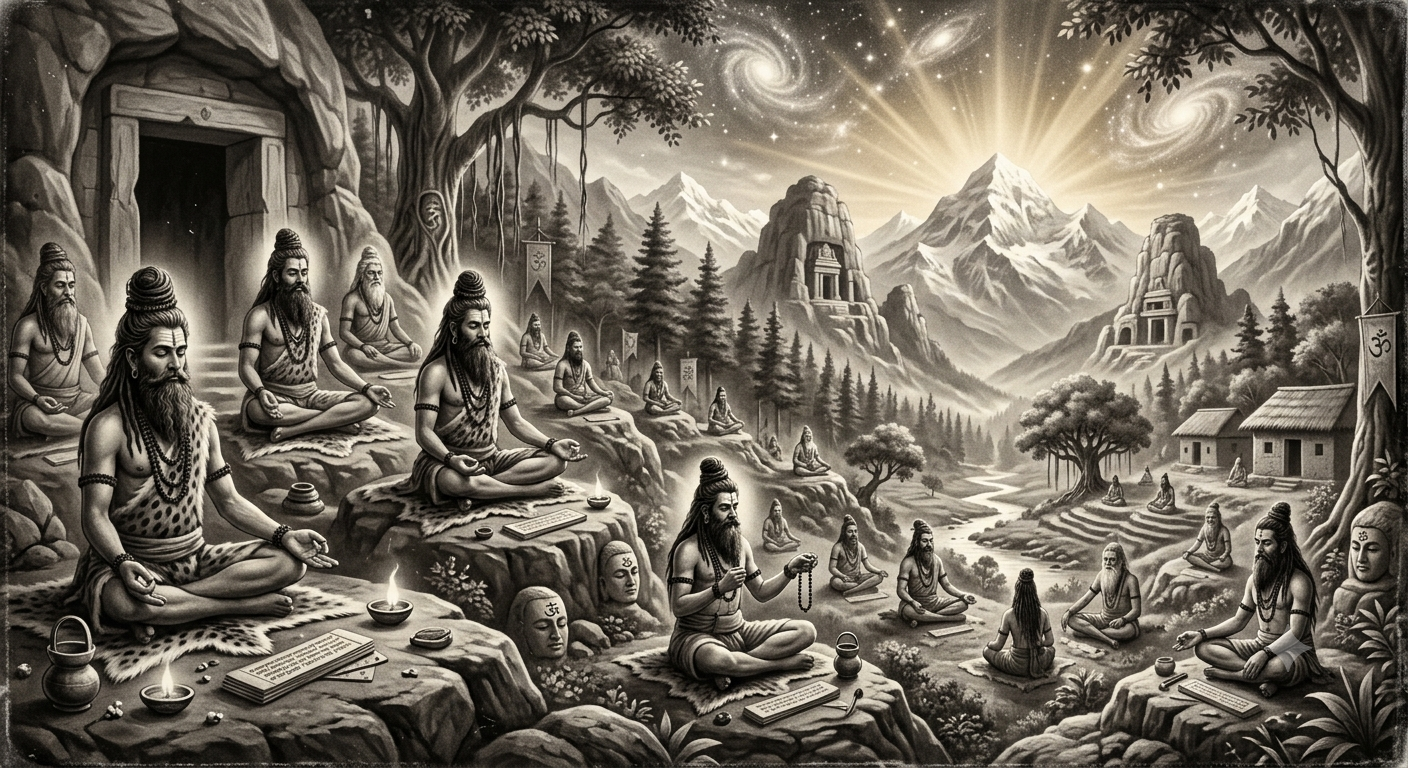
The opposition between Garuḍa and the Nāgas is one of the most striking symbolic structures in the Mahābhārata. At first sight, their conflict appears to be a mythic struggle between a celestial bird and a race of serpents. Yet the narrative preserves several conceptual patterns that are deeply rooted in the Vedic imagination: the opposition between the ascending bird and the terrestrial or subterranean serpent, the celestial acquisition of Soma, the relationship between ṛta, dharma and cosmic stability and the transformative power of tapas. The epic therefore does not simply create an independent mythology of Garuḍa and Śeṣa; it reworks older Vedic motifs into a more elaborate narrative and ethical framework.
The most important Vedic background to the Garuḍa story is the myth of the eagle or Suparṇa who obtains Soma. In the Ṛgveda, the Suparṇa or Śyena is associated with the extraordinary feat of bringing Soma from a distant celestial location [1].¹ One hymn describes the Soma brought by Suparṇa, the son of the falcon, from afar [2].² Another Vedic passage similarly describes the swift bird penetrating the heavenly stronghold and bringing Soma to Indra [3].³ These hymns provide an important antecedent for the later epic narrative in which Garuḍa penetrates the divine realm and carries away the nectar of immortality. The correspondence should not be reduced to a claim that Vedic Suparṇa and epic Garuḍa are already identical characters. Rather, the Mahābhārata appears to develop an established Vedic mythic pattern into the fully personalized figure of Garuḍa.
Further, this continuity becomes particularly visible in the Ādiparvan. Garuḍa undertakes his extraordinary journey not in pursuit of personal pleasure but in order to obtain the amṛta demanded by the Nāgas as the price for freeing his mother Vinatā. The epic therefore transforms the older celestial-bird-and-Soma motif into a narrative of filial obligation, bondage, liberation and moral agency. Garuḍa must cross increasingly difficult obstacles, defeat the guardians of the nectar and finally seize the amṛta [4].⁴ His acquisition of the nectar consequently represents not simply supernatural strength but the successful completion of a difficult obligation.
The distinction between Vedic Soma and epic amṛta is important. They should not simply be treated as identical substances. Nevertheless, the structural continuity is unmistakable: in both traditions, a powerful bird obtains a precious substance located in the celestial realm and carries it away. The epic therefore preserves the Vedic image while transforming its narrative function. The Vedic bird brings Soma into the sphere of sacrifice, whereas Garuḍa obtains amṛta to accomplish an act of liberation. This is an example of Vedic influence operating through structural continuity rather than literal repetition.
Here, Garuḍa’s conduct after obtaining the nectar is especially significant. He does not drink the amṛta himself. Instead, he places it on kuśa grass for the Nāgas and asks them to perform their ablutions before drinking it [5].⁵ Meanwhile, Indra retrieves the nectar before the serpents can consume it. The episode establishes Garuḍa’s extraordinary relation to immortality: he obtains the substance capable of conferring immortality without making its consumption the source of his own power. The narrative should not, however, be described anachronistically as a doctrine of jīvanmukti. The Mahābhārata does not state that Garuḍa becomes a liberated individual in the later Vedāntic sense. His refusal to consume the nectar is better interpreted as an epic representation of freedom from dependence upon the object he has obtained.
On the other hand, the story of Śeṣa provides a striking counterpoint. Unlike his brothers, Śeṣa withdraws from the Nāga community because of their destructive conduct and undertakes severe austerities. He lives on air, controls his passions and travels to sacred places while maintaining his vows [6].⁶ Brahmā is impressed by his tapas and grants him the boon that his mind remain devoted to dharma, tranquillity and austerity. Śeṣa’s asceticism therefore does not culminate in withdrawal from the world. Instead, Brahmā directs him toward the welfare of creation: he must support the unstable earth [7].⁷
This episode is crucial for understanding the relationship between asceticism and cosmic order in the Mahābhārata. Śeṣa initially seeks separation from his brothers and even desires to abandon his body. Brahmā, however, redirects his austerity toward lokahita, the welfare of beings. His tapas consequently becomes the basis of cosmic responsibility. Śeṣa enters beneath the earth and supports it upon his head, after which Brahmā identifies him with Dharma because he alone sustains the earth [8].⁸ The epic thus refuses to present renunciation and worldly responsibility as absolute opposites. Ascetic withdrawal becomes meaningful when it is transformed into a capacity to sustain the world.
This is where the relationship between Garuḍa and Śeṣa becomes particularly significant. Garuḍa represents movement across cosmic boundaries: he rises into the heavens, penetrates guarded spaces, obtains the celestial nectar and returns to the terrestrial world. Śeṣa, by contrast, moves beneath the earth and becomes its support. One is characterized by extraordinary mobility; the other by extraordinary stability. Their opposition therefore creates a symbolic polarity between ascent and foundation, rather than simply between good and evil.
Moreover, the Vedic background makes this polarity more intelligible. The Ṛgveda repeatedly employs the imagery of the Suparṇa and the serpent within its wider symbolic vocabulary, while the Soma-bearing bird represents movement between terrestrial and celestial spheres [9].⁹ The epic develops this imagery into a genealogy in which Garuḍa and the Nāgas are half-brothers through Kaśyapa. Their opposition is therefore simultaneously a conflict and a relationship within a single cosmic family. The epic does not simply place celestial and chthonic powers in unrelated worlds; it narratively connects them.
Importantly, the Īśā Upaniṣad provides a useful later Vedic framework for understanding this broader tension, although it should not be presented as the direct source of the Garuḍa story. Its discussion of vidyā and avidyā insists that the two must be understood together rather than through a simplistic rejection of one in favour of the other [10].¹⁰ This provides a useful interpretive parallel for the epic’s treatment of Garuḍa and Śeṣa: transcendence and worldly stability are not necessarily mutually exclusive. Garuḍa’s movement beyond ordinary limitations and Śeṣa’s sustaining of the earth represent different modes through which order can be preserved.
The other Nāgas, meanwhile, should not simply be described as embodiments of avidyā or sensual pleasure. The epic’s actual narrative explanation is more specific: their hostility and jealousy contribute to their mother’s curse and their conduct contrasts with Śeṣa’s commitment to dharma and austerity [11].¹¹ The distinction is therefore ethical rather than a straightforward Upaniṣadic allegory of knowledge versus ignorance.
Thus, the Garuḍa-Nāga narrative consequently demonstrates how the Mahābhārata transforms Vedic motifs into an integrated epic symbolism. The celestial bird who brings Soma becomes Garuḍa, the liberator of Vinatā; the serpent world becomes associated with subterranean existence and, in Śeṣa’s case, cosmic support; and tapas becomes a force that converts personal renunciation into responsibility for the world. The deepest Vedic continuity therefore lies not in identifying Garuḍa mechanically with mokṣa or Śeṣa mechanically with karma-yoga, but in the epic’s preservation of an older cosmological grammar in which heaven and earth, ascent and stability, sacrifice and immortality and individual discipline and cosmic order remain interconnected. The Mahābhārata takes these inherited Vedic motifs and transforms them into a narrative meditation on liberation, obligation, austerity and the maintenance of dharma.
Footnotes
[1] Stephanie W. Jamison and Joel P. Brereton, trans., The Rigveda: The Earliest Religious Poetry of India, 3 vols. (New York: Oxford University Press, 2014), 4.26-27. The Vedic śyena or suparṇa is associated with the acquisition and transportation of Soma.
[2] Ṛgveda 10.144.4. See Jamison and Brereton, The Rigveda, 10.144.4: yaṃ suparṇaḥ parāvataḥ śyenasya putra ābharat / śatacakraṃ yo ‘hyo vartaniḥ. The verse describes the Soma brought from afar by Suparṇa, the son of the falcon.
[3] Ṛgveda 8.100.8. See Jamison and Brereton, The Rigveda, 8.100.8. The hymn describes the swift Suparṇa passing through the celestial stronghold and bringing Soma to Indra. The Vedic motif of the Soma-bearing bird is also discussed in studies of Soma mythology.
[4] V. S. Sukthankar et al., eds., The Mahābhārata: For the First Time Critically Edited, 19 vols. (Poona: Bhandarkar Oriental Research Institute, 1933-1966), 1.29-30. See especially 1.30, where Garuḍa penetrates the defenses surrounding the amṛta and carries it away.
[5] Ibid., 1.30.15-18: idam ānītam amṛtaṃ nikṣepsyāmi kuśeṣu vaḥ / snātā maṅgalasaṃyuktās tataḥ prāśnīta pannagāḥ. Garuḍa places the amṛta on kuśa grass and instructs the Nāgas to bathe and perform the required rites before drinking it. Indra subsequently removes the nectar.
[6] Ibid., 1.36. Śeṣa leaves his mother and undertakes severe austerities, living on air and controlling his passions.
[7] Ibid., 1.36. Brahmā directs Śeṣa to support the earth for the welfare of creatures, transforming his austerity into a cosmic responsibility.
[8] Ibid., 1.36: tvaṃ hi dharmas tvayā dhāryate mahī. Brahmā identifies Śeṣa with Dharma because he alone sustains the earth. See also Mahābhārata 5.102.2: eṣa śeṣaḥ sthito nāgo yeneyaṃ dhāryate sadā / tapasā lokamukhyena prabhāvasahitā mahī.
[9] Jamison and Brereton, The Rigveda, 4.26-27; 8.100.8; 10.144.4. The Vedic Suparṇa is a bird of prey associated in several passages with the acquisition or transportation of Soma. On the broader Vedic evidence for suparṇa, see Arthur Anthony Macdonell and Arthur Berriedale Keith, Vedic Index of Names and Subjects, 2 vols. (London: John Murray, 1912), s.v. “Suparṇa.” The Vedic Index notes occurrences in Ṛgveda 1.164.20, 2.42.2, 4.26.4, 8.100.8 and 10.144.4.
[10] Īśā Upaniṣad 9-11. See Patrick Olivelle, trans., The Early Upaniṣads: Annotated Text and Translation (New York: Oxford University Press, 1998), 248-49. Verse 11 states: vidyāṃ cāvidyāṃ ca yas tad vedobhayaṃ saha / avidyayā mṛtyuṃ tīrtvā vidyayāmṛtam aśnute. The passage should be used here as a later Upaniṣadic interpretive framework, not as evidence that the Īśā Upaniṣad directly explains the Garuḍa-Nāga narrative.
[11] Sukthankar et al., eds., Mahābhārata, 1.35-36. The epic distinguishes Śeṣa from his brothers through his rejection of their hostile conduct and his subsequent commitment to dharma, tranquillity and austerity.

