
Our Vision
The Centre for Vedic and Consciousness Studies at Indus University is founded upon a simple yet profound conviction: that the Veda is not merely an ancient literary corpus to be admired from a historical distance, but a living reservoir of knowledge whose philosophical, psychological, and spiritual insights remain deeply relevant to humanity’s enduring quest for self-understanding. Our vision is to cultivate a platform where rigorous scholarship, traditional learning, contemplative inquiry, and interdisciplinary research converge in the shared pursuit of re(dis)covering the deeper significance of the Vaidika revelation. We aspire to build a vibrant intellectual community that approaches the Vedas neither as relics of a forgotten civilization nor as the objects of unquestioning reverence, but as texts that invite sustained reflection, careful interpretation, and continuous dialogue across traditions, disciplines, and generations.
The Vaidika corpus presents an extraordinary hermeneutical challenge. Vaidika Sanskrit is not merely archaic in its linguistic structure, it is profoundly symbolic in its mode of expression. Every mantra unfolds simultaneously upon multiple planes of meaning, where the literal, ritualistic, psychological, cosmological, and spiritual dimensions coexist in a carefully woven semantic tapestry. The language of the Ṛṣis is deliberately suggestive rather than exhaustively descriptive, inviting the seeker to participate in an ever-deepening process of discovery instead of merely receiving fixed doctrinal conclusions. Consequently, the Vedas cannot be reduced to a collection of primitive hymns, ritual prescriptions, or poetic compositions. They represent an intricate symbolic architecture in which every word, image, deity, and sacrificial act participates in a larger metaphysical vision. To approach such a literature without adequate preparation is to risk mistaking symbolic expression for literal description and metaphysical insight for mythology.
A similar challenge confronts the student of the Itihāsa-Purāṇa tradition. The Rāmāyaṇa, the Mahābhārata, and the Purāṇas were composed to disseminate the quintessence of Vaidika wisdom among a wider audience. Their language is comparatively accessible, yet their narratives operate through symbolism, metaphors, and allegories. Characters embody psychological dispositions, battles dramatize inner conflicts, genealogies encode philosophical continuities, and seemingly historical events frequently point beyond themselves towards enduring truths concerning dharma, consciousness, and the human condition. Without an adequate understanding of the Vaidika worldview from which these narratives emerge, many of their profoundest dimensions remain concealed beneath the surface of the story. Conversely, an exclusive engagement with the Vedas, detached from their later narrative elaborations, often leaves the seeker without the interpretive framework necessary to appreciate how Vaidika principles unfold within lived human experience. We therefore envision a holistic approach in which the Vedas and the Itihāsa-Purāṇa corpus illuminate one another, allowing the symbolic language of the mantras and the metaphorical language of the narratives to be understood as complementary expressions of a unified civilizational consciousness.
The history of Vaidika interpretation further reveals the necessity of such an integrative endeavour. Within the long evolution of Vaidika learning, two great streams developed alongside one another: the practitioners of the karma-kāṇḍa, whose foremost concern lay in the preservation and performance of the sacred rituals, and the reflective thinkers of the jñāna-kāṇḍa, whose attention was directed towards philosophical inquiry and contemplative realization. In their earliest phases, these traditions existed in a dynamic and mutually enriching relationship. Ritual was animated by insight, while philosophical reflection remained grounded in the discipline of sacred practice. The recitation of the mantra and the contemplation of its significance formed two inseparable dimensions of a single intellectual and spiritual culture.
Over the centuries, however, this organic relationship gradually weakened. Historical, institutional, and intellectual developments contributed to an increasing separation between ritual preservation and philosophical interpretation. Those who devoted themselves to the meticulous oral transmission of the mantras became unparalleled custodians of phonetic precision, accentuation, and recitation, yet the deeper symbolic significance of many hymns increasingly receded from active inquiry. Conversely, those engaged in speculative reflection and philosophical debate often distanced themselves from the living oral tradition that had preserved these texts with astonishing fidelity across millennia. As these two currents drifted apart, memory became detached from meaning, and interpretation became detached from transmission. What had once been a harmonious unity gradually transformed into parallel traditions, each preserving an indispensable yet incomplete aspect of the Vaidika inheritance.
The intellectual consequences of this separation were profound. Interpretive uncertainty accumulated across generations, eventually giving rise to scepticism concerning the very intelligibility of the Vaidika mantras. This scepticism found its most famous expression in the assertion attributed to Kautsa, who argued that the mantras were fundamentally devoid of any coherent meaning. Although later scholars vigorously contested this position, the very emergence of such a claim illustrates the extent to which the original interpretive framework had become obscured. For us, this episode is not merely an interesting historical controversy but a reminder of the importance of restoring the dialogue between preservation and understanding. The Centre therefore seeks to investigate the historical conditions that produced this interpretive fragmentation while simultaneously exploring new pathways through which ritual expertise, philological precision, philosophical reflection, and contemplative insight may once again inform one another. Our aim is not to privilege one tradition over another but to recover the deeper unity that originally sustained them both.
The history of Vaidika exegesis also demonstrates that interpretation has never been monolithic. The great traditional commentators approached the Vedas through diverse methodological lenses, each illuminating particular dimensions of the texts. Yāska’s Nirukta inaugurated one of the earliest systematic attempts to recover the semantic richness of Vaidika vocabulary through etymology and contextual analysis. Durgācārya expanded this interpretive heritage with remarkable philological sensitivity. Skandasvāmī, Maheśvara, and numerous other commentators contributed insights that reflected the intellectual concerns and spiritual orientations of their respective ages. Their differences remind us that the Vaidika tradition has always flourished through dialogue rather than uniformity, through interpretive creativity rather than rigid dogmatism.
The last great traditional commentator whose influence came to dominate subsequent scholarship was Sāyaṇa. His monumental achievement in preserving and explaining the Vaidika corpus remains indispensable and deserves the highest scholarly respect. Nevertheless, his interpretive framework was primarily oriented towards the ritualistic dimension of the Vedas. While this perspective successfully elucidated innumerable sacrificial contexts, it gradually overshadowed earlier attempts to explore the psychological, symbolic, and spiritual depths of the mantras. As later generations increasingly relied upon Sāyaṇa as the definitive authority, alternative hermeneutical possibilities received comparatively less attention. This narrowing of interpretive horizons inadvertently contributed to the eclipse of a long-standing tradition that sought to uncover the inner significance of Vaidika symbolism.
The situation became even more complex with the emergence of modern Western Indology. Many early Indologists depended extensively upon Sāyaṇa’s ritualistic explanations while simultaneously approaching the Vedas through intellectual paradigms shaped by nineteenth-century evolutionary theories, comparative mythology, and colonial assumptions regarding the development of religion. Consequently, the Vedas were frequently interpreted as the products of a primitive pastoral society whose religious imagination had not yet matured into philosophical reflection. Such readings often overlooked the symbolic density, psychological sophistication, and metaphysical subtlety that indigenous traditions had long recognized within the mantras. While modern philology has undoubtedly contributed immensely to textual criticism and historical linguistics, its conclusions cannot be considered exhaustive when separated from the living interpretive traditions that preserved these texts for millennia.
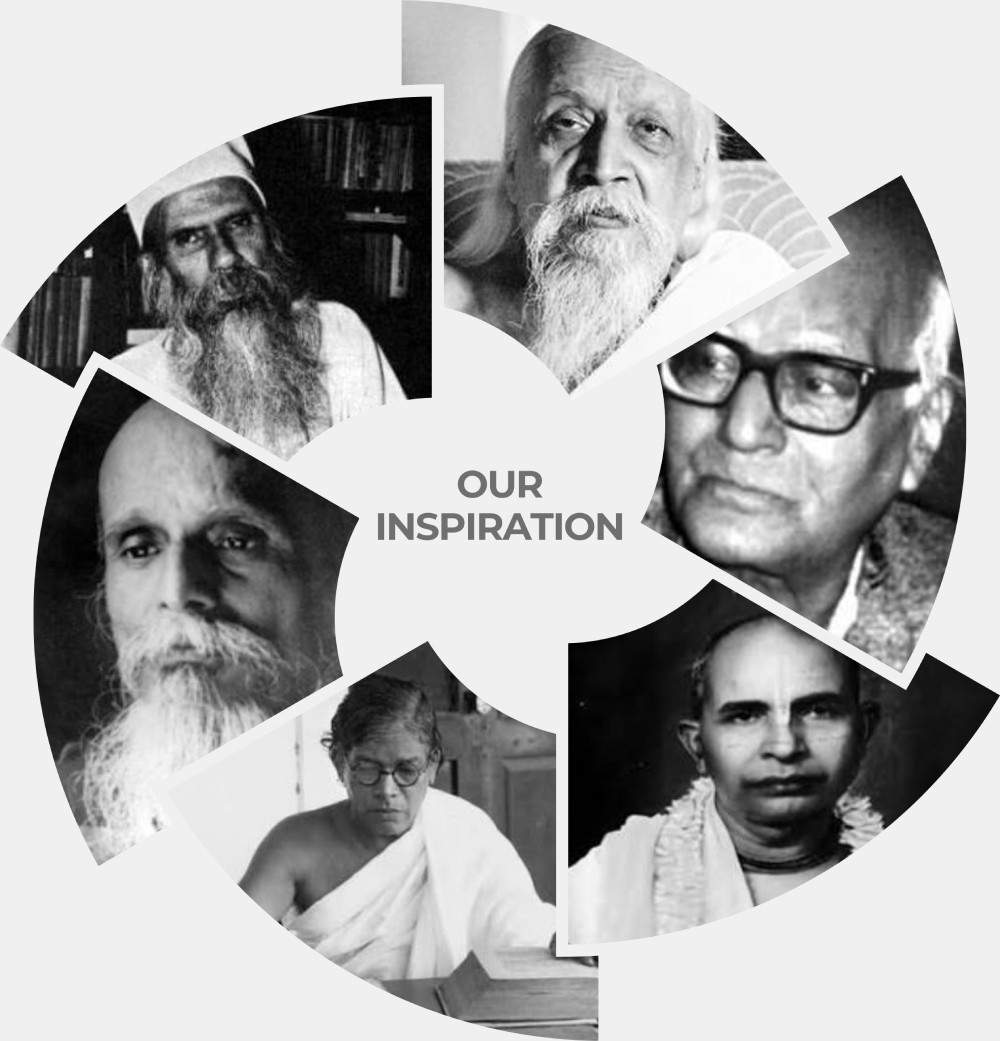
The twentieth century witnessed a remarkable effort to reopen these neglected avenues of interpretation. Sri Aurobindo proposed that the Vaidika deities, sacrifices, and symbols encode profound psychological and spiritual processes rather than merely external ritual actions. Sri Anirvan continued this line of inquiry with extraordinary philological depth and philosophical sensitivity, while T. V. Kapali Sastry brought together traditional learning and modern intellectual inquiry in a manner that remains exemplary. Their work demonstrated that the symbolic language of the Vedas is neither arbitrary nor obsolete but capable of speaking directly to the modern search for meaning, consciousness, and human transformation. Their scholarship represents not a rejection of tradition but its creative renewal. It is this unfinished intellectual and spiritual project that inspires our own efforts. We aspire, with humility and scholarly responsibility, to become torchbearers of this living legacy by encouraging fresh research, critical dialogue, and thoughtful reinterpretation grounded equally in traditional wisdom and contemporary academic rigour.
Yet our endeavour ultimately extends beyond the interpretation of ancient texts. It is animated by a larger question that lies at the heart of contemporary intellectual discourse: the nature of consciousness itself. Across philosophy, cognitive science, psychology, neuroscience, artificial intelligence, and religious studies, consciousness continues to resist definitive explanation. Despite extraordinary technological advances, the fundamental questions of subjective experience like how awareness arises, what constitutes selfhood, and how consciousness relates to reality et cetera remain among the greatest unresolved problems of modern scholarship. Long before these debates assumed their present form, the Indian intellectual tradition had developed extraordinarily sophisticated investigations into precisely these questions. The Vedas, Brāhmaṇas, Āraṇyakas, Upaniṣads, and their subsequent philosophical traditions constitute one of humanity’s most sustained explorations into the nature of consciousness, existence, cognition, and ultimate reality.
We believe that this civilizational inheritance deserves to be engaged not merely as an object of historical curiosity but as a meaningful participant in contemporary global conversations. The symbolic language through which the Vaidika seers articulated their insights may appear distant to the modern reader, yet beneath that symbolic surface lies a remarkably coherent investigation into the structure of consciousness and the possibilities of human transformation. To recover the deeper meanings of the mantras is therefore not simply an act of cultural preservation; it is an intellectual necessity for expanding the horizons of contemporary consciousness studies. Such a recovery has the potential to contribute not only to the renewal of Bhārata’s philosophical heritage but also to the advancement of humanity’s collective understanding of the ontological nature of existence and the mystery of conscious experience itself.
The Centre for Vedic and Consciousness Studies is our humble stride towards acting on this larger vision. We seek to cultivate an environment where scholars, practitioners, students, and seekers may come together in the shared spirit of inquiry to study, reflect, discuss, and reinterpret the Vaidika tradition with both fidelity and intellectual openness.
Whould you like our effort and wish to support us and join our mission, please click this button.