
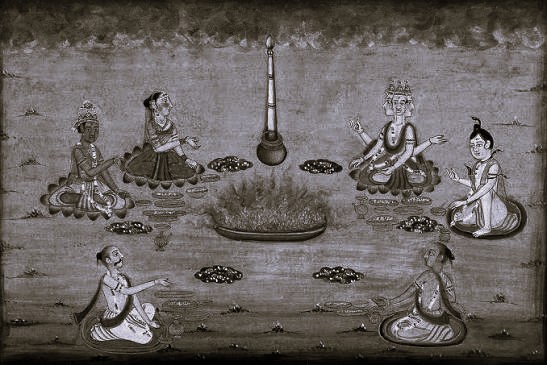
As Agnikarya or Yajna or Vedic fire ritual maintains the seasons and contributes to the Nature, it is taken to be the symbol of universal welfare. It is always identical to the service to beings throughout the scriptures. The word Yajna is from the root Yaj: 1. Donating, 2. Unifying and 3. Worship. The word Yajna is an archetypal expression which conveys all three meanings simultaneously.
The word Yajna is extended to convey five meanings. 1. Deva Yajna (Yanja performed for Gods) 2. Pitru Yajna (Yajna for manes), 3. Brahma Yajna (Yajna for seers), 4. Manushya Yajna (Yajna for humans) and 5. Bhuta Yajna (Yajna for other species).
Yajna is not just ‘Svaha’ to gods and ‘Svadha’ to manes, but ‘Hanta’ to humans as found in Taittiriya Aranyaka. ‘Hanta’ is an expression of compassion to fellow beings. Remember gods in the Veda are principles found in Nature and therefore Deva Yajna is to offer to the principles of Nature. It is to satisfy the principles of Nature. This is what we found in the previous essay.
Pitru Yajna includes 1. Performance of the rituals like Shraaddha 2. Taking care of living parents and 3. Growing our children in the path of Dharma. Manushya Yajna is hospitality and social service. Hospitality is always connected to fire-worship throughout scriptures and tradition. Agni is Atithi (Unknown visitor) and Atithi is Agni.
In many places, the Veda advocates worshipping Agni and Soma as Atithi. What does it convey?
अतिथिदेवो भव । See your Atithi as God.
This expression is not a surprise. But why is it advocated that God should also be seen as Atithi? It clearly shows the devotion and reverence with which the Vedic people showed hospitality. Seeing this, the Veda advises the people to show the same kind of reverence and devotion to God. To express this only, the Veda advocates to see Agni or Soma as Atithi. This is truly amazing.
The Veda talks on Jiva-Yaja (life-Yajna).
स्वादुक्षद्मा यो व॑स॒तौ स्यो॑न॒कृञ्जजींवयार्ज यज॑ते॒ सोपमा दि॒वः ॥
Space is the simile to him who consumes being in house, gladdening others, performing life-Yajna (1.31.15.).
Compare this with the verse found in Mahabharata.
चतुर्थेऽहनि षष्ठे वा शाकं पचति यो गृहे।
अनृणी चाप्रवासी च स वारिचर मोदते ॥
He enjoys his life who dwells in his own house without any debt and cooks his own cultivation on the fourth or sixth occasion.
One of the materials with which Yajna has to be performed is meditation.
क॒विर्होता यज॑ति मन्मसार्धनः ।
The seer and the invoker performs Yajna with meditation as Sadhana (mean or material) (1.151.7.).
वन॑स्पतेऽव॑ सृजोप॑ दे॒वान॒ग्निर्हविः शमिता सूदद्याति ।
सेदु होता॑ स॒त्यत॑रो यजाति॒ि यथा॑ दे॒वानां जर्निमानि वेद॑ ॥
O Vanaspati! Release the gods. Agni, the one who calms, impels the oblation for gods. He being the performer of Yajna for worshiper and being highly truthful performs Yajna in such a way that the worshiper can understand the source of gods (3.4.10.).
त्रिक॑द्धकेषु चेत॑नं दे॒वासों य॒ज्ञम॑त्नत ।
In three realms, gods expanded the conscious Yajna (8.13.18).
All these show Yajna is esoteric.
[Acknowledgement: This article is an excerpt from Dr. R. Rangan’s The Veda: My Passion.]

