
In the Vedic tradition, yajña is not merely a ritual act but one of the fundamental principles through which the relation between gods, humans and the cosmos is understood. The Vedic texts present sacrifice as the means by which order is established, sustained and renewed [1]. The Puruṣa Sūkta of the Ṛgveda further describes the cosmos itself as emerging from a primordial sacrifice in which the cosmic being, Puruṣa, becomes the offering and from that offering arise the various forms of the world [2]. Sacrifice therefore represents a process of transformation in which destruction and creation are inseparably linked.
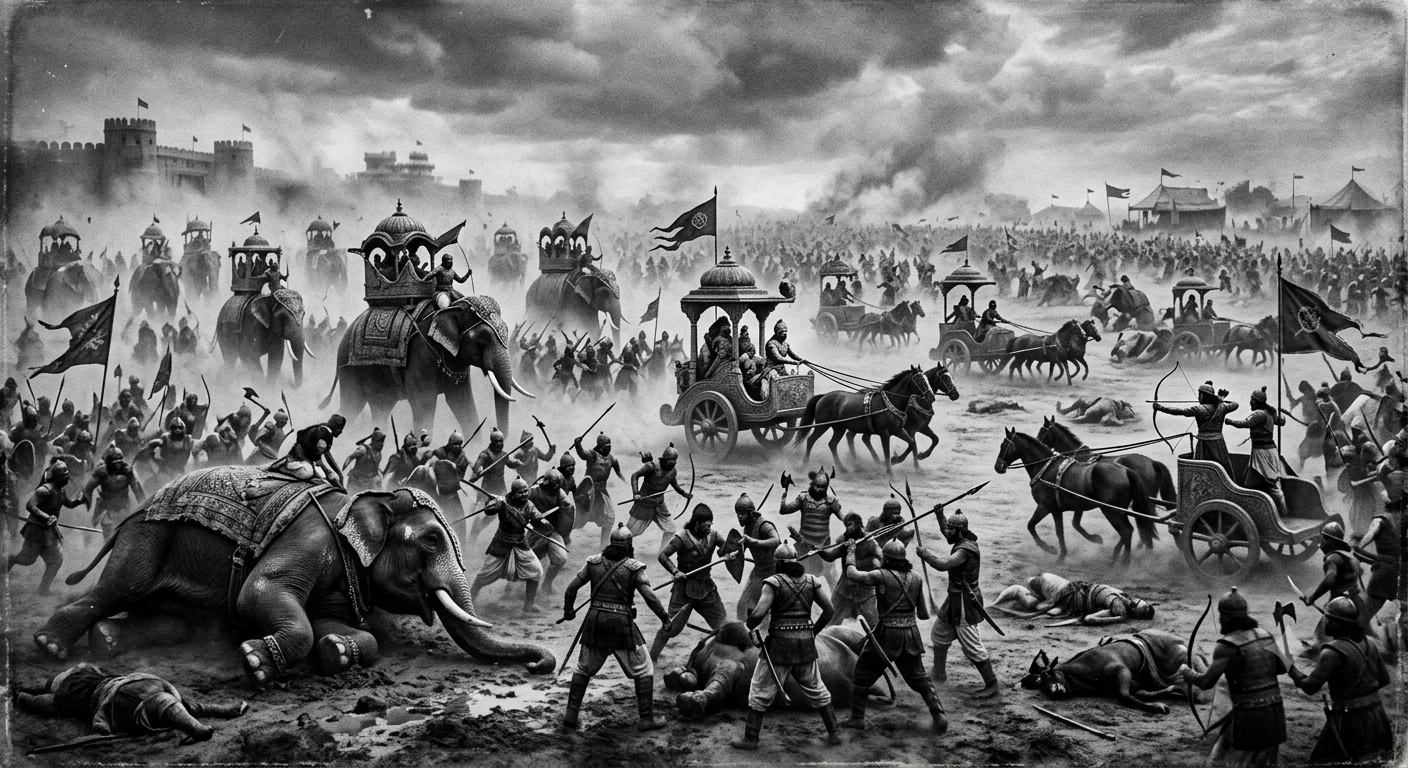
The Mahābhārata inherits this sacrificial worldview and adapts it to the sphere of history, ethics and political conflict. One of the most significant examples of this continuity is the epic’s conception of the Kurukṣetra war as a raṇayajña, or “battle-sacrifice.” The war is not presented merely as an act of violence but as an event interpreted through the conceptual language of Vedic ritual. The epic explicitly uses terms such as yajña, dīkṣā and paśu in describing the conflict, thereby transferring the ritual structure of sacrifice into the battlefield [3].
The sacrificial correspondence becomes particularly detailed in the Udyogaparvan. The battlefield is envisioned as an alternative ritual arena where the chariot functions as the altar (vedī), weapons become sacrificial implements, arrows correspond to sacred darbha grass and the principal warriors collectively represent the fourfold priestly functions of the sacrifice [4]. Such imagery is significant because it demonstrates that the epic is not merely borrowing ritual vocabulary but reorganizing the experience of warfare according to a sacrificial framework inherited from Vedic thought.
More importantly, the analogy preserves the functional structure of sacrifice rather than merely reproducing its external vocabulary. The battlefield requires a designated space, differentiated participants, ritualized instruments, acts of offering and a concluding transformation. In this sense, the raṇayajña can be read as a structural rearticulation of the Vedic sacrificial model. The epic does not reproduce the śrauta ritual in another setting; it makes the sacrificial pattern a conceptual framework through which violence, duty, kingship and the restoration of order can be narrated and interpreted.
Particularly, the Śāntiparvan develops this analogy even further. The bow is identified with the sacrificial post (yūpa), the bowstring with the binding cord, blood with clarified butter (ājya) and the battle itself with the sacrificial fire [5]. These correspondences reveal an important feature of the epic imagination: objects associated with warfare acquire ritual meaning through their integration into a sacrificial system. The battlefield thus becomes intelligible through categories that originally belonged to Vedic ritual practice.
This conception of battle as sacrifice should not, however, be understood as a claim that the Kurukṣetra war was literally a Vedic śrauta ritual. Rather, the Mahābhārata transforms the sacrificial paradigm into a narrative and ethical framework. Danielle Feller has argued that the raṇayajña is not a decorative metaphor but a substantive epic conception through which warfare is interpreted [6]. The epic preserves the logic of sacrifice while relocating it from the ritual arena into the realm of human action, kingship, conflict and moral choice.
The language of consecration strengthens this interpretation. One passage describes the warrior as entering the yuddhadīkṣā, or consecration of battle, performing the raṇayajña and offering himself into the fire constituted by his enemies [7]. The completion of battle is compared to the avabhṛtha, the ritual bath marking the conclusion of a sacrifice. Death in battle is therefore not represented merely as destruction but as an offering within a larger sacrificial process. Such passages suggest that the warrior’s fate is integrated into a ritualized understanding of action and consequence.
Now, the connection with the Vedic tradition becomes clearer when viewed alongside the Puruṣa Sūkta. In that hymn, the cosmic person is offered in sacrifice and from that act emerges a renewed and differentiated order [8]. The Mahābhārata adapts this sacrificial pattern to the historical world. The destruction of the Kṣatriya order at Kurukṣetra becomes the precondition for the establishment of a new political and moral order under Yudhiṣṭhira. The war is therefore represented not simply as an event of annihilation but as a transformative process through which order is painfully reconstituted.
Further, the Bhagavad Gītā provides an ethical dimension to this sacrificial understanding of action. Kṛṣṇa teaches that actions performed in the spirit of sacrifice differ fundamentally from actions driven solely by individual desire [9]. The battlefield thus becomes the setting in which the Vedic concept of yajña is reinterpreted as a principle governing human duty, responsibility and detachment. Action, sacrifice and dharma are brought together within a single philosophical framework.
The temporal setting of the war further reinforces its sacrificial significance. The Mahābhārata places the conflict at the transition between the Dvāpara and Kali ages [10]. The war therefore occurs at a moment of cosmic and historical change. Just as Vedic sacrifices were often associated with transitions and renewals, the Kurukṣetra war marks the end of one age and the beginning of another. The destruction of the old order becomes the condition for the emergence of a new one.
The conception of the Kurukṣetra war as raṇayajña therefore reveals a profound continuity between the Vedic tradition and the Mahābhārata. The epic does not merely preserve descriptions of Vedic rituals such as the Rājasūya and Aśvamedha; it extends the sacrificial imagination into the domain of narrative history. The battlefield becomes an altar, warriors become participants in a ritual process and death becomes an offering within a larger order of meaning. Yet the Mahābhārata also deepens the Vedic paradigm by emphasizing the human cost of sacrifice. The restoration of order is achieved only through grief, loss and moral uncertainty.
The idea of raṇayajña thus represents not the abandonment of Vedic sacrifice but its transformation. What the Vedic texts express through ritual action, the Mahābhārata narrates through human conflict and historical change. The continuity between Veda and epic lies not merely in shared terminology but in a common understanding that relinquishment, sacrifice and transformation are integral to the maintenance and renewal of cosmic and social order.
Footnotes
[1] Stephanie W. Jamison and Joel P. Brereton, trans., The Rigveda: The Earliest Religious Poetry of India, 3 vols. (New York: Oxford University Press, 2014), 10.90.16: yajñena yajñam ayajanta devās tāni dharmāṇi prathamāny āsan.
[2] Ṛgveda 10.90.7. See Jamison and Brereton, The Rigveda, 10.90.7: taṃ yajñaṃ barhiṣi praukṣan puruṣaṃ jātam agrataḥ / tena devā ayajanta sādhyā ṛṣayaś ca ye.
[3] V. S. Sukthankar et al., eds., The Mahābhārata: For the First Time Critically Edited, 19 vols. (Poona: Bhandarkar Oriental Research Institute, 1933-1966), 5.57.12: ahaṃ ca tāta karṇaś ca raṇayajñaṃ vitatya vai / yudhiṣṭhiraṃ paśuṃ kṛtvā dīkṣitau bharatarṣabha.
[4] Ibid., 5.57.13: ratho vedī sruvaḥ khaḍgo gadā sruk kavacaṃ sadaḥ / cāturhotraṃ ca dhuryā me śarā darbhā havir yaśaḥ.
[5]. Ibid., 12.25.26: dhanur yūpo raśanā jyā śaraḥ sruk-sruvaḥ / rudhiraṃ cājyam ity āhur yuddham agnir udāhṛtaḥ.
[6] Danielle Feller Jatavallabhula, “Raṇayajña: The Mahābhārata War as a Sacrifice,” in Violence Denied: Violence, Non-Violence and the Rationalization of Violence in South Asian Cultural History, ed. Jan E. M. Houben and Karel R. van Kooij (Leiden: Brill, 1999), 69-103.
[7] Sukthankar et al., eds., Mahābhārata, 9.59.25: yuddhadīkṣāṃ praviśyājau raṇayajñaṃ vitatya ca / hutvātmānam amitrāgnau prāpa cāvabhṛthaṃ yaśaḥ. The verse combines yuddhadīkṣā, raṇayajña, self-offering (ātmānam hutvā) and avabhṛtha, extending the sacrificial analogy beyond individual implements.
[8] Ṛgveda 10.90.7. See Jamison and Brereton, The Rigveda, 10.90.7.
[9] Sukthankar et al., eds., Mahābhārata, 6.23.9 (Bhagavad Gītā 3.9): yajñārthāt karmaṇo ‘nyatra loko ‘yaṃ karmabandhanaḥ / tadarthaṃ karma kaunteya muktasaṅgaḥ samācara.
[10] Sukthankar et al., eds., Mahābhārata, 1.2.9: antare caiva saṃprāpte kalidvāparayor abhūt / samantapañcake yuddhaṃ kurupāṇḍavasenayoḥ.

