
Let us begin understanding the Vedas and their secret imports with Sri Aurobindo who was perhaps the first to confront one of the most enduring questions surrounding the world’s most ancient text: does it truly contain a hidden spiritual wisdom, or is it merely a primitive collection of sacrificial hymns, as modern scholarship has often maintained? He begins by examining the dominant European interpretation of the Ṛgveda, which regards the hymns as the poetic expressions of an early and semi-barbaric people addressing the powers of Nature— fire, sun, rain, dawn, and storm— through ritual and propitiation. He argues, “But, if we accept the current interpretations, whether Sāyana or the modern theory, the whole of this sublime and the sacred reputation is a colossal fiction” (p. 5). To Sri Aurobindo, such a reading appears profoundly insufficient, especially when one considers that the Veda was revered for millennia in India as the fountainhead of the highest spiritual knowledge.
The central difficulty, therefore, is both historical and philosophical. How could the luminous metaphysics and subtle spiritual psychology of the Upaniṣads emerge from texts supposedly occupied only with ritual formalism and nature-worship? Sri Aurobindo argues that no civilisation advances through such abrupt discontinuities. The deeper intuitions of the Upaniṣads must already have existed, at least in seed form, within the Vedic revelation itself.
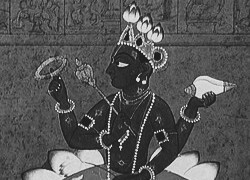
He therefore proposes a radically different approach to the Veda. According to him, the Vedic Ṛṣis employed a symbolic and many-layered language. The hymns possess an outer meaning connected with sacrifice and cosmic powers, yet simultaneously conceal an inner and psychological significance accessible only to the initiated seeker. For instance, “Soma, the plant which yielded the mystic wine for the Vedic sacrifice, has become not only the God of the moon, but manifests himself as mind in the human being” (p. 7). The gods are not merely personifications of natural phenomena, but powers of consciousness and spiritual forces operative within the human being. Thus, Agni becomes the “Divine Will” or the “Inner Flame”, Sūrya the “Light of Truth”, and the sacrifice itself an inward process of self-offering and transformation. The anthropomorphic conceptualizations in the latter Purāṇas actually are metaphors for these inner symbols of the Veda. While the former is comprehensive for the masses, the latter is for the intuitive mind. Thus, they two may not be seen as antithetical, but rather complementary.
Sri Aurobindo compares this symbolic method with the mystery traditions of ancient Greece, where sacred truths were similarly veiled beneath myth and ritual. The Veda, he suggests, belongs to an age in which spiritual knowledge was deliberately concealed within symbolic imagery, preserving it from misunderstanding while revealing it to those prepared for deeper insight. Sri Aurobindo explains:
“One of the leading principles of the mystics was the sacredness and secrecy of self-knowledge and the true knowledge of the Gods. This wisdom was, they thought, unfit, perhaps even dangerous to the ordinary human mind or in any case liable to perversion and misuse and loss of virtue if revealed to vulgar and unpurified spirits” (p. 8).
Thus, he lays the intellectual foundation of the entire work. The Veda, in Sri Aurobindo’s view, is not a relic of primitive superstition, but one of humanity’s earliest and most profound spiritual scriptures, whose inner meaning has gradually been obscured and now awaits rediscovery.

