
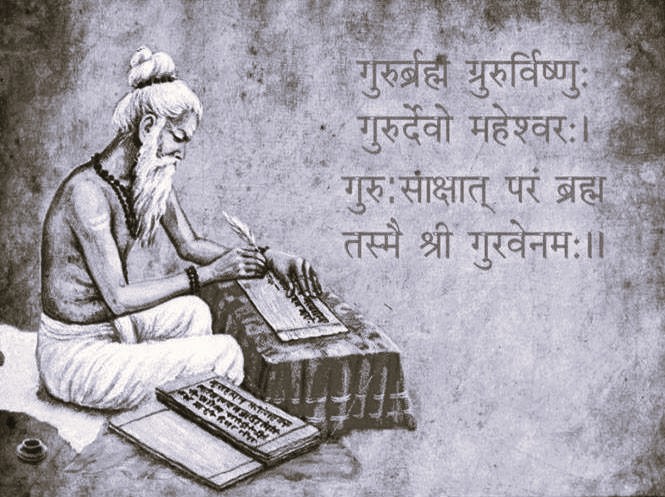
Now, let us turn from the statement of his central thesis to a historical reflection on how the Veda has been understood (or misunderstood) through the centuries. For this, we require an intellectual archaeology of Vedic interpretation. Understanding this, Aurobindo traces the gradual obscuration of the original spiritual meaning of the Veda and examines the various traditions that attempted to preserve, reinterpret, or recover it over the centuries.
He begins by reminding us that the Veda belongs to an age prior to systematic philosophy and analytical reasoning. The Ṛṣis were not speculative thinkers in the modern sense, but seers who arrived at knowledge through inner experience, intuition, and revelation. The mantra was not considered a human composition, but a truth “heard” or “seen” by the awakened consciousness. However, the idea of ‘revelation’ here is different from the Semitic religions:
“In the Vedic idea of the revelation there is no suggestion of the miraculous or the supernatural. The Rishi who employed these facilities, had acquired them by a progressive self-culture. Knowledge itself was a travelling and a reaching, or a finding and a winning; the revelation came only at the end, the light was the price of a final victory. There is continually in the Veda this image of this journey, the soul’s march on the path of Truth. On that path, as it advances, it also ascends; new vistas of power and light open to its aspiration; it wins by a heroic effort its enlarged spiritual possessions” (p. 10).
The Veda emerged from this spiritual culture in which symbolic expression served as the natural language of higher experience. Sri Aurobindo argues that the remarkable consistency of Vedic imagery and symbolism suggests not a primitive beginning, but the culmination of a long and sophisticated spiritual tradition. The repeated symbols— the journey, the sacrifice, the dawn, the rivers, the cows, the battle against darkness— all formed a sacred and carefully preserved symbolic vocabulary through which profound psychological truths were communicated:
“We have, at any rate, the same notions repeated from hymn to hymn with the same constant terms and figures and frequently in the same phrases with an entire indifference to any search for poetic originality or any demand for novelty of thought and freshness of language. No pursuit of aesthetic grace, richness, or beauty induces these mystic poets to vary the consecrated form which had become for them a sort of divine algebra transmitting the eternal formulae of the knowledge to the continuous succession of the initiates” (p. 11).
Yet this knowledge gradually faded. As, the inner spiritual discipline weakened over time, the external ritual survived while the symbolic significance behind it became increasingly obscure. The Brāhmaṇas attempted to preserve the ritual framework and fragments of older meanings, while the Upaniṣads sought to recover the spiritual essence through renewed intuition and contemplation. However, the sages in the Upaniṣads often moved beyond the symbolic language of the Veda and lucubrated a more direct philosophical expression. Over time, this produced a widening separation between the two systems: the Veda of ritual and the Vedānta of thought.
Sri Aurobindo then examines the role of later commentators, especially Yāska and Sāyaṇa. While acknowledging their immense scholarly contribution in preserving the text and linguistic tradition, he argues that Sāyaṇa’s interpretation reduced the Veda largely to ritualism and material aims. According to Sri Aurobindo, this ritualistic reading ultimately prepared the ground for modern European scholarship, which further intensified the naturalistic and primitive interpretation of the hymns from an anthropological standpoint. Sri Aurobindo examines the various modern scholarly attempts to interpret the Veda and subjects them to a careful yet penetrating critique. While acknowledging the immense labour and intellectual rigour that European scholars brought to Vedic studies, he argues that their conclusions were largely shaped by assumptions that prevented them from grasping the deeper spirit of the Vedic revelation.
According to Sri Aurobindo, modern scholarship inherited from Sāyaṇa the notion that the Veda is primarily a collection of ritual hymns composed by an early and relatively primitive society. Building upon this foundation, nineteenth-century scholars developed elaborate theories of comparative mythology, philology, and history. The Vedic gods came to be interpreted as personifications of natural phenomena; the hymns were read as poetic descriptions of sunrise, storm, rain, and other physical events; and the Vedic people themselves were portrayed as simple pastoral tribes standing at an early stage of cultural evolution.
Sri Aurobindo challenges these assumptions at their root. He points out that the theory of a primitive Aryan society arose during a period when European thinkers generally believed that civilization had evolved gradually from barbarism. Subsequent discoveries of ancient civilizations in Egypt, Mesopotamia, and elsewhere had already begun to undermine this simplistic narrative. There was therefore no compelling reason to assume that the Vedic people lacked intellectual depth or spiritual sophistication. On the contrary, the enduring influence of the earliest Indo-European cultures suggests the presence of profound and formative ideas rather than primitive superstition.
Critiquing comparative mythology and comparative philology, Sri Aurobindo argues that both disciplines, despite their valuable contributions, often relied upon conjecture rather than certainty. According to him, “Comparative Mythology is the creation of Hellenists interpreting un-Hellenic data from a standpoint which is itself founded on a misunderstanding of the Greek mind” (p. 28). Their interpretations frequently rested upon imaginative associations, speculative etymologies, and broad generalizations that could be altered or overturned with changing scholarly fashions. As a result, they offered no definitive key to the meaning of the Veda. Thus, the history of Vedic interpretation faces a gradual loss of spiritual insight. Yet, for Sri Aurobindo, this loss is not final. Beneath the ritual, mythology, and philological disputes, the deeper psychological and spiritual truth of the Veda still survives, awaiting rediscovery through a more sympathetic and intuitive approach.
Yet Sri Aurobindo does not dismiss modern scholarship altogether. He recognizes its achievements in textual study and historical investigation, while insisting that these methods alone are insufficient. The Veda cannot be understood merely through linguistic analysis or historical reconstruction because it belongs to a symbolic and spiritual mode of thought that transcends purely external interpretation.
Aurobindo welcomes several modern Indian contributions to Vedic studies, particularly those of Bal Gangadhar Tilak (whose ‘Arctic’ theory is contending idea), T. Paramasiva Aiyar’s The Riks, and Swami Dayananda Saraswati’s grand application via the Ārya Samāj. Of these, Dayananda’s effort to restore the Veda as a living spiritual scripture receives his special attention. Although Sri Aurobindo does not fully accept Dayananda’s conclusions, he appreciates his recognition that the Veda contains meanings far deeper than ritualism or nature-worship. Apart from that, Aurobindo also opines that:
“The monotheism of the Veda includes in itself also the monistic, pantheistic and even polytheistic views of the cosmos and is by no means trenchant and simple creed of modern Theism. It is only by a violent struggle with the text that we can force on it a less complex aspect” (p. 32).
Thus, by revisiting the existing prevailing modern theories and exposing their limitations, Sri Aurobindo prepares us for his own interpretive approach which seeks the key to the Veda not in primitive mythology or ritual practice, but in the psychological and spiritual experiences of the ancient Ṛṣis themselves. For him, the Ṛṣis “arranged the substance of their thought in a system of parallelism by which the same deities were at once internal and external Powers of universal Nature, and they managed its expression through a system of double values by which the same language served for their worship in both aspects. But the psychological sense predominates and is more pervading, close-knit and coherent for spiritual enlightenment and self-culture” (p. 33). Let us now discuss that gradually.

