
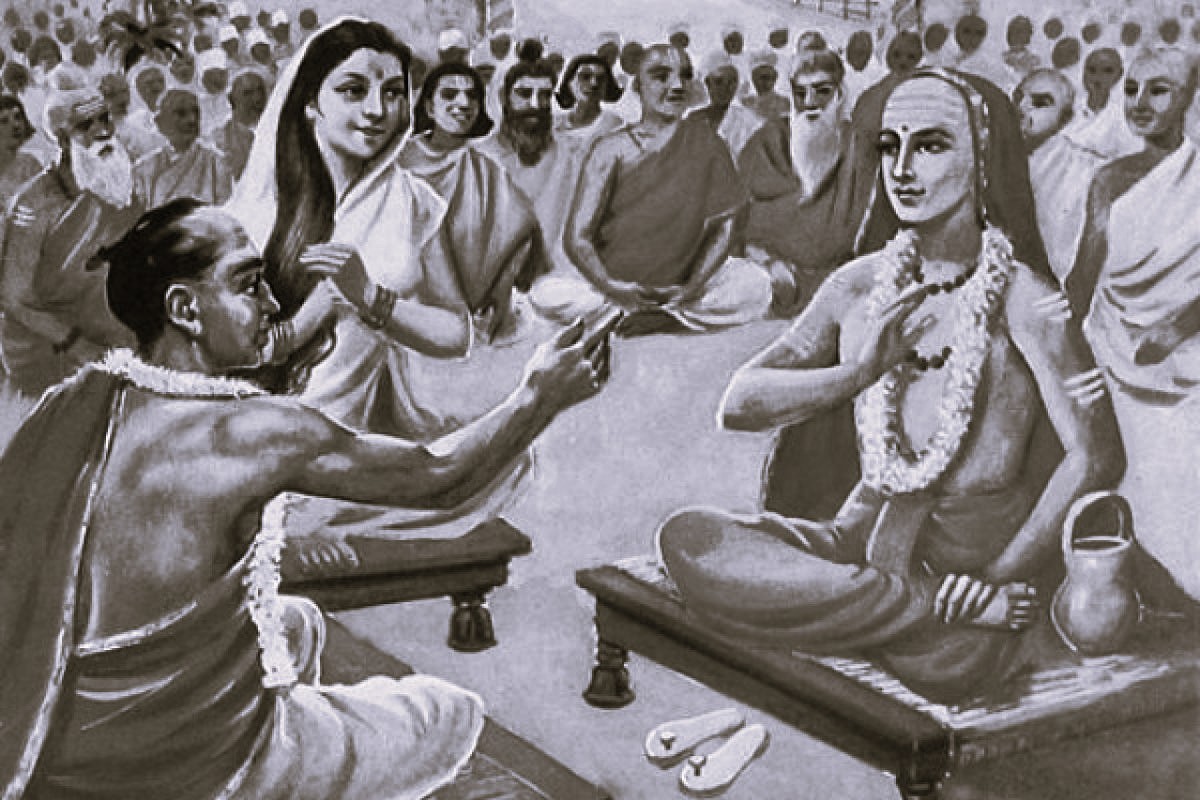
Nyāya, traditionally associated with the sage Gautama, occupies a distinctive position among the six classical darśanas of Indian philosophy. Often described as the Indian school of logic, Nyāya is concerned with much more than the formal structure of arguments. Its central questions concern how human beings acquire valid knowledge, distinguish truth from error, establish reliable conclusions, and overcome suffering. The Nyāya Sūtra begins its systematic exposition with the means of valid cognition and the objects of knowledge, ultimately connecting philosophical understanding with the attainment of apavarga, or liberation. Its Vedic foundations are therefore best understood through the relationship between knowledge, authoritative testimony, ethical order, and spiritual freedom. Nyāya does not simply reproduce Vedic teachings; it develops a distinctive philosophical method for examining claims about reality, including those grounded in sacred texts.
The opening aphorism of the Nyāya Sūtra introduces sixteen categories of philosophical inquiry, beginning with pramāṇa, or the means of valid knowledge, followed by prameya, the objects of knowledge. The remaining categories include doubt, purpose, examples, established conclusions, the members of an argument, hypothetical reasoning, ascertainment, debate, disputation, destructive criticism, fallacies, quibbles, false objections, and grounds of defeat. This arrangement is significant because it establishes a relationship between knowing reality and examining the procedures through which knowledge is claimed. Nyāya assumes that philosophical and spiritual progress requires more than sincere belief. One must understand how beliefs are formed, what supports them, and whether the reasoning through which they are defended is reliable.
The Vedic tradition provides an important background for this concern with knowledge. Vedic learning depended upon careful preservation, recitation, interpretation, and transmission. The authority of a mantra was inseparable from its correct transmission, while the interpretation of Vedic passages involved questions of language, ritual context, and meaning. Nyāya develops a different but related intellectual concern: how can a statement be accepted as a source of knowledge, and what makes the person communicating it trustworthy? Its investigation of verbal testimony transforms the question of authority into a subject of systematic epistemological analysis.
The Nyāya Sūtra recognizes four pramāṇas: pratyakṣa (perception), anumāna (inference), upamāna (comparison), and śabda (verbal testimony). Perception provides knowledge through the appropriate operation of the senses and mind. Inference establishes something not directly perceived through a reliable relation between evidence and conclusion. Comparison enables knowledge through similarity, while verbal testimony provides knowledge through the statements of a trustworthy speaker. Together, these four means allow Nyāya to investigate both ordinary experience and matters that cannot be established through immediate perception.
The inclusion of śabda is particularly important for understanding the school’s relationship with Vedic authority. Nyāya recognizes verbal testimony as a genuine means of knowledge, but its account of testimony is not identical to the Mīmāṃsā theory of the intrinsic authority of the Vedas. Classical Nyāya generally explains the reliability of testimony through the competence and trustworthiness of the speaker. The authority of a statement is therefore connected with the epistemic qualifications of its source. In later Nyāya discussions, this approach becomes important in arguments concerning the authority of the Vedas and the existence of an omniscient or supremely knowledgeable being.
The Nyāya Sūtra itself contains a discussion of objections to Vedic testimony. In 2.1.57, an opponent questions its authority on the grounds of possible falsity, inconsistency, and repetition. The subsequent aphorisms defend Vedic testimony against these objections, with 2.1.68 connecting its authority with the competence of the authoritative source, in a comparison with medical instruction. This exchange is philosophically revealing. Nyāya does not treat the question of Vedic authority as beyond discussion; instead, it subjects the issue to argument and attempts to establish why the testimony should be accepted.
This method distinguishes Nyāya from an approach in which scriptural authority alone settles every philosophical question. For Nyāya, perception and inference remain indispensable means of investigating reality. The acceptance of Vedic authority does not eliminate rational examination, and rational examination does not automatically invalidate sacred testimony. Rather, the school attempts to establish the proper conditions under which different sources of knowledge may be trusted. The relationship between śabda and anumāna consequently becomes a major issue in the later history of Indian philosophy.
The importance of valid knowledge becomes clearer when considered in relation to liberation. The Nyāya Sūtra identifies the removal of suffering as the ultimate philosophical objective. Its discussion of apavarga connects liberation with the cessation of suffering and the conditions that sustain it. In the classical Nyāya account, ignorance produces mistaken understanding, which contributes to attachment, aversion, action, and the continuation of embodied existence. Correct knowledge helps remove the underlying errors through which this cycle persists. Philosophical inquiry is therefore not an end in itself. It becomes a means of transforming the conditions of human existence.
This orientation has a significant affinity with the Upaniṣadic emphasis on knowledge as a means of liberation. The Upaniṣads repeatedly investigate the nature of the self, the world, and the conditions of freedom from suffering and mortality. Nyāya shares the conviction that knowledge can have consequences extending beyond intellectual understanding. However, its approach is distinct. Rather than making the identity of ātman and brahman the foundation of liberation, Nyāya develops a realist account of individual selves and the external world. Liberation requires knowledge of reality as it is, including the distinction between the self, the body, the senses, the mind, and other objects of experience.
The relationship between Vedic ideas and Nyāya is thus neither one of simple repetition nor one of complete separation. Nyāya accepts Vedic authority within its broader philosophical commitments, yet it also develops an independent analysis of evidence, inference, testimony, and argument. Its conception of dharma and liberation belongs to a wider Indian intellectual environment in which knowledge, right conduct, and the highest good are interconnected. The school contributes a distinctive answer to the question of how claims about reality should be examined and justified.
The Vedic foundations of Nyāya ultimately lie in its effort to bring the authority of inherited knowledge into a rigorous framework of philosophical inquiry. Through pramāṇa, it asks how truth is known; through śabda, it examines the conditions under which testimony becomes reliable; through debate and inference, it tests competing claims; and through tattva-jñāna, it connects correct understanding with liberation. Nyāya demonstrates that reverence for sacred knowledge and critical reasoning need not be mutually exclusive. Its enduring contribution is the insistence that the pursuit of the highest good requires a disciplined understanding of how human beings know, reason, and distinguish truth from error.

