
Nyāya philosophy represents one of the most elaborate traditions of logical and epistemological inquiry in classical India. Traditionally attributed to Gautama, the Nyāya Sūtra develops a systematic account of valid knowledge, inference, argument, debate, and the identification of errors in reasoning. Its significance extends beyond the formal analysis of logic because Nyāya treats correct reasoning as essential to understanding reality and attaining liberation. Although the Vedas do not contain the mature logical system presented in the Nyāya Sūtra, the philosophical culture in which Nyāya emerged had long been concerned with interpretation, verbal precision, disputation, and the relationship between knowledge and truth. Nyāya can therefore be understood as a distinctive development within the wider Indian intellectual tradition, transforming the general pursuit of knowledge into a systematic method of critical investigation.
The Vedic tradition required exceptional precision in the preservation and transmission of sacred knowledge. Correct recitation depended upon attention to sound, accent, sequence, and grammatical form. The development of the Vedāṅgas, including śikṣā and vyākaraṇa, reflects the importance attached to the accurate transmission and interpretation of Vedic texts. Śikṣā concerns phonetics and pronunciation, while vyākaraṇa investigates grammatical structure. Although these disciplines are not themselves Nyāya logic, they belong to a broader intellectual environment in which claims about knowledge required attention to form, meaning, and method. The preservation of a text and the assessment of an argument are different tasks, yet both depend upon disciplined procedures designed to prevent error.
Nyāya takes this concern with intellectual discipline into the systematic examination of knowledge. The Nyāya Sūtra identifies sixteen topics that structure philosophical inquiry. Among them are saṃśaya (doubt), prayojana (purpose), dṛṣṭānta (example), siddhānta (established conclusion), avayava (members of an argument), tarka (hypothetical reasoning), nirṇaya (ascertainment), and vāda (constructive debate). These categories reveal that Nyāya is interested not only in the truth of conclusions but also in the processes through which conclusions are reached, defended, challenged, and established.
The four pramāṇas provide the epistemological foundation of this system. Pratyakṣa, or perception, establishes knowledge through an appropriate relation between the senses and their objects. Anumāna, or inference, enables the knower to establish what is not directly perceived through a reliable connection between evidence and conclusion. Upamāna, or comparison, provides knowledge through similarity, while śabda, or verbal testimony, establishes knowledge through reliable communication. The inclusion of these four means demonstrates that Nyāya does not reduce knowledge to reasoning alone. It recognizes that human beings encounter reality through several distinct but complementary sources of cognition.
Inference receives particular attention because it allows knowledge to extend beyond immediate experience. Smoke on a distant hill, for example, may lead one to infer the presence of fire. The inference is reliable when the relationship between smoke and fire has been established and the relevant conditions are understood. Nyāya analyses such reasoning in detail, asking what constitutes evidence, how the relation between evidence and conclusion is known, and under what circumstances an inference becomes defective. This analysis distinguishes a valid argument from one that merely appears persuasive.
The Nyāya tradition also develops a characteristic five-membered form of inference: pratijñā (proposition), hetu (reason), udāharaṇa (example), upanaya (application), and nigamana (conclusion). A familiar illustration is the argument that a hill has fire because it has smoke, as in a kitchen where smoke is associated with fire; the hill has smoke of that relevant kind; therefore, the hill has fire. The five members make the structure of the reasoning explicit, exposing the relationship between the claim, its supporting evidence, the general principle, and its application. This is not merely a formal exercise. It is a method for making reasoning available to examination by others.
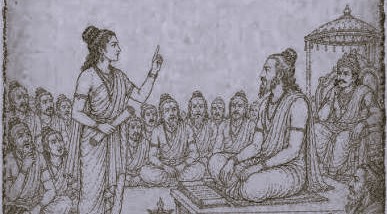
The importance of examples and shared evidence also illuminates the role of debate. Nyāya recognizes that philosophical claims must be tested through reasoned exchange. Its discussion of vāda, jalpa, and vitaṇḍā distinguishes constructive debate from disputation directed towards victory and criticism that seeks to undermine an opponent without establishing an independent position. The distinctions reveal an awareness that intellectual disagreement can serve different purposes. Debate becomes philosophically valuable when it seeks to establish truth through appropriate evidence and reasoning, rather than merely to defeat an opponent.
This emphasis on debate belongs to a wider Indian culture of philosophical disputation. Vedic and Upaniṣadic literature preserves dialogues in which teachers, students, sages, and rulers question one another about the nature of reality and the grounds of knowledge. Such exchanges should not be equated with the technical procedures of classical Nyāya, but they demonstrate that questioning and argument were important modes of intellectual activity long before the Nyāya Sūtra systematized the principles of reasoning. Nyāya’s contribution is to make the conditions of successful inquiry themselves an object of philosophical investigation.
The identification of fallacies is central to this task. Nyāya classifies defective reasons under the heading hetvābhāsa, or apparent reason. A claim may appear to be supported by evidence while failing to establish its conclusion. The reason may be inconclusive, contradicted by stronger evidence, or otherwise unsuitable for the inference being attempted. By identifying such errors, Nyāya develops a method for distinguishing genuine proof from superficial plausibility. Its analysis is relevant not only to formal philosophical debates but also to ordinary judgments, where mistaken assumptions and incomplete evidence can lead to unreliable conclusions.
The Vedic relationship becomes especially significant when logical inquiry encounters scriptural claims. Nyāya accepts śabda as a means of valid knowledge, but it also examines the conditions under which testimony is reliable. The Nyāya Sūtra discusses objections to Vedic authority and offers arguments in its defence. This engagement shows that the school does not treat the relationship between reason and scripture as a question that can be settled without analysis. Its philosophers investigate the credibility of testimony, the qualifications of authoritative speakers, and the relationship between verbal claims and other sources of knowledge.
Nyāya’s approach is consequently distinct from the assumption that all knowledge must be derived either from direct perception or from scriptural revelation alone. Perception, inference, comparison, and testimony have different functions, and their proper application depends upon the nature of the question being investigated. Philosophical maturity consists partly in understanding these differences and avoiding the mistake of demanding that one means of knowledge perform the work of another.
The ultimate purpose of this analytical discipline is not simply to produce more sophisticated arguments. Nyāya connects valid knowledge with the elimination of ignorance and the attainment of apavarga. The systematic examination of claims helps correct false beliefs about the self and the world, while the removal of ignorance contributes to freedom from suffering. Logic thus becomes part of a wider philosophical and spiritual project. Its value lies not merely in winning debates but in enabling the knower to understand reality more accurately.
The relationship between Vedic inquiry and Nyāya logic should therefore be understood as a historical development rather than a direct identity. Vedic traditions cultivated precise transmission, interpretation, dialogue, and reflection upon truth. Nyāya transformed the broader concern with knowledge into a systematic investigation of evidence, inference, testimony, debate, and error. Its achievement was to make reasoning itself a subject of disciplined analysis. In doing so, Nyāya demonstrated that the search for truth requires not only access to sources of knowledge but also a careful understanding of how those sources operate. Its legacy lies in the conviction that intellectual discipline, critical examination, and the pursuit of liberation can belong to a single philosophical enterprise.

