
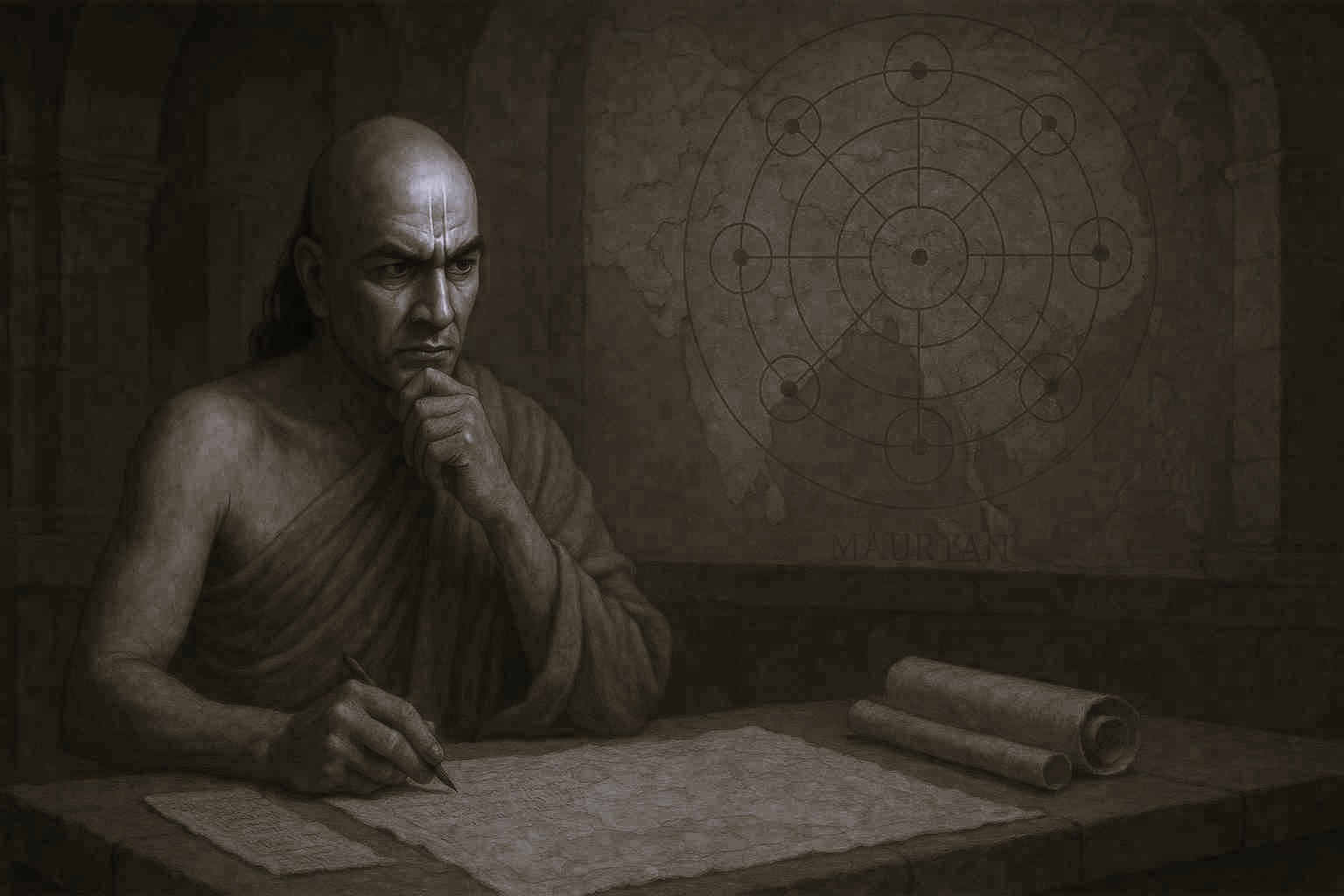
The Indian tradition of Nītiśāstra occupies a distinctive position between ethics, political philosophy, social thought, diplomacy, and the practical science of governance. Unlike a single canonical text, Nītiśāstra refers to a broad tradition represented by works such as Kauṭilya’s Arthaśāstra, Kāmandaka’s Nītisāra, the Viduranīti of the Mahābhārata, and later works such as the Śukranīti. Although these texts are frequently compared with modern political science or political realism, their intellectual background is deeply rooted in the older Indian conception of dharma, ṛta, kingship, social responsibility, and the ordered relationship between human action and the larger cosmos. The Vedic elements in Nītiśāstra are therefore best understood not as a collection of quotations from the Saṃhitās, but as the survival and transformation of Vedic ideas within the science of governance.
One of the most important foundations is the Vedic conception of ṛta, the principle of cosmic order. In the Ṛgveda, ṛta denotes the order through which the movements of the cosmos, the functioning of sacrifice, and the relationship between human beings and divine powers are sustained. Although the later political tradition increasingly uses the vocabulary of dharma rather than ṛta, the underlying principle remains recognisable: legitimate authority exists to preserve order rather than merely to exercise power. The king’s responsibility is therefore not exhausted by territorial expansion. He must protect the stability of the kingdom, prevent disorder, administer justice, and ensure the conditions under which society can flourish.
This becomes particularly clear in the conception of rājan inherited by the political tradition. The Vedic king is associated with protection, prosperity, ritual patronage, and the maintenance of social order. Later Nītiśāstra transforms these functions into a systematic theory of kingship. Kāmandaka’s Nītisāra, for example, places considerable emphasis on the education and self-discipline of the ruler. The king must first acquire vinaya, discipline and mastery over himself, before attempting to govern others. The second sarga also turns to the duties of the brahmacārin, showing that political education is embedded within a larger Indian conception of disciplined human formation.
The relationship between knowledge and governance is another distinctly Vedic inheritance. The Vedic tradition does not regard knowledge merely as information; vidyā is connected with disciplined perception, appropriate action, and the maintenance of order. Kāmandaka makes this connection explicit when his Nītisāra recognises the Trayī—the Ṛgveda, Yajurveda, and Sāmaveda—as a foundation of knowledge. Nītisāra 2.12 states that the three Vedas constitute Trayī and that one who follows it properly attains both worlds. The following discussion places this Vedic learning within the education of the ruler.
The point is not that the ruler is expected to become a Vedic ritual specialist. Rather, the Nītiśāstra tradition assumes that governance requires a moral and intellectual framework extending beyond immediate political expediency. The king must know what ought to be protected, what constitutes justice, and what consequences follow from his actions. Politics consequently becomes part of a larger ecology of knowledge.
The opening of Kāmandaka’s Nītisāra makes the connection particularly striking. Kāmandaka praises Viṣṇugupta, identified with Kauṭilya, as a master who possessed knowledge of the four Vedas and whose brilliance was compared with blazing fire. The image is revealing: political intelligence is represented through the language of tejas, fire, learning, and disciplined power. The political thinker is therefore not imagined simply as a strategist but as a bearer of a larger intellectual tradition.
A third Vedic element is the relationship between brahman and kṣatra. The Vedic and later Brahmanical traditions repeatedly represent these as complementary forms of power: the authority of sacred knowledge and the authority of political protection. The Nītiśāstra inherits this relationship. The king requires the counsel of learned advisers, while the learned order requires the protection and institutional power of the king. Political order is thus not imagined as the autonomous activity of the ruler. It depends upon cooperation between different forms of social and intellectual power. Later Indian political thought continued to regard the alliance between brahman and kṣatra as fundamental to the functioning of kingship.
This principle also explains why the purohita occupies an important position in classical discussions of kingship. The royal court is not entirely secular in the modern sense. Counsel, ritual legitimacy, ethical instruction, auspiciousness, and political decision-making intersect. The king possesses daṇḍa, the power of punishment, but daṇḍa must operate within dharma. The weapon of the state cannot become an end in itself.
The idea of daṇḍa itself provides another bridge between Vedic social order and later political theory. A kingdom without effective authority risks matsyanyāya, the “law of the fish,” in which the strong consume the weak. Kāmandaka retains this concern from the wider Arthaśāstra tradition. Yet his political thought also places dharma alongside artha and kāma, insisting that the ruler cannot pursue power independently of the broader purposes of human life. The continuity between Kauṭilya and Kāmandaka is particularly evident in their shared concern with matsyanyāya, control of the senses, anvīkṣikī, the seven constituents of the state, diplomacy, and the regulation of power.
The Vedic background also becomes visible in the idea that the ruler’s prosperity is inseparable from the prosperity of the realm. Vedic kingship was connected with abundance, cattle, rain, fertility, protection, and victory. A successful ruler was therefore not simply one who defeated enemies. His success was measured by the flourishing of the people and the stability of the kingdom. Kāmandaka’s tradition likewise assigns the ruler the responsibilities of protection and welfare. This distinguishes the Indian conception of kingship from a purely conquest-oriented model of political power.
The saptāṅga theory of the state provides a particularly illuminating example of this holistic conception. The state is described through seven interconnected elements: svāmin or king, amātya or ministers, janapada or territory and population, durga or fortified centre, kośa or treasury, daṇḍa or armed power, and mitra or ally. The state is therefore conceived organically rather than as the ruler alone. Its health depends upon the coordination of its constituent parts. Kāmandaka preserves this framework while adapting it to his own political context.
This organic conception has an important conceptual affinity with the Vedic imagination. Vedic thought frequently understands reality through relationships between interdependent powers rather than isolated entities. The sacrifice itself functions through coordinated elements: mantra, ṛtvij, Agni, offering, deity, metre, time, and ritual action. Similarly, the saptāṅga state functions only when its constituent powers are properly coordinated. One should not claim that the political theory was directly derived from the sacrificial system, but the structural resemblance reveals a shared preference for understanding order as relational and systemic.
The diplomatic thought of Nītiśāstra also reflects this practical conception of order. Kāmandaka discusses the maṇḍala, the six measures of foreign policy, and the four upāyas: sāma, dāna, bheda, and daṇḍa. War is therefore only one instrument among several. Diplomacy, negotiation, alliance, intelligence, strategic patience, and calculated restraint are equally important. Modern scholarship has noted that Kāmandaka places considerable emphasis on mantraśakti, the power of counsel or diplomacy, alongside prabhāvaśakti, material power, and utsāhaśakti, the power of leadership.
This preference for ordered and proportionate action also resonates with the wider Indian conception of dharma. The ruler must distinguish between circumstances, assess consequences, and choose the appropriate course rather than applying force mechanically. The Nītiśāstra tradition is therefore pragmatic without being reducible to political cynicism. Its realism is situated within a civilisation that continued to ask what legitimate power is for.
The Vedic elements of Nītiśāstra consequently become most visible when political power is viewed as a responsibility rather than a possession. ṛta becomes the broader ideal of order; dharma becomes the ethical framework of governance; brahman and kṣatra become complementary forms of authority; disciplined knowledge becomes a prerequisite for kingship; and daṇḍa becomes a regulated instrument for protecting social order.
The journey from Vedic thought to Nītiśāstra is therefore not a movement from spirituality to politics. It is a movement from cosmic and ritual order towards its institutional expression in human society. The question changes from “How is the universe maintained?” to “How should human beings organise power so that society remains ordered and prosperous?” The answer developed by Indian political thought is that power must be informed by knowledge, restrained by dharma, supported by counsel, and exercised for protection and welfare.
In this sense, Nītiśāstra represents another transformation of the Vedic imagination. The ancient concern with ṛta, disciplined action, sacred knowledge, reciprocal obligation, and the preservation of order enters the sphere of kingship and statecraft. The Vedic world does not disappear when political thought becomes systematic; it becomes institutional. The king, the minister, the army, the treasury, diplomacy, justice, and even war are brought within a larger question that lies at the heart of Indian political philosophy: how can power participate in, rather than destroy, the order upon which human flourishing depends?

