
Indian poetics is often presented as a highly developed system of literary theory beginning with Bharata and gradually producing the doctrines of rasa, alaṅkāra, rīti, dhvani, vakrokti, aucitya, and related concepts. Yet the intellectual background of this tradition reaches much further back. Its deepest foundations can be found in the Vedic understanding of vāc, sound, metre, vision, emotion, and the transformative power of utterance. The relationship should not be understood as a simple historical claim that later theorists directly borrowed every concept from the Vedas. Rather, Indian poetics developed within a civilisational environment in which poetry was already associated with sacred speech, inspired vision, rhythm, and the revelation of meanings beyond ordinary language.
The Vedic ṛṣi provides perhaps the earliest model of the Indian kavi. The Vedic poet is not merely a craftsman who invents an aesthetically pleasing arrangement of words. He is a mantra-draṣṭṛ, a “seer of the mantra,” whose poetic utterance emerges from a deeper act of vision. This conception is important for understanding the later Indian idea of poetic genius. The kavi is repeatedly associated with insight, wisdom, and the ability to perceive what is not immediately visible. Poetry therefore begins not simply with linguistic ornamentation but with a special mode of seeing. This continuity between the Vedic ṛṣi and the later kavi is one of the most significant Vedic elements in Indian poetics.
The second foundation is vāc, Speech. The Vedic hymns elevate Speech from an ordinary instrument of communication to a cosmic principle. In the famous Vāk Sūkta (Ṛgveda 10.125), Vāc speaks in the first person as a divine power that moves among gods and humans. Elsewhere, Ṛgveda (1.164.45) speaks of Speech as possessing four levels, of which only one is ordinarily spoken by human beings. Such ideas establish a fundamental distinction between what words say on the surface and the deeper realities that language may reveal. Later Indian poetics, especially the theory of dhvani, would develop an extraordinarily sophisticated account of meanings that are suggested rather than directly stated. It would be an overstatement to claim that dhvani is simply derived from the Vedic doctrine of vāc; nevertheless, both belong to an intellectual culture that treats language as capable of exceeding its immediately expressed meaning.
The importance of sound is equally fundamental. Vedic knowledge was preserved through an extraordinarily precise oral tradition in which pronunciation, accent, rhythm, and metre were integral to the integrity of the utterance. The six Vedāṅgas included śikṣā, concerned with phonetics and pronunciation, and chandas, concerned with metre. The poetic tradition that developed later inherited this extraordinary sensitivity to the relationship between śabda and artha, sound and meaning. The aesthetic pleasure of poetry could consequently never be reduced entirely to its subject matter. The manner in which something is said became as important as what is said.
This Vedic inheritance becomes especially explicit in Bharata’s Nāṭyaśāstra. The text presents nāṭya as Nāṭyaveda, or the “Veda of drama,” traditionally described as a fifth Veda. Brahmā is said to have fashioned it by drawing different elements from the four Vedas: pāṭhya, or recitation, from the Ṛgveda; gīta, or song, from the Sāmaveda; abhinaya, or expressive representation, from the Yajurveda; and rasa, the aesthetic experience, from the Atharvaveda (Nāṭyaśāstra 1).
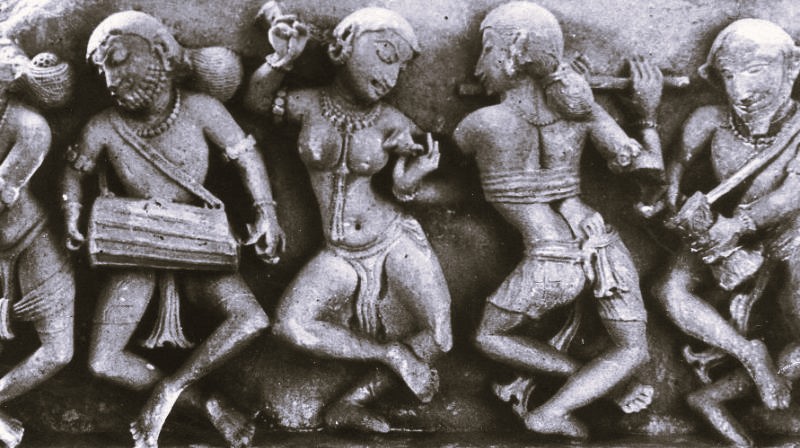
This account is more than a mythological explanation of the origins of theatre. It provides a theory of artistic synthesis. Poetry is not conceived as an isolated verbal art. Speech, music, gesture, emotion, rhythm, and performance belong to a single aesthetic field. The Nāṭyaveda consequently extends the Vedic world into a form of art capable of communicating with a wider human community. Bharata’s drama is at once entertainment, instruction, representation, and an experience of aesthetic delight. The traditional account of its creation therefore establishes an important continuity between yajña and performance: both involve ordered action, sound, gesture, spectatorship or participation, and a carefully structured movement towards a desired effect.
The most influential contribution of Bharata to Indian poetics is the theory of rasa. His celebrated rasasūtra states: vibhāvānubhāvavyabhicārisaṃyogād rasa-niṣpattiḥ— rasa arises through the conjunction of vibhāva, anubhāva, and vyabhicāribhāva (Nāṭyaśāstra 6). The word rasa itself means essence, sap, flavour, or taste. Its aesthetic application is particularly suggestive in relation to the Vedic tradition because the Vedas repeatedly use the language of essence, offering, nourishment, and Soma. One should not, however, simply equate Vedic rasa with Bharata’s technical aesthetic rasa. The connection is conceptual rather than a direct identity: something experienced through a carefully constituted process becomes capable of being “tasted” or inwardly assimilated.
The Vedic sacrificial imagination also helps illuminate the importance of transformation in Indian aesthetics. In yajña, ordinary substances are placed within a sacred process and acquire a different significance through ritual transformation. Similarly, in poetry, ordinary human emotions—love, grief, anger, wonder, fear—are transformed into aesthetic experience. The spectator does not simply suffer the emotion represented on stage; through aesthetic distance and artistic organisation, the emotion becomes rasa. The dramatic process thus converts the personal into the universal. This is one reason why rasa eventually became the central aesthetic concept of Indian literary thought.
The Vedic concept of chandas provides another important bridge. Metre was not merely an ornamental feature of Vedic poetry. It helped preserve the integrity of sacred utterance and gave verbal expression a precise rhythmic structure. Classical Sanskrit poetics retained an equally sophisticated concern with metre, phonetic arrangement, diction, and the relationship between sound and meaning. The later theories of guṇa, rīti, and alaṅkāra therefore developed within a culture already deeply attentive to the formal power of language.
The evolution of Indian poetics from Bharata to Ānandavardhana and Kuntaka demonstrates how this concern gradually moved inward. Ānandavardhana’s Dhvanyāloka placed dhvani, or poetic suggestion, at the centre of literary meaning, while Kuntaka’s Vakroktijīvita emphasised the distinctive or oblique turn of poetic expression. These theories differ substantially from one another, yet they share an important assumption: poetry cannot be adequately explained by its literal statement alone. The poetic utterance does something more than communicate information.
This becomes particularly profound in the work of Abhinavagupta, who brought together rasa and dhvani within a sophisticated theory of aesthetic experience. The spectator’s experience of rasa is not merely private emotion but a transformed, universalised mode of awareness. Indian poetics consequently moves progressively from the external features of poetry towards the experience generated within the sahṛdaya, the sensitive or empathetic reader and spectator.
The Vedic elements in Indian poetics are therefore best understood as a continuity of assumptions rather than a catalogue of borrowed doctrines. The Vedic ṛṣi becomes the prototype of the visionary kavi; vāc establishes the mysterious potency of speech; chandas gives rhythm an intellectual and sacred importance; śabda remains inseparable from the creation of meaning; and the sacrificial transformation of experience provides a useful conceptual parallel for the transformation of emotion into rasa.
Indian poetics thus emerges from a civilisation in which language was never regarded as merely utilitarian. The highest utterance could reveal, transform, and elevate. The journey from mantra to kāvya, from ṛṣi to kavi, and from sacred utterance to rasa is consequently not a journey from religion to secular art. It is a process of aesthetic transformation in which the ancient Indian concern with sound, vision, consciousness, and meaning finds increasingly sophisticated literary expression.

