
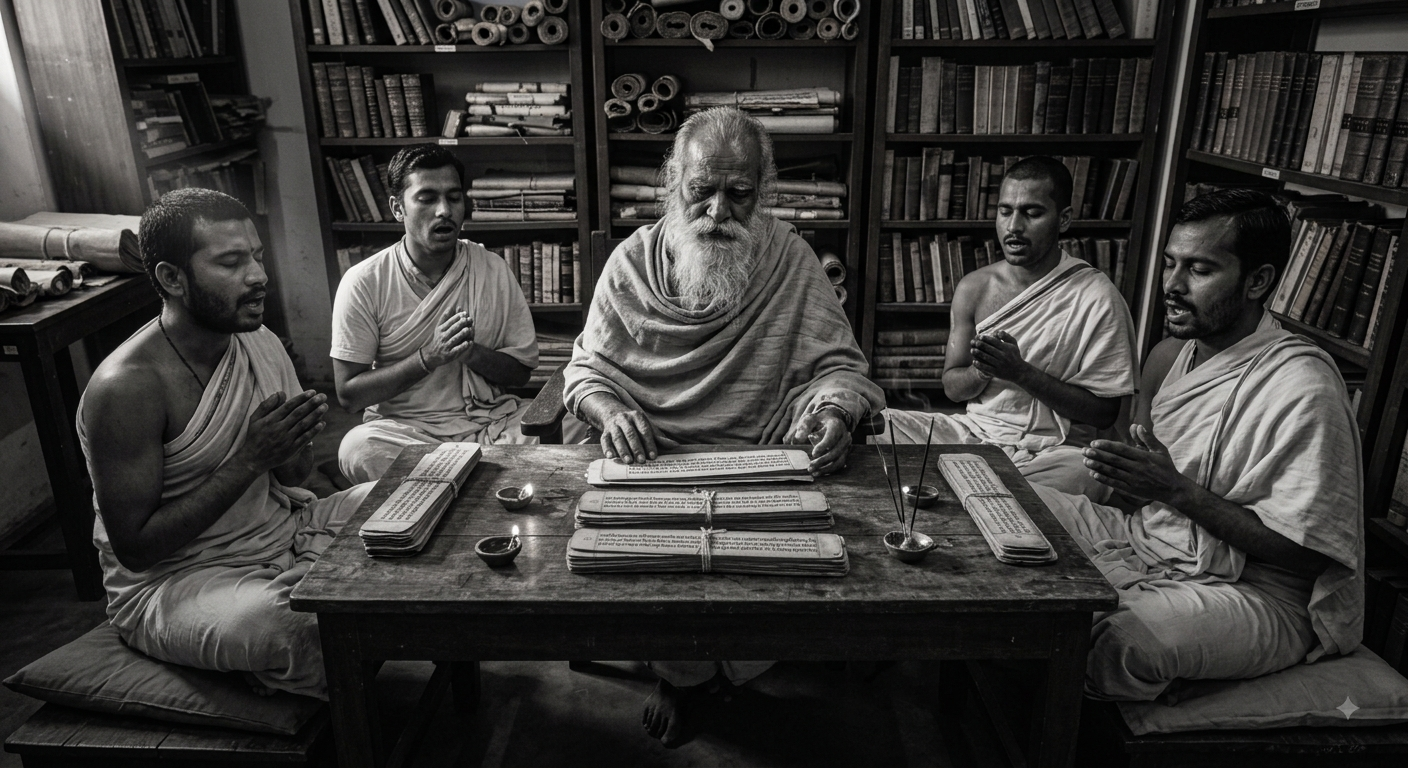
To approach the Vedic texts merely as written language is to encounter only one dimension of their richness. The Vedas belong fundamentally to an oral civilization in which sound, rhythm, accent, and intonation were inseparable from meaning. For this reason, an understanding of Vedic metre and prosody is essential for anyone who wishes to engage seriously with the mantras. A Vedic mantra is not simply a sequence of words arranged to convey an idea; it is also a carefully structured sonic composition whose rhythm contributes to its identity, memorisation, recitation, and interpretation.
The Sanskrit discipline concerned with metre is known as Chandas. Traditionally regarded as one of the six Vedāṅgas, Chandas examines the metrical structures through which Vedic verses are composed. The word chandas is itself associated with the idea of covering or protecting, suggesting the traditional understanding that metre safeguards the form of the mantra. Just as grammar preserves linguistic precision and phonetics safeguards pronunciation, prosody preserves the rhythmic architecture of Vedic speech.
The most familiar Vedic metres are eight, viz. Gāyatrī, Uṣṇih, Anuṣṭubh, Bṛhatī, Paṅkti, Triṣṭubh, and Jagatī. They differ principally in the number and arrangement of syllables within their pādas, or metrical quarters. The celebrated Gāyatrī, for instance, generally consists of three pādas of eight syllables each, giving it a total of twenty-four syllables. Triṣṭubh, one of the most prevalent metres of the Ṛgveda, generally consists of four pādas of eleven syllables each, while Jagatī generally contains four pādas of twelve syllables each. These patterns are not merely technical classifications; they constitute part of the formal architecture through which the mantras were composed and transmitted. Here is tabular projection of these metres for the ease of your understanding:
|
Metre (Chandas) |
Number of Lines (Padas) | Syllables per Line | Total Syllables |
| Gāyatrī | 3 lines | 8 syllables | 24 |
| Uṣṇih | 4 lines | 7 syllables (varies) | 28 |
| Anuṣṭubh | 4 lines | 8 syllables | 32 |
| Bṛhatī | 4 lines | 9 syllables (average) | 36 |
| Paṅkti | 5 lines | 8 syllables | 40 |
| Triṣṭubh | 4 lines | 11 syllables | 44 |
| Jagatī | 4 lines | 12 syllables |
48 |
Vedic prosody, however, cannot be reduced to counting syllables. Svara, or Vedic accent, plays an equally important role. The traditional recitation distinguishes primarily between udātta, anudātta, and svarita. The precise pronunciation of these accents was transmitted with extraordinary care because alteration of sound could alter the grammatical or ritual character of a passage. The elaborate oral traditions of the Veda consequently developed sophisticated methods of recitation to preserve both textual and phonetic accuracy across generations.
For the modern seeker, attention to metre can reveal dimensions that remain invisible in translation. Repeated rhythmic structures create patterns of movement, emphasis, and cadence. The placement of words within a pāda may illuminate syntactical relationships, while deviations from an expected metrical pattern can sometimes provide clues concerning textual transmission or interpretation. Prosody can therefore serve as an important aid to philology and hermeneutics.
More importantly, metre reminds us that the Vedic mantra was intended not merely to be read but heard. Its meaning resides not only in lexical definitions but also in the living relationship between word, breath, rhythm, and voice. The mantra belongs simultaneously to language and sound.
For those beginning Vedic studies, learning the basic metres is therefore an invaluable discipline. One need not become a specialist in Sanskrit prosody before approaching the Vedas. Even a preliminary awareness of pāda, syllable, metre, and accent can transform the way one encounters the text. Gradually, what initially appears to be an obscure collection of ancient verses begins to reveal an extraordinary sonic architecture.
To understand Vedic metre is ultimately to understand something fundamental about the Vedic vision itself: knowledge was not merely written down; it was embodied in sound, preserved through memory, and transmitted through disciplined listening. The study of Chandas thus brings us closer to the world in which the mantras were originally heard— not merely as poetry, but as living utterances whose rhythm formed an integral part of their being.
