
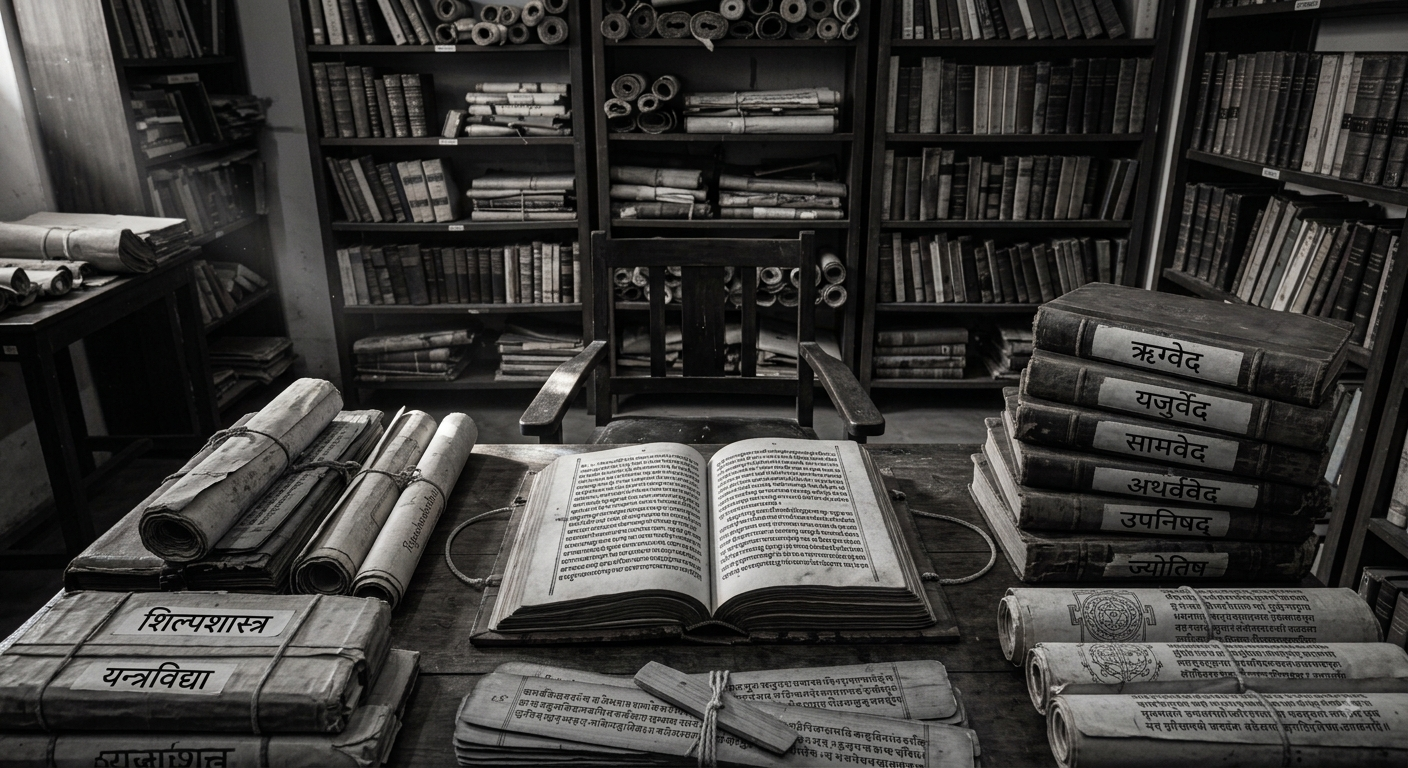
One of the first difficulties in approaching the Vedas is linguistic. Before we begin interpreting a Vedic mantra, we have already placed it within categories that may not adequately belong to the Vedic world. We call a mantra a “hymn,” we call the Vedas “scriptures,” and we speak of Vedic “religion” as though these terms were transparent equivalents. They are convenient translations, but convenience can sometimes conceal more than it reveals. The Vedic tradition emerges from an intellectual, ritual, and contemplative world whose categories cannot always be accommodated within the vocabulary of modern religious studies. To understand the Vedas on their own terms, therefore, we must begin by asking a deceptively simple question: what exactly is a mantra? And what exactly is a Veda?
A mantra is not merely a hymn.
In ordinary usage, the word “hymn” suggests a poetic composition addressed to a deity, usually expressing praise, devotion, supplication, or thanksgiving. Some Vedic mantras certainly contain these elements. Yet to describe them simply as hymns risks reducing their function and significance. A Vedic mantra is not merely something that says something about the divine; it is also something that is uttered, heard, transmitted, contemplated, and enacted. Its significance lies not only in what its words communicate but also in its sound, rhythm, accent, structure, context, and ritual or contemplative application.
The Sanskrit word mantra itself is traditionally associated with the verbal root man, “to think,” together with the suffix -tra, conveying an instrumentality. A mantra may thus be understood, broadly, as an instrument of thought or consciousness. This etymological explanation does not by itself provide a complete definition, but it points towards an important feature of the Vedic conception: the mantra is not merely a sentence carrying information. It is a carefully formed linguistic and sonic vehicle through which consciousness is directed, intensified, invoked, or transformed.
This is one reason why the Vedic tradition places extraordinary emphasis upon śruti, hearing. The mantra is not merely a written statement waiting to be read silently from a page. Its phonetic form is integral to its identity. Accent, duration, pronunciation, metre, sequence, and oral transmission have historically received extraordinary attention. The Vedic recitation traditions preserved not only the words of the mantras but remarkably elaborate systems for ensuring their accurate transmission across generations. Such preservation makes little sense if the mantra is regarded merely as a container of conceptual information. In the Vedic understanding, sound itself participates in meaning.
The ṛṣis are therefore traditionally described not simply as “authors” of the Vedic mantras. They are mantra-draṣṭāraḥ— “seers of the mantras.” This distinction is fundamental. The mantra is not imagined as an arbitrary poetic invention produced by an individual poet for aesthetic expression. The ṛṣi is one who “sees” or apprehends a truth and gives it linguistic and sonic expression. This does not mean that Vedic language should be treated as beyond all historical or linguistic analysis. Rather, it reminds us that the traditional conception of Vedic revelation is substantially different from the modern notion of literary authorship.
The word mantra also cannot be confined to devotional praise. A mantra may invoke a deity, describe a cosmic process, articulate a metaphysical insight, accompany a ritual action, express a prayer, encode a symbolic process, or direct the mind towards a particular state of awareness. The same mantra can therefore operate upon multiple levels. Its literal meaning may be intelligible while its symbolic significance remains obscure. Its ritual application may reveal one dimension while contemplative reflection reveals another.
Consider Agni. To translate Agni simply as “fire” is linguistically reasonable but conceptually incomplete. Agni is indeed fire, but the Vedic conception of Agni encompasses sacrificial fire, illumination, transformation, mediation, aspiration, and other associated dimensions. Similarly, Soma cannot be adequately understood merely as the name of a ritual plant or beverage, just as Indra cannot be exhausted by the description of a thunder-god. The Vedic deities occupy a symbolic universe in which natural, cosmic, psychological, and spiritual dimensions frequently overlap.
This brings us to the second proposition: the Vedas are not merely “scriptures.”
The English word “scripture” usually denotes a sacred text regarded by a religious community as authoritative and revelatory. It is therefore tempting to translate Veda as “scripture.” Yet the word veda derives from the Sanskrit root vid, “to know.” At its most fundamental level, Veda signifies knowledge. This does not mean that the Vedas are not sacred texts; they unquestionably occupy the highest position within the orthodox Vedic tradition. The point is that the category of “scripture” does not exhaust what the Vedic tradition understands by Veda.
A scripture is often conceived primarily as a book or collection of authoritative teachings. The Veda, however, was historically and traditionally transmitted as an oral body of knowledge long before it became something modern readers encountered in printed editions. The written page is therefore a relatively recent technological representation of a tradition whose identity was preserved through disciplined oral transmission. The Veda is not reducible to ink, paper, or written characters. The written Saṃhitā is a representation of a larger sonic and intellectual tradition.
This distinction becomes particularly important because modern readers often approach the Vedas as they would approach a book such as the Bible, the Qur’an, or another canonical scripture: they open the volume, read the words sequentially, extract propositions, and attempt to determine the theological system contained within them. Such an approach can be useful for comparative purposes, but it can also obscure the distinctive character of Vedic literature. The Vedas are not organized around a single narrative, a single historical personality, or a systematic exposition of doctrine. They are a vast corpus of mantras, ritual knowledge, cosmological speculation, invocations, symbolic imagery, philosophical questioning, and liturgical formulations transmitted through highly specialized traditions.
Even the term “Vedic religion” can therefore become misleading when used without qualification. The Vedic tradition cannot easily be reduced to a fixed system of beliefs comparable to a modern institutional religion. It is better understood as a complex civilization of knowledge and practice encompassing ritual, language, cosmology, ethics, metaphysics, social order, contemplation, and theories of consciousness. The Vedas constitute one of the foundational layers of this immense intellectual tradition, rather than a closed doctrinal manual.
Perhaps the most important consequence of this distinction concerns interpretation.
If we assume that a mantra is merely a hymn, we will primarily ask: “What is the poet praising?” If we assume that the Veda is merely a scripture, we will primarily ask: “What doctrine does this book teach?” But the Vedic texts often demand different questions. What is the symbolic relationship between the images in this mantra? Why is a particular deity invoked in this context? What does the ritual action signify? How does the same word function elsewhere in the Vedic corpus? What does its etymology reveal? How does its metre contribute to its expression? How might the external ritual correspond to an internal process? What conception of consciousness emerges through these recurring symbols?
These questions open a substantially richer field of inquiry.
This does not mean that every mantra possesses an esoteric meaning that can be freely invented by a modern interpreter. Nor does it mean that the ritual dimension should be discarded in favour of psychological or mystical interpretations. The opposite is equally problematic. The Vedic corpus should be approached through multiple layers of evidence: grammar, etymology, ritual context, textual parallels, traditional commentaries, metre, history of interpretation, and philosophical reflection. A responsible interpretation must be able to distinguish between what the text demonstrably says, what the tradition has understood it to mean, and what a modern scholar proposes as a possible extension of its significance.
This is also why the history of Vedic interpretation is indispensable. Yāska, Durgācārya, Skandasvāmī, Sāyaṇa, and other traditional interpreters did not always agree about the meaning of difficult passages. Their disagreements should not be regarded merely as evidence of confusion. They demonstrate that the Vedic tradition possessed an active hermeneutical culture. Later thinkers such as Sri Aurobindo, Sri Anirvan, and T. V. Kapāli Śāstrī attempted to recover dimensions of Vedic symbolism that they believed had become obscured by predominantly ritualistic interpretations. Their works provide important resources for reconsidering the relationship between mantra, symbolism, psychology, and consciousness.
The distinction between mantra and hymn, and between Veda and scripture, is therefore not merely terminological. It changes the manner in which we listen to the Vedic tradition.
A hymn may be read. A mantra is traditionally heard.
A scripture may be consulted for doctrine. The Veda invites us into a field of knowledge.
A poem may communicate an author’s imagination. A mantra, in the Vedic conception, is something seen by the ṛṣi and transmitted through sound.
A book may be approached primarily through its written words. The Vedic tradition demands attention to śabda, to sound, recitation, accent, memory, meaning, and lived transmission.
To say that “mantras are not hymns” is therefore not to deny that Vedic mantras possess poetic beauty. To say that “Vedas are not scriptures” is not to deny their sacred and authoritative character. It is to recognize that these translations are insufficient. They describe something of the Vedic tradition, but they do not exhaust it.
The young seeker should consequently approach the Vedas without forcing them into categories created elsewhere. Before asking what the Vedas mean, we should first learn how the Vedic tradition understands Veda, mantra, ṛṣi, śruti, śabda, and yajña. Before translating the words, we must learn to listen to them. And before reducing the mantras to propositions, we must allow ourselves to encounter their symbolic world.
The Vedas may be ancient, but their central questions remain remarkably contemporary. What is knowledge? What is consciousness? What lies behind appearance? What is the relationship between the human being and the cosmos? What transforms ordinary awareness into insight?
Perhaps, then, the most appropriate way to approach the Veda is neither as an antiquarian document nor merely as a scripture to be believed, but as an invitation to know—to listen, to inquire, to contemplate, and ultimately to discover what the ancient seers meant when they spoke of vidyā: the movement from merely possessing knowledge to becoming transformed by it.
