
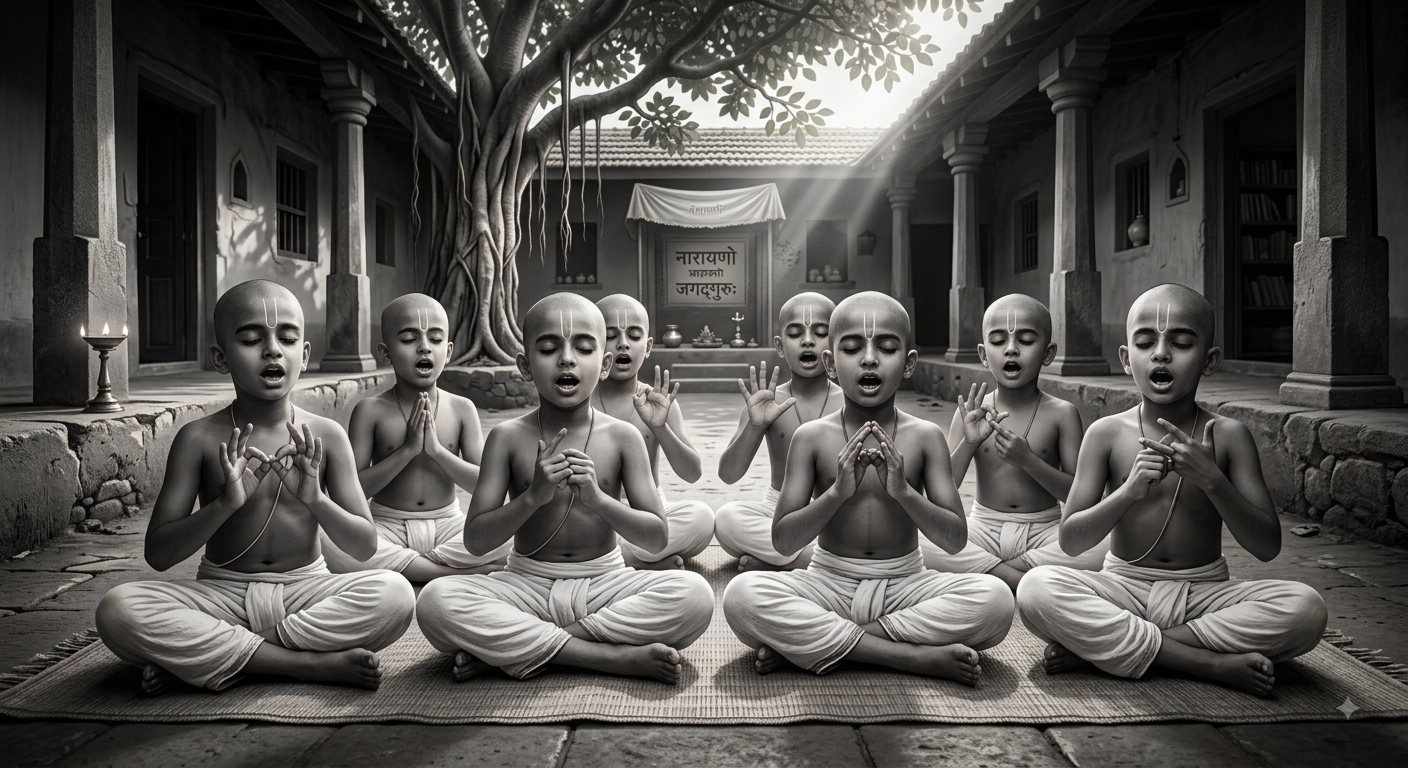
The Vedas have survived across thousands of years with astonishing textual and phonetic precision, largely because they were preserved not through manuscripts but through an extraordinarily sophisticated system of oral transmission. In the Vedic tradition, the mantra is not merely a sequence of written words. Its pronunciation, accent, duration, rhythm, and sequence are integral to its identity. To safeguard this intricate structure, Vedic scholars developed elaborate methods of recitation known as Vedic pāṭha, or modes of chanting. Among these, eight principal methods are traditionally recognised: Saṃhitā, Pada, Krama, Jaṭā, Mālā, Śikhā, Rekhā, and Dhvaja.
The first and most fundamental mode is Saṃhitā-pāṭha. Here, the mantra is recited in its continuous form, preserving the phonetic combinations that arise when words are joined according to the rules of sandhi. This is the form in which Vedic mantras are ordinarily encountered in continuous recitation. Its purpose is not merely aesthetic. It preserves the natural phonetic flow of the mantra and provides the foundation upon which the other methods are constructed.
The second is Pada-pāṭha, in which the mantra is divided into its individual words or padas. The phonetic combinations of the continuous recitation are analysed and separated so that the constituent words become clearly identifiable. Pada-pāṭha is therefore particularly valuable for linguistic and grammatical study. It allows the student to distinguish the individual lexical elements that may otherwise be obscured by continuous sandhi.
The third method is Krama-pāṭha. Here, words are recited in successive pairs: the first with the second, the second with the third, the third with the fourth, and so forth. If the sequence is represented as A B C D, Krama-pāṭha proceeds approximately as A-B, B-C, C-D. This creates a systematic overlap between adjacent words and provides another layer of protection against textual corruption.
The remaining methods employ increasingly elaborate patterns of repetition. Jaṭā-pāṭha, literally associated with a “braid” or “matted” arrangement, interweaves words through a forward-and-reverse pattern. A simple sequence A B may become A-B, B-A, A-B. Through such patterned repetition, the relationship between neighbouring words becomes extraordinarily difficult to alter accidentally.
Mālā-pāṭha, meaning “garland recitation,” develops the principle of patterned interconnection further, arranging words in a manner resembling links in a garland. Śikhā-pāṭha, “crest” or “top-knot recitation,” employs another intricate sequence of forward and backward repetitions. Rekhā-pāṭha, literally “line recitation,” and Dhvaja-pāṭha, “banner recitation,” represent further specialised patterns designed to reinforce the integrity of the textual sequence.
These methods should not be mistaken for eight different interpretations of a mantra. They are, fundamentally, technologies of preservation. By repeatedly rearranging, overlapping, reversing, and reconnecting the words, Vedic reciters created a remarkable oral safeguard against omission, alteration, or inadvertent interpolation. The system functioned almost like an elaborate error-detection mechanism, centuries before the invention of writing technologies capable of performing comparable tasks.
The achievement becomes even more remarkable when considered alongside the preservation of svara, the Vedic accents of udātta, anudātta, and svarita. The oral tradition did not merely preserve vocabulary and sequence; it preserved pronunciation, accent, rhythm, and phonetic detail with extraordinary fidelity.
For the modern student, the eight methods of Vedic chanting reveal something fundamental about the Vedic civilisation: memory itself was cultivated as a scholarly discipline. The Vedas were not preserved because ancient India lacked writing, but because the oral tradition developed methods of transmission whose precision could surpass that of manuscripts. To study Vedic chanting, therefore, is to encounter one of humanity’s most remarkable experiments in the preservation of knowledge through disciplined sound, memory, and repetition.
