
Approaching the Vedic texts is unlike approaching an ordinary work of literature. The Vedas are among the oldest surviving bodies of sacred knowledge in the world, but their antiquity is not the only reason they can appear difficult to a modern reader. Their language, imagery, symbolism, and intellectual framework belong to a world considerably different from our own. A young seeker who opens the Ṛgveda for the first time may therefore find the mantras obscure, repetitive, or even unintelligible. This should not be a cause for discouragement. The difficulty lies not necessarily in the absence of meaning, but in the richness of a language and symbolic tradition that requires preparation. The Vedic texts must be approached patiently, contextually, and with a willingness to allow their meanings to unfold gradually.
The first principle is simple: do not begin with the assumption that the Vedas are either primitive poetry or a collection of ready-made philosophical propositions. Neither approach does justice to them. The Vedic ṛṣis expressed their insights through a symbolic language in which natural phenomena, ritual actions, divine figures, psychological states, and metaphysical principles frequently intersect. Agni, for instance, is certainly fire, but the Vedic conception of Agni cannot be exhausted by the physical phenomenon of fire. Similarly, Sūrya is the visible sun, yet the symbolism associated with illumination, vision, knowledge, and consciousness may also operate through the figure of Sūrya. The first task of the seeker, therefore, is to resist premature simplification.
The second principle is to acquire a basic familiarity with Vedic Sanskrit. One need not become an accomplished Sanskrit scholar before beginning one’s engagement with the Vedas, but some knowledge of Sanskrit is indispensable for serious study. Translations are useful doors into the text, but they should not be mistaken for the text itself. A single Sanskrit word can possess a range of meanings that no single English equivalent can adequately convey. Etymology, grammatical form, context, and association with other Vedic usages can all influence its interpretation. Even a modest acquaintance with Sanskrit will gradually reveal dimensions that disappear in translation. For this reason, the aspiring student should cultivate Sanskrit alongside Vedic study rather than treating language as an optional preliminary exercise.
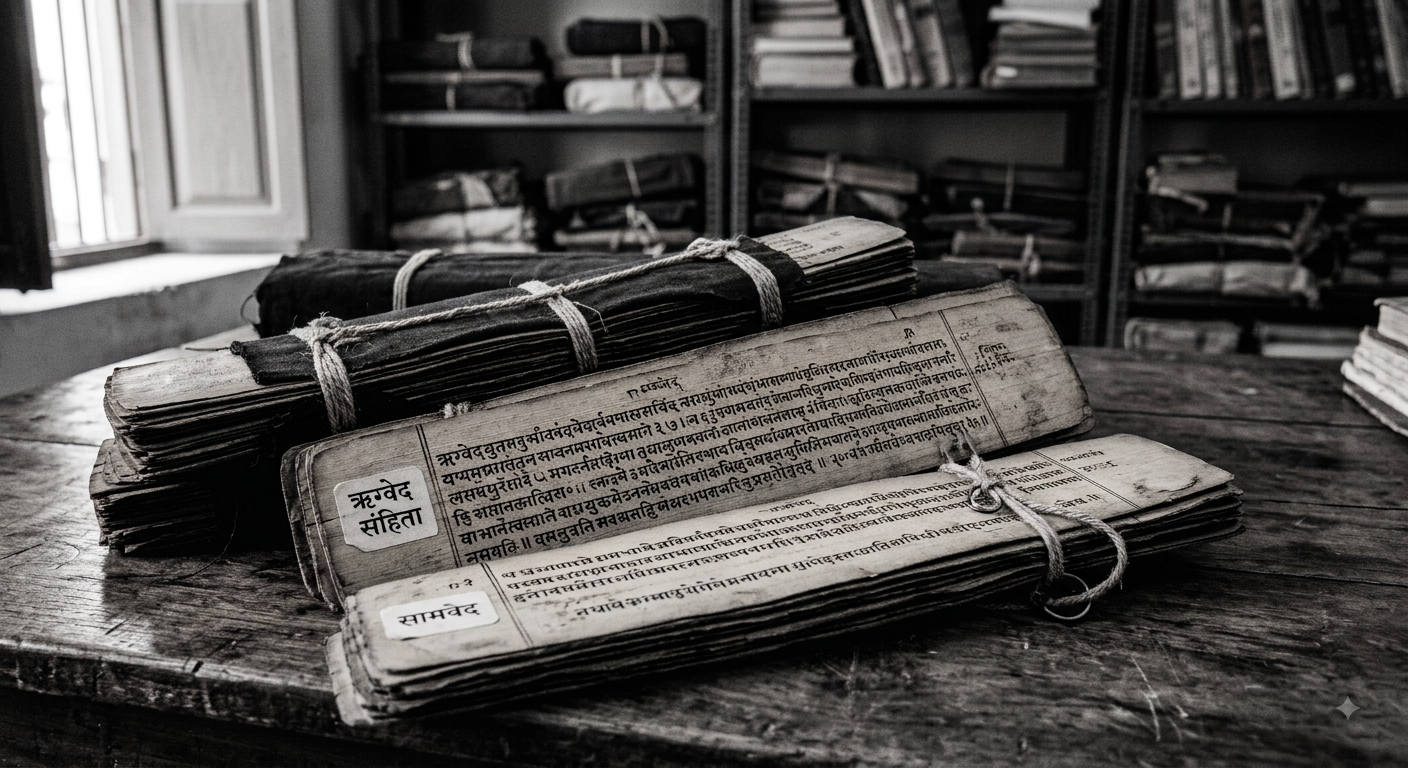
The third principle is to understand the structure of the Vedic corpus. The Vedas are not simply four books that can be read like four volumes of a modern anthology. The Ṛgveda, Yajurveda, Sāmaveda, and Atharvaveda represent distinct yet interconnected traditions of Vedic knowledge and practice. Within the broader Vedic literature, one encounters Saṃhitās, Brāhmaṇas, Āraṇyakas, and Upaniṣads, each representing different modes and contexts of engagement with the sacred corpus. A seeker should therefore develop a sense of where a particular passage belongs and what kind of text it represents. Without this orientation, individual mantras can easily be detached from the intellectual ecosystem in which they originally functioned.
The Ṛgveda is often the most appropriate place for those interested in understanding Vedic symbolism because it preserves an extraordinary collection of hymns addressed to various deities and cosmic powers. Yet it should not necessarily be read from the first mantra to the last as though it were a continuous narrative. A thematic approach can be more fruitful for beginners. One might initially explore hymns associated with Agni, Indra, Soma, Uṣas, Sūrya, Vāyu, or Varuṇa and gradually observe the relationships between their different symbolic dimensions. Repeated images and expressions begin to acquire significance when encountered across different hymns.
At this stage, the seeker must learn to distinguish between literal, ritual, symbolic, psychological, and philosophical dimensions of interpretation. These dimensions need not always contradict one another. A Vedic hymn may describe an external ritual while simultaneously employing that ritual as a symbolic representation of an inner process. The sacred fire may be physically kindled, ritually invoked, and inwardly understood as an image of aspiration, transformation, illumination, or consciousness. The mistake is not in accepting one level of meaning; the mistake is in assuming that one level necessarily excludes all others.
This is where the traditional interpretive heritage becomes essential. Vedic texts should not be approached as though every modern reader must rediscover their meaning independently. India possesses a remarkably extensive history of Vedic interpretation. Yāska, in the Nirukta, investigated difficult Vedic words and their etymological and contextual meanings. Later commentators such as Durgācārya, Skandasvāmī, and Sāyaṇa developed different approaches to explaining the mantras. Their works should be read critically but respectfully. They do not always agree, and their disagreements are themselves valuable because they demonstrate that Vedic interpretation has never been a completely uniform enterprise.
For the modern seeker, it is equally important to encounter the twentieth-century attempts to recover the symbolic and inner dimensions of the Veda. Sri Aurobindo, Sri Anirvan, and T. V. Kapāli Śāstrī are particularly significant in this regard. Their works demonstrate that the Vedas can be approached not merely as documents of ancient ritual but as texts containing profound reflections on consciousness, transformation, knowledge, and the human journey. Their interpretations should not simply be accepted as unquestionable conclusions; rather, they should be studied as sophisticated proposals that invite further investigation.
A fourth principle is to read the Vedas alongside the wider Indian intellectual tradition. The Vedas did not exist in isolation from the later development of Indian thought. The Upaniṣads, the Bhagavad Gītā, the Rāmāyaṇa, the Mahābhārata, the Purāṇas, and the various darśanas preserve, transform, and elaborate themes that emerge in earlier Vedic literature. For a beginner, the Itihāsa-Purāṇa tradition can sometimes provide a more accessible entry into ideas that appear cryptic in the Saṃhitās. The narrative form of these texts makes abstract principles easier to encounter through characters, conflicts, choices, and consequences.
The relationship between the Vedas and the Itihāsa-Purāṇa tradition is particularly important because the latter often communicates Vedic principles through story and metaphor. The ethical dilemmas of the Mahābhārata, the dharmic vision of the Rāmāyaṇa, and the cosmological narratives of the Purāṇas can therefore be studied as extensions and reinterpretations of a much older intellectual world. A seeker who reads these traditions together begins to see that the Indian scriptural heritage is not a collection of disconnected books but a vast and evolving conversation concerning dharma, consciousness, reality, knowledge, and human flourishing.
Another essential principle is patience. Vedic study does not reward hurried reading. A single mantra may require repeated readings, consultation of dictionaries and commentaries, comparison with other passages, and prolonged reflection before its significance becomes apparent. One should therefore resist the contemporary habit of seeking immediate explanations. The purpose of studying the Vedas is not merely to accumulate information but to develop a refined capacity for seeing relationships between words, symbols, ideas, and experiences.
It is equally important to cultivate intellectual humility. The Vedas contain mysteries that may not yield themselves completely to any single interpreter. A sincere seeker should therefore be willing to say, “I do not yet understand this,” rather than forcing an interpretation upon an obscure passage. At the same time, reverence should not become an excuse for abandoning critical inquiry. The ideal approach lies between credulity and cynicism: neither accepting every interpretation merely because it is ancient nor dismissing an idea merely because it does not conform to modern expectations.
Finally, the seeker should remember that Vedic study is ultimately concerned with knowledge that transforms the knower. The Vedic tradition does not regard knowledge as merely the possession of propositions. Its deepest questions concern the nature of reality, the self, consciousness, order, action, sacrifice, mortality, and the possibility of transcendence. The texts repeatedly invite the human being to move from appearance towards understanding, from fragmentation towards wholeness, and from external observation towards deeper self-awareness.
To approach the Vedas, therefore, is to undertake both a scholarly and an inward journey. Learn the language, study the history, understand the traditions of interpretation, read the commentaries, compare translations, question assumptions, and engage contemporary scholarship. But alongside these intellectual disciplines, cultivate patience, attentiveness, silence, and reflection. Allow the mantra to remain a question before turning it into an answer. Allow its symbols to reveal their relationships gradually. Above all, approach the Vedic texts neither with the arrogance of one who believes that the past has nothing to teach the present nor with the sentimentality of one who believes that everything ancient must automatically be true. Approach them as a seeker: with śraddhā, but also with viveka; with reverence, but also with inquiry.
The Vedic world does not necessarily disclose itself at the first reading. It asks to be entered slowly. And perhaps that is precisely where the journey begins: not with the claim that we already possess the meaning of the Veda, but with the humility to recognize that we are still learning how to listen.
