
वैतथ्यं बाध्यमानत्वात्।
Vaitathyaṃ bādhyamānatvāt—what is sublatable is not ultimately real. The importance of this Advaitic manner of reasoning lies not in its familiar example of the rope and the snake, but in the question, it raises about knowledge itself. What appears before consciousness may be examined, corrected, contradicted and finally sublated. But what of consciousness, in whose presence the appearing and the sublation take place?
The contemporary philosophy of mind usually approaches the question from another direction. Consider seeing a red flower. The wavelengths of light, retinal stimulation, neural activity and subsequent cognitive processing can all be described. Yet there remains the question of the experience itself. Thomas Nagel’s question about what it is like to be a bat gives this difficulty its most familiar modern expression.
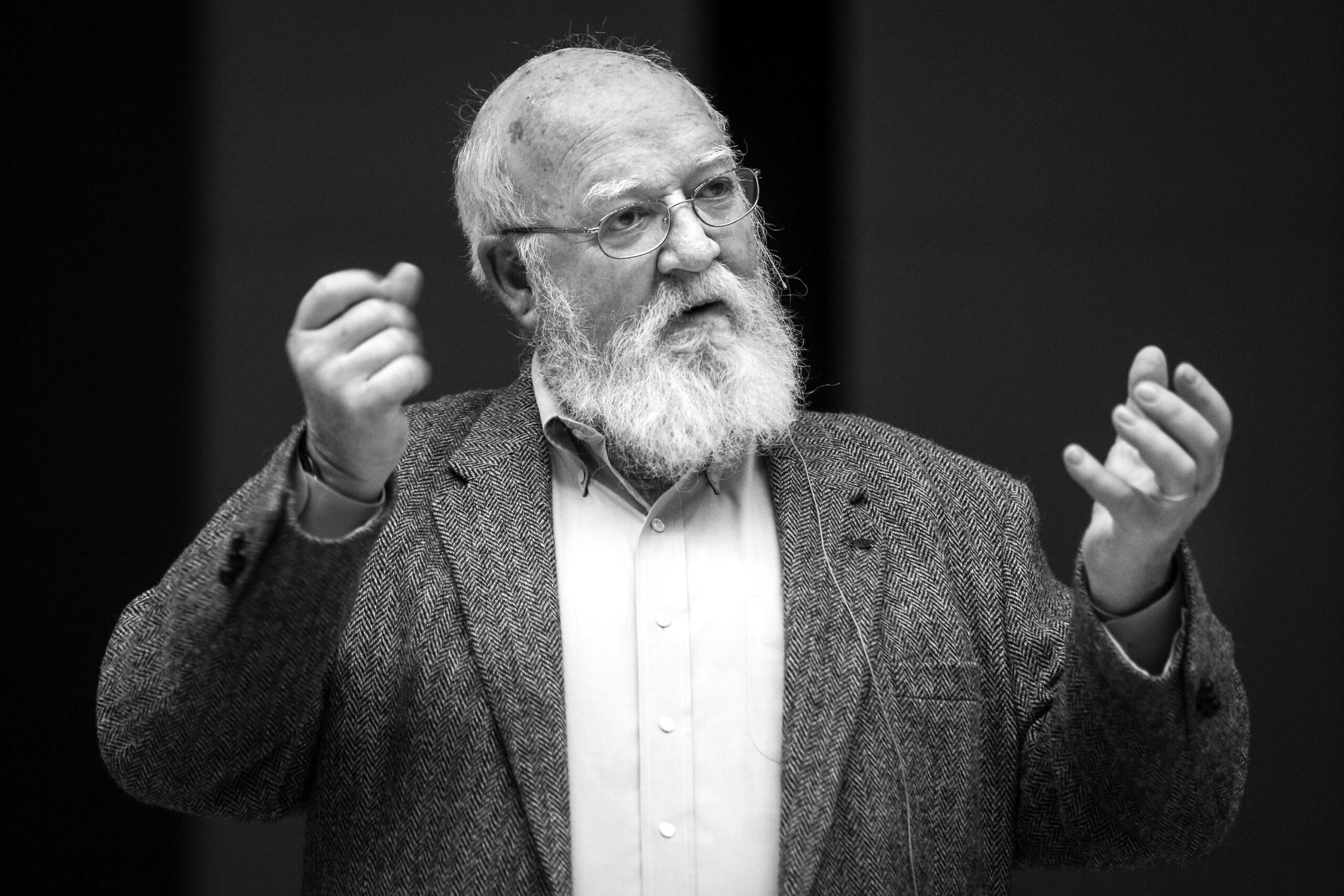
Daniel Dennett’s response is to question the picture of consciousness implicit in the question. There is no inner theatre in which completed experiences are displayed before a spectator. His Multiple Drafts Model explains conscious life through distributed processes of perception, memory, attention and interpretation. The Cartesian observer disappears.
But the disappearance of the observer does not necessarily settle the question of consciousness. Bernardo Kastrup’s criticism is significant here. If the subjective character of experience is redescribed as a functional or informational process, one may still ask whether consciousness has been explained or whether the phenomenon has merely been redescribed.
The Advaitin would press the question further. Śaṅkara writes in his Bṛhadāraṇyaka Upaniṣad Bhāṣya:
न हि विज्ञातुर्विज्ञातेर्विपरिलोपो विद्यते।
Na hi vijñātur vijñāter viparilopo vidyate.
There is no disappearance of the knowing of the knower.
The point is not that another person—the ātman—is concealed somewhere behind the mind. The point is epistemological. The body is known; sensations are known; thoughts are known; memory is known; even the mind may become an object of awareness. The knower cannot, in the same manner, be converted into another known object.
Hence the Advaitic tradition insists:
येन सर्वमिदं विजानाति तं केन विजानीयात्।
Yena sarvam idaṃ vijānāti taṃ kena vijānīyāt?
By what should one know that by which all this is known?
The question is not answered by adding consciousness to the list of things science has yet to discover. It questions the list itself. Ordinary knowledge operates through the distinction between pramātṛ, prameya and pramāṇa—knower, known and means of knowledge. But the Self cannot simply occupy the place of another prameya. As Śaṅkara repeatedly insists, the Self is not established as an object in the way a pot or a perceptible event is established.
This is why the Advaitic discussion of pramāṇa becomes important. The Upaniṣadic sentence is not offered as another empirical hypothesis about the universe:
वेदान्तवाक्यमिह कारणमात्मबोधे ।
हेत्वन्तराणि परिपन्थिनिबर्हणानि ॥The Vedānta sentence is the means for Self-knowledge; reasoning has its role in removing the obstacles to that knowledge.
And yet Advaita does not ask us to deny empirical knowledge. Śaṅkara is emphatic:
न च श्रुतिशतं शीतोऽग्निरप्रकाशो वेति।
A hundred scriptural statements cannot make cold what is hot, or darkness what is luminous.
This distinction matters for the comparison with Dennett. Advaita is not proposing a competing neuroscience. It is asking whether consciousness belongs to the same ontological order as the objects and processes that neuroscience describes. Dennett removes the inner spectator and explains the organization of cognitive processes. Advaita agrees that the imagined spectator cannot be another object within the mind, but then asks what makes the mind, the brain, the spectator and even the scientific description of them available as objects of knowledge.
The disagreement, therefore, is not simply between materialism and a spiritual substance. It concerns a more fundamental question: is consciousness something that occurs within the field of experience, or is it that by which the field is disclosed as experience at all?

