
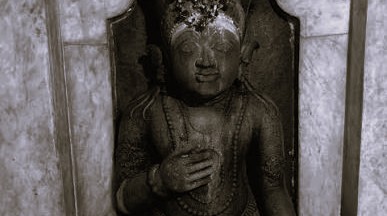
Sāṃkhya is traditionally regarded as one of the oldest systematic schools of Indian philosophy, associated with the sage Kapila. Its classical formulation is preserved most clearly in Īśvarakṛṣṇa’s Sāṃkhyakārikā, while Kapila occupies the position of the foundational teacher in the traditional history of the system. The precise historical relationship between the Kapila of tradition and the classical Sāṃkhya system, however, remains difficult to establish. The lost Sāṃkhya Sūtra attributed to Kapila cannot be securely treated as an ancient text authored by him. What can be examined more fruitfully is the intellectual environment from which Sāṃkhya emerged. In this respect, Sāṃkhya represents neither a simple repetition of Vedic doctrine nor an entirely unrelated philosophical invention. Its distinctive dualism, theory of evolution, analysis of matter and consciousness, and doctrine of liberation appear to develop through a long engagement with questions already present in Vedic and especially Upaniṣadic thought.
The earliest Vedic texts do not present Sāṃkhya as a fully developed philosophical system. There is no systematic doctrine of twenty-five tattvas, no formal theory of prakṛti and puruṣa, and no developed doctrine of the three guṇas in the Ṛgveda. It would therefore be historically inaccurate to describe Sāṃkhya as simply “contained” in the Vedas. The more meaningful claim is that certain Vedic questions and conceptual patterns created the intellectual conditions in which Sāṃkhya could eventually emerge. Among these are the relationship between the manifest and the unmanifest, the distinction between consciousness and material existence, the structure of the cosmos, the nature of the self, causation, and the possibility of liberation from suffering.
One of the most important Vedic antecedents is the conception of puruṣa. The word occurs in several senses across Vedic literature, and the famous Puruṣa Sūkta of the Ṛgveda (10.90) presents Puruṣa as a cosmic person from whom the differentiated universe emerges through sacrifice. The Sāṃkhya puruṣa, however, is not simply the Vedic cosmic Puruṣa. Classical Sāṃkhya understands puruṣa as pure consciousness, inactive, witnessing, eternal, and distinct from material nature. Nevertheless, the persistence of the term and the older association of puruṣa with cosmic and existential questions indicate an important conceptual history. Modern scholarship has also emphasized the long development of the puruṣa concept across the Saṃhitās, Brāhmaṇas, Upaniṣads, and later philosophical literature.
The Upaniṣads provide a much closer philosophical background. Their central concern with ātman as the enduring subject of experience creates an important foundation for the Sāṃkhya conception of consciousness. The Bṛhadāraṇyaka Upaniṣad, for instance, describes the Self as the seer, hearer, thinker, and knower, while simultaneously distinguishing it from the objects and faculties through which experience occurs. Such a conception of a witnessing and enduring subject bears a striking conceptual resemblance to the later Sāṃkhya puruṣa. Sāṃkhya, however, develops this insight in its own direction: instead of identifying the individual self with a single universal Brahman, it posits a plurality of puruṣas.
This distinction is crucial. The Upaniṣadic quest frequently moves towards the discovery of an ultimate unity between ātman and brahman. Sāṃkhya retains the insistence that consciousness is fundamentally different from material and psychological processes but rejects the necessity of reducing all conscious selves to one universal principle. The classical system therefore proposes numerous puruṣas, each pure consciousness, alongside a single prakṛti, primordial material nature. In this respect, Sāṃkhya can be understood as taking an important Upaniṣadic intuition, that is the distinction between the witnessing Self and the changing world, and developing it into a rigorous dualistic metaphysics.
The idea of prakṛti likewise has a complex prehistory. The exact technical meaning of prakṛti as the primordial, unmanifest material principle is characteristic of developed Sāṃkhya and should not simply be projected backwards into the Ṛgveda. Yet Vedic and Upaniṣadic literature repeatedly asks how multiplicity emerges from an underlying principle. The Nāsadīya Sūkta (Ṛgveda 10.129) famously reflects upon the origin of existence, asking what existed before the distinction between being and non-being and whether anyone can truly know how creation arose. The Hiraṇyagarbha Sūkta (Ṛgveda 10.121) similarly contemplates a primordial principle associated with the emergence and ordering of the cosmos. These hymns do not teach Sāṃkhya metaphysics, but they demonstrate an early Indian preoccupation with the relation between primordial reality and manifest existence.
The Nāsadīya Sūkta is particularly important for understanding the philosophical atmosphere from which later speculative traditions emerged. Its refusal to provide an easy cosmological answer demonstrates that Vedic thought was capable of sustained reflection upon causation and the limits of knowledge. Sāṃkhya eventually approaches the question differently. Rather than leaving cosmic origins in the form of a metaphysical question, it proposes an ontological structure in which prakṛti contains the potentiality of the manifest world and unfolds through successive transformations. The classical system thereby turns an ancient cosmological problem into a systematic theory of evolution.
This theory is closely connected with satkāryavāda, the doctrine that the effect pre-exists in its cause. What appears as a new product is actually a transformation or manifestation of what was already present in an unmanifest condition. This principle is central to Sāṃkhya’s pariṇāmavāda, according to which prakṛti transforms into the various levels of manifest existence. The twenty-five tattvas describe this process: from prakṛti emerge mahat or buddhi, ahaṃkāra, the subtle elements, the senses, manas, and ultimately the gross elements, while puruṣa remains outside the chain of material transformation.
The doctrine of the three guṇas (viz. sattva, rajas, and tamas) provides the internal dynamism of this prakṛti. Their equilibrium constitutes the unmanifest condition of nature; disturbance of that equilibrium initiates manifestation. These three principles explain the diversity and changing character of material existence. Although the fully developed guṇa theory belongs to classical Sāṃkhya, its vocabulary and broader conceptual associations have earlier resonances in Indian literature. The important point is again one of development rather than identity: classical Sāṃkhya systematizes categories that had a longer intellectual history.
The Vedic and Upaniṣadic inheritance becomes especially visible in Sāṃkhya’s concern with liberation. Indian philosophy does not generally treat metaphysics as an intellectual exercise detached from human suffering. The purpose of knowledge is transformation. Sāṃkhya begins with the recognition of duḥkha, suffering, and seeks liberation through discriminative knowledge. Bondage arises because consciousness identifies itself with the processes of prakṛti—body, senses, mind, intellect, and ego. Liberation, or kaivalya, occurs when puruṣa recognizes itself as distinct from prakṛti. This emphasis on knowledge of the Self as a means of liberation has a clear affinity with the Upaniṣadic quest for ātma-vidyā, even though Sāṃkhya articulates the metaphysics differently.
The relationship between Sāṃkhya and the Vedas consequently becomes particularly interesting. Classical Sāṃkhya is traditionally classified among the āstika systems, but its philosophical arguments do not depend upon interpreting the Vedas in the manner characteristic of Vedānta or Mīmāṃsā. Indeed, classical Sāṃkhya develops a distinctive metaphysical position that does not require a creator God, while still affirming puruṣa, liberation, and a spiritual dimension of existence. Later Sāṃkhya commentators also engaged explicitly with the status and origin of the Vedas, demonstrating that the relationship between Sāṃkhya and Vedic authority was itself philosophically debated.
What emerges, therefore, is not a simple line of doctrinal descent but a process of philosophical transformation. Vedic literature raises questions concerning cosmic origins, puruṣa, order, causation, and the nature of existence. The Upaniṣads turn increasingly towards the inner subject and the knowledge of ātman. Sāṃkhya takes several of these questions and reorganizes them into a precise analytical system distinguishing consciousness from material nature and explaining the evolution of the manifest universe.
The Vedic roots of Kapila’s Sāṃkhya Darśana should thus be understood as roots of inquiry rather than a ready-made philosophical system. Sāṃkhya does not merely repeat the Vedas; nor does it stand wholly outside the Vedic intellectual world. It represents one of the remarkable ways in which the Indian philosophical tradition transformed ancient cosmological and spiritual questions into systematic metaphysics. From the Vedic contemplation of puruṣa and cosmic emergence, through the Upaniṣadic discovery of the witnessing ātman, to Sāṃkhya’s distinction between puruṣa and prakṛti, there is a continuing concern with one fundamental question: what is the relationship between the consciousness that experiences the world and the world that is experienced? Sāṃkhya’s answer through prakṛti, puruṣa, guṇas, tattvas, and kaivalya constitutes one of the most rigorous philosophical developments of that ancient Indian quest.

