
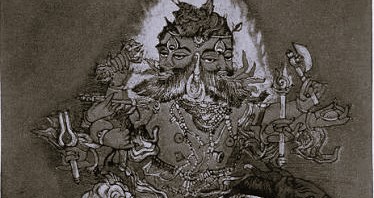
The Agni Purāṇa occupies a distinctive position within the Purāṇic tradition. Narrated by Agni to the sage Vasiṣṭha, it presents itself not simply as a collection of myths but as a vast repository of knowledge encompassing cosmology, ritual, philosophy, pilgrimage, iconography, architecture, medicine, polity, grammar, prosody, and sacred practice. Its encyclopaedic character is itself significant: knowledge is not divided into isolated compartments but understood as part of an interconnected vision of existence.
Its Vedic inheritance is especially visible in the way it transforms older cosmological and symbolic ideas into accessible narratives. The Purāṇa repeatedly takes concepts associated with yajña, ṛta, tapas, Veda, pralaya, devatā, and cosmic order and gives them narrative form. Stories that may appear at first to be accounts of supernatural events can therefore also be approached as symbolic reflections upon preservation, transformation, knowledge, and the relationship between the human and the cosmic.
One of the clearest examples is the story of Matsya, narrated in the second adhyāya of the Agni Purāṇa. Agni begins by defining the purpose of an avatāra: the destruction of the wicked and the protection of the virtuous (Agni Purāṇa 2.2). The story then begins at the end of a cosmic cycle, when a naimittika pralaya inundates the worlds (Agni Purāṇa 2.3). Manu Vaivasvata is performing tapas and tarpaṇa on the banks of the Kṛtamālā when a tiny fish appears in the water held in his palms (Agni Purāṇa 2.4–5).
The transformation of the fish is central to the symbolism of the episode. Manu places it successively in larger vessels, but the fish continually outgrows each one. Finally, it is placed in the ocean, where it expands to an extraordinary size (Agni Purāṇa 2.6–9). Manu then recognises that the apparently insignificant creature is Viṣṇu himself and asks why he is being bewildered by māyā (Agni Purāṇa 2.10).
At one level, this is a story of divine incarnation. At another, it presents a profound image of recognition. The infinite initially appears in a form so small that it can be held within human hands. The seeker encounters the sacred first as something apparently limited, and only through attentive relationship does its magnitude become visible. The progression from vessel to lake to ocean can consequently be read as a movement from restricted perception toward an ever-expanding horizon of consciousness.
The flood introduces another dimension. Matsya instructs Manu to preserve the seeds of life, the Saptarṣis, and the essential elements necessary for continuity through the cosmic dissolution (Agni Purāṇa 2.12–14). The boat therefore becomes more than a means of physical survival. It becomes a vessel of continuity: life, knowledge, memory, and the possibility of renewed creation are carried through dissolution. The text explicitly connects the episode with the preservation of the Vedas and the recovery of sacred knowledge (Agni Purāṇa 2.15–17).
The symbolism is consequently larger than that of a flood narrative. Pralaya destroys forms, but it does not necessarily destroy the possibility of renewal. What must survive is not merely biological existence but knowledge capable of restoring order. The preservation of the Vedas within the narrative places knowledge at the heart of cosmic continuity.
A second example is the story of Kūrma and the churning of the ocean in the third adhyāya. The gods have lost their prosperity and are unable to overcome the asuras. Viṣṇu therefore advises them to cooperate with their former enemies in order to churn the ocean of milk and obtain amṛta (Agni Purāṇa 3.1–5). Mount Mandara becomes the churning rod and Vāsuki the rope (Agni Purāṇa 3.5–6). When the mountain begins to sink, Viṣṇu assumes the form of Kūrma and supports it from below (Agni Purāṇa 3.7–8).
The imagery is remarkably rich. The mountain represents the axis around which the great process of transformation takes place; Vāsuki represents the binding force through which opposing powers participate in that process; and Kūrma, supporting everything from beneath, represents the unseen foundation that makes transformation possible.
The symbolism becomes particularly striking when the first substance to emerge from the churning is not amṛta but Hālāhala, the deadly poison. Śiva contains the poison in his throat and becomes Nīlakaṇṭha (Agni Purāṇa 3.8–9). Only after this crisis do other treasures emerge: Vāruṇī, Pārijāta, Kaustubha, the celestial cows, the apsaras, Lakṣmī, and finally Dhanvantari carrying amṛta (Agni Purāṇa 3.9–11).
The narrative thus offers a powerful symbolic principle: transformation does not immediately yield immortality or prosperity. Churning first brings hidden poison to the surface. What is concealed within the depths must be confronted before the desired treasure can emerge.
This idea resonates strongly with the Vedic understanding of yajña, in which transformation requires disciplined action, controlled energy, offering, and mediation. The cosmic churning can be read as a Purāṇic expansion of an older sacrificial imagination: opposing forces are brought into a structured process, and through that process latent possibilities are released.
The story also has an important Vedic antecedent. The basic image of the tortoise supporting the cosmic process is already found in the Śatapatha Brāhmaṇa, where Kūrma is connected with Prajāpati and the sacrificial construction. The Purāṇic narrative therefore does not arise in complete isolation from Vedic literature; it develops an older symbolic vocabulary into a new theological narrative.
A third example is the Narasiṃha episode, which the Agni Purāṇa preserves within its early avatāra narratives and later recalls in its account of the great divine conflicts. The central opposition is between Hiraṇyakaśipu, whose extraordinary power is acquired through tapas, and Prahlāda, whose steadfast devotion refuses to recognise his father as the supreme reality. The climactic act is the appearance of Narasiṃha and the destruction of Hiraṇyakaśipu. The Agni Purāṇa later summarises this explicitly: Narasiṃha tears apart Hiraṇyakaśipu and establishes Prahlāda as king (Agni Purāṇa 275.13).
The significance of this story lies partly in its treatment of tapas. Hiraṇyakaśipu possesses immense ascetic power, but that power has become separated from ethical order. His tapas grants him extraordinary capacities, yet it does not transform his desire for domination. The story therefore distinguishes between the acquisition of power and the right use of power.
Prahlāda represents another kind of strength. His power is inward: fidelity to what he recognises as the supreme reality. The contrast is therefore not simply between a powerful demon and a weak child. It is between external power founded upon domination and an interior strength founded upon recognition.
Narasiṃha’s form itself symbolises the inadequacy of rigid categories. Hiraṇyakaśipu’s boon attempts to define every possible condition of death; Narasiṃha appears between categories. He is neither simply human nor animal, and the narrative places the decisive encounter within an exceptional temporal and spatial condition. The symbolism suggests that reality cannot always be contained within the conceptual boundaries created by the ego.
Across these stories, therefore, the Vedic inheritance of the Agni Purāṇa becomes visible not merely through the appearance of Vedic names or rituals but through structures of thought. Pralaya becomes a crisis through which continuity must be preserved; tapas becomes a source of extraordinary power that nevertheless requires ethical orientation; cosmic churning becomes an image of transformation in which poison must emerge before amṛta can be obtained.
The Purāṇa itself reinforces this connection by repeatedly incorporating explicitly Vedic material into its ritual and theological sections. It preserves mantras, sacrificial procedures, forms of worship, Veda-based ritual knowledge, and sacred practices alongside its narratives. The text is therefore not merely telling stories about gods; it is attempting to situate those stories within a comprehensive sacred vision of knowledge and practice.
This is perhaps the most important way to understand the relationship between the Vedic and Purāṇic worlds. The Purāṇas do not simply repeat the language of the Vedic saṃhitās. They transform it. Ideas that were once encountered through mantra, yajña, cosmic imagery, and symbolic devatās become stories of Matsya, Kūrma, Narasiṃha, Manu, Prahlāda, and other figures.
The movement is therefore from hymn to narrative, from ritual image to mythic drama, and from compressed symbolism to an expanded imaginative world. Yet the underlying questions remain remarkably continuous: How is order preserved? What survives dissolution? How does hidden potential become manifest? What is the relationship between power and righteousness? And how does consciousness recognise the reality that exceeds its ordinary categories?
The Agni Purāṇa can consequently be read as one of the many bridges between the Vedic and later Hindu worlds. Its stories are not merely tales of supernatural intervention. Beneath their narrative surface lies an inherited symbolic vocabulary through which ancient Indian thought continued to contemplate knowledge, transformation, order, and the mystery of the divine.

