
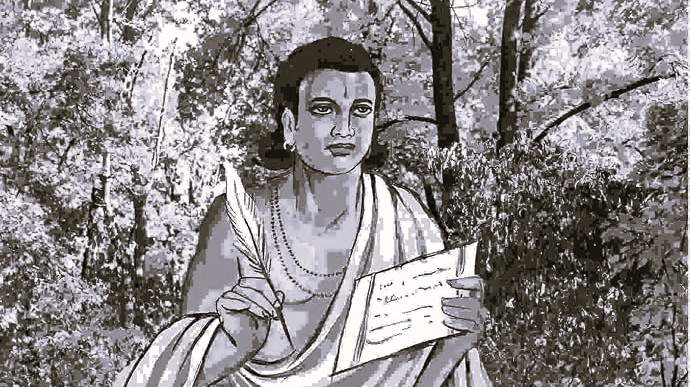
Kālidāsa is often celebrated as the supreme poet of śṛṅgāra, nature, beauty, and human emotion. Yet beneath the apparent elegance of his romantic plots lies a deeply Vedic imagination. His plays do not usually reproduce Vedic hymns or rituals in their original form. Instead, they absorb Vedic ideas into the worlds of kings, sages, forests, gods, sacrifice, love, and cosmic order. Abhijñānaśākuntalam, Vikramorvaśīyam, and Mālavikāgnimitram consequently demonstrate three different modes through which Vedic culture continued to live within classical Sanskrit drama: as ritual practice, as inherited myth, and as a conception of royal and cosmic order.
The Vedic inheritance is already visible in the dramatic conventions with which Kālidāsa begins his plays. His invocations (nāndī) invoke the divine through imagery of creation, sacrifice, cosmic space, and transcendence. In Abhijñānaśākuntalam, for instance, the opening invocation speaks of that which is present throughout the universe and is associated with the elemental and cosmic principles through which existence is sustained. Such invocations are not merely conventional prayers. They establish the metaphysical horizon of the drama: human experience unfolds within a universe that is animated by powers greater than the individual self. The stage itself is thus ritually framed before the human story begins.
The most visible Vedic element appears in Abhijñānaśākuntalam, particularly in the world of Kaṇva’s āśrama. The hermitage is not simply a picturesque forest inhabited by gentle ascetics. It is a functioning Vedic environment in which yajña, tapas, study, discipline, and the protection of sacred order are interconnected. Early in the play, Duṣyanta learns that the sacrifices of the sages are being obstructed by rākṣasas. He therefore understands his duty as a king in explicitly sacrificial terms: “The sacrifices are being obstructed … Let us discharge the sage’s debt through kṣatra-dharma” (Abhijñānaśākuntalam, Act II, Verse 9).
This is significant because Kālidāsa does not present the king’s martial power and the sage’s spiritual power as competing domains. The king protects the yajña so that the sage may perform it; the sage, in turn, sustains the sacred order upon which the kingdom depends. The relationship recalls the wider Vedic conception of reciprocal obligations between different forms of social and cosmic power. Duṣyanta’s entry into the hermitage therefore transforms what initially appears to be a hunting expedition into a confrontation with his deeper dharma.
The Vedic atmosphere becomes even more explicit when Śakuntalā leaves the hermitage. Kaṇva asks her to circumambulate the sacrificial fires and blesses her with words described in the text as belonging to ṛk-chandas. He invokes the fires surrounding the vedi, fed with samidh, accompanied by darbha, and fragrant with oblations, asking them to purify Śakuntalā and remove evil (Abhijñānaśākuntalam, Act IV). The scene is much more than an emotional farewell. Śakuntalā’s transition from the forest hermitage into married life is ritually framed by Agni. The sacrificial fire becomes the witness and purifier of a major transformation in her life.
Here Kālidāsa achieves something characteristic of his poetry: ritual and emotion become inseparable. The Vedic fire is simultaneously a physical presence, a sacred force, and a poetic image of continuity. Śakuntalā leaves the hermitage, but the fires remain. The individual moves through change while the larger sacred order continues. Kālidāsa therefore uses the Vedic ritual world not as antiquarian decoration but as a framework through which human transition acquires cosmic significance.
The second major example is Vikramorvaśīyam, whose very plot reaches back to one of the most remarkable dialogue hymns of the Ṛgveda. The love of Purūravas and Ūrvaśī appears in Ṛgveda 10.95, an eighteen-verse saṃvāda between the mortal king and the celestial woman. The story subsequently develops in the Śatapatha Brāhmaṇa and later epic and Purāṇic traditions before becoming the subject of Kālidāsa’s five-act drama.
Kālidāsa’s achievement lies precisely in transforming this enigmatic Vedic dialogue into a fully developed drama of love, separation, desire, loss, and reunion. The Vedic hymn is psychologically compressed: Purūravas pleads, while Ūrvaśī remains elusive. Kālidāsa expands this tension into a dramatic universe populated by kings, apsaras, Gandharvas, gods, curses, celestial performances, forests, and human longing. The original Vedic story thus becomes an exploration of the relationship between the mortal and the immortal.
Yet the Vedic symbolism need not be reduced to a single allegory. The older tradition permits several levels of interpretation, including the relationship between Purūravas and Ūrvaśī as a cosmic or solar-dawn image. Kālidāsa does not simply reproduce that symbolic structure. He humanises it. His Purūravas experiences the emotional consequences of separation, while Ūrvaśī moves between the celestial and earthly worlds. The result is a classical nāṭaka in which an archaic Vedic myth becomes a sophisticated meditation on the desire to unite what is separated by different orders of existence.
The play also preserves the Vedic association of kingship with the divine sphere. Purūravas is not merely a romantic hero. He is a heroic king who assists the gods and is connected with Indra’s celestial world. Kālidāsa’s heroes repeatedly occupy this intermediate position: they belong to the human world but possess the capacity to enter, serve, or participate in the divine realm. This is consistent with the older Vedic conception of the king as a figure whose responsibilities extend beyond private life and whose power participates in the maintenance of cosmic and social order.
The third example is Mālavikāgnimitram, where the Vedic inheritance takes a more historical and political form. The play’s romantic plot eventually intersects with the Aśvamedha performed by Puṣyamitra Śuṅga. In Act V, news arrives concerning the progress of the sacrificial horse and the military exploits of Vasumitra, who protects it against opposing forces. The Aśvamedha is consequently not an incidental reference: it becomes part of the political resolution of the drama.
The importance of this episode lies in what the Aśvamedha represents. In the Vedic tradition, the horse sacrifice was associated with sovereignty, royal power, prosperity, and the extension of political authority. Kālidāsa places this ancient sacrificial institution within the historical memory of the Śuṅga court. The wandering horse becomes an emblem of sovereignty whose movement is simultaneously ritual and political. Vasumitra’s defence of the horse therefore converts military victory into the protection of sacrificial order.
The conclusion of Mālavikāgnimitram is especially revealing because the political and romantic plots converge. The successful Aśvamedha helps create the circumstances in which Agnimitra’s union with Mālavikā can finally be accepted. Modern scholarship has noted this structural relationship between the sacrificial horse and the romantic plot: both are initially obstructed, both must be protected, and both eventually reach their intended destination. Kālidāsa thus allows an ancient Vedic ritual to participate in the emotional architecture of a seemingly light court comedy.
Across the three plays, therefore, the Vedic presence assumes different forms. In Abhijñānaśākuntalam, it is the living world of the āśrama, yajña, Agni, ṛṣi, and kṣatra-dharma. In Vikramorvaśīyam, it is the transformation of a Vedic saṃvāda into a drama of mortal and celestial love. In Mālavikāgnimitram, it appears through the Aśvamedha and the Vedic conception of sovereignty.
What makes Kālidāsa important for the study of Vedic continuity is precisely this transformation. He does not write Vedic literature in a later period; nor does he merely reproduce Vedic passages. He takes the conceptual world of yajña, Agni, ṛṣi, deva, dharma, cosmic order, and sacred kingship and allows it to enter the emotional and dramatic world of classical Sanskrit literature.
His plays therefore demonstrate how the Vedic imagination could survive without remaining confined to the sacrificial altar. It could become a hermitage, a royal duty, a celestial love story, a political ceremony, or a moment of personal transformation. The Vedic world in Kālidāsa is not simply remembered; it is reimagined. Through drama, ritual becomes experience, myth becomes emotion, and cosmic order becomes part of human destiny.

