
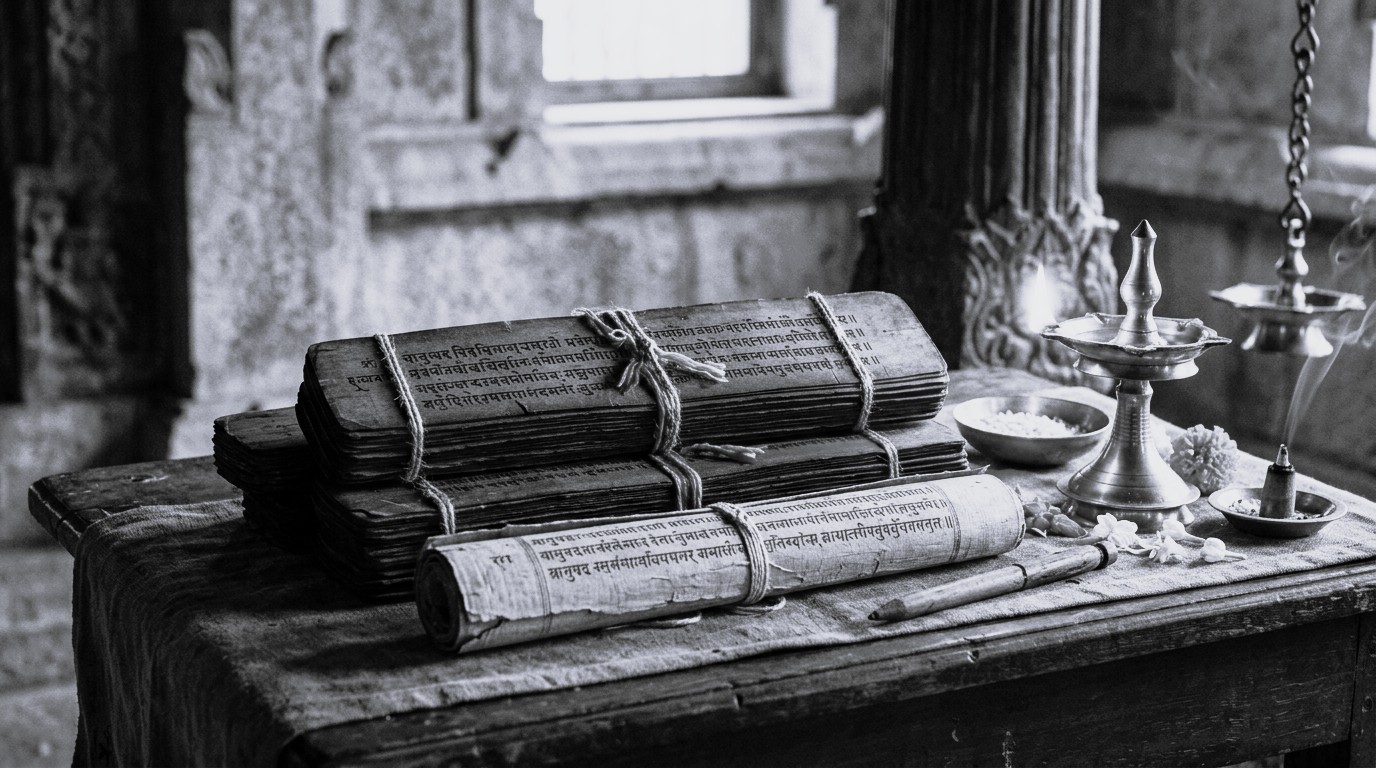
An eminent Indian refuses to accept Sri Aurobindo’s interpretation of the Veda and the doctrine of the mystics chiefly on the ground that it is opposed to the verdict of European scholars as well as to the Indian tradition as propagated by the Mimamsakas. To have a picture of the possible objections before us is, doubtless, an advant-age, for that will help us to follow intelligently and with caution and discerning appreciation the lines of thought chalked out in the writings of Sri Aurobindo on the Veda. We shall, there-fore, start with a succinct statement of the reasons largely in the critic’s own words and then proceed to examine the position, make clear to ourselves and show how far our view is in consonance with the religious and spiritual traditions of India, supported by textual evi-dence from the Rik Samhita down to the Puranas that are the scriptures of popular religions of our own times. The writer is an Indian of wide renown, a competent exponent of Indian thought and culture, and if we attach value to his objections, it is not because he is an authority in the field of Vedic learning -nor does he claim to be one, and it is not views of reputed authors-but because his views necessary for one to be a specialist to share the are representative of current conceptions about the Vedas among most Indians of modern edu-cation. Let us first state the opinions of authors on whom he relies for his ideas of the Rig Veda,
Twofold Objection
‘Competent scholars who have made these scriptures their life-study hold these views: they eak of the primeval childlike naive prayer of speak the Rig Veda and maintain that the Aryans of the Rig Veda possessed a Monotheism however primitive it might be. Roth and Dayananda Saraswati agree with this view. Ram Mohan Roy considers the Vedic gods to be the allegori-cal representations of the attributes of the supreme deity. According to others, Bloomfield among them, the hymns of Rig Veda are sacri-ficial compositions of a primitive race which attached a great importance to ceremonial rites. Bergaigne holds that they are all allegorical. Sayana, the famous Indian commentator adopts the naturalistic interpretations of the Gods of the hymns, which is supported by modern European scholarship. Sayana sometimes inter-prets the hymns in the spirit of the later Brah-manic religion. These varying opinions need not be looked upon as antagonistic to one an-other, for they only point to the heterogeneous nature of the Rig Vedic collection. Equipped with the opinions of these eminent men, our writer drives at a summary rejection of Sn Aurobindo’s view of the Rig Veda. The famous author quotes a passage from the Secret of the Veda in the Arya and recommends the dis-missal of the same with an air of hesitancy that adds to the poise of scholarly reserve, at the same time heightening the tone of a persuasive (Sri Aurobindo)……the Veda to hims appeal. “The great Indian scholar-mystic mystery-religion corresponding to the Orphic and Eleusinian creeds of ancient Greece…… when we find this view is opposed not only to the modern views of European scholars but also to the traditional interpretations of Sayana and the system of Purva Mimamsa, the authority on Vedic interpretation, we must hesitate to follow the lead of Mr. Aravinda Ghose however inge nious his point of view may be.”
Criticism Examined
The chief point in the objection raised against Sri Aurobindo’s views may be summed up in the words of the same scholar. ‘It is not likely that the whole progress of Indian thought has been a steady falling away from the highest spiritual truths of the Vedic hymns. It is more in accordance with what is known as the general nature of human development, and easier to concede that the later religions and philosophies rose out of the crude suggestions and elemen-tary moral ideas and spiritual aspirations of the of an original perfection. This is how the early mind, than that they were a degradation modern Indian mind at its best has assimilated the historic spirit of Europe, developed the rationalistic outlook of the nineteenth century and grown into a strong, almost stubborn, self-complacent attitude that precludes from its pur-view the admission of any fresh or neglected fact, new evidence or other view that is likely to unsettle its notions of man’s past history and the course of his psychological ychological and spiritual development. The error in the conception lies in the supposition that man began to develop an inner and spiritual life in a comparatively developed stage of culture and civilisation, at any rate, long after he left behind the fears and fancies of a relatively remote period of primi-tive life. But Sri Aurobindo has nowhere stated that there was an original perfection of which the later stages were a degradation. To say that the seers of the Rig Veda were mystics who had developed an inner life and self-culture of a high order is not the same thing as to assert that the men of Rig Vedic times times had had had obtained an all-comprehensive perfection, spiritual, moral and intellectual, which was followed by a long course of degradation across the cen-turies. When we come to state the bases of the Rig Veda these misconceptions will lose their grounds or their semblance to stand on; but it is necessary to point out here that the Vedic age is not at all presumed to be an age of Reason and intellectual development and what we call exact sciences as we know them, but it was undoubtedly one of Intuition, an age of the self-development and culture of the Spirit and mystics who had developed had their own technique of the Yogic art, and methodised their system of building the inner life. This does not mean that all men of the Vedic age were mystics and seers or that the latter shared with the populace their profound knowledge of the laws and processes of the workings of the Inner Nature, or of the truths and secrets of the Godhead they communed with. We can take up an illustration from our own times. Ours is an age of high intellectual advancement, an age of Science that daily and hourly continues unravelling the mysteries of Physical Nature and her revelations are pinnacles of wonder. But how many are intel-lectual in this age of intellectual supremacy? Very few, indeed. How many again among the small proportion of intellectuals are competent to follow the strides of Science and intelligently appreciate her progress? Again, how many are among them qualified and initiates for entry into the secret world of the laws and processes that release vast dimensions of energy lying hidden in the womb of the Atom? Few, few and less than few. But whatever the dominating prin-ciple of power be, whether it is spiritual wisdom and occult knowledge, or scientific culture, aesthetic sense and refinement and intellectual ardour, or sheer political skill and military strength, or production and distribution of necessaries or luxuries of life, of wealth answer-ing to the material and vital needs of human groups, always it works itself out through just a few human centres amidst masses of men who receive and benefit and prosper or resist and reject and perish or tolerate and bear with the consequences of the concentrated expressions of a few, by far numerically the inferior few.
The question of perfection in any age or stage of human development in any field does not arise at all. In India, the intellectual philo-sophies are not a degradation of an original perfection of the Vedic age, but a certain line of development practically cut off from the differ-ent lines of spiritual thought and occult know-ledge and life developed to a high degree by the mystics of the Vedic age-an age far remote and removed from the days of the Brahmanas and the Upanishads. Besides, it is a mistaken conception that spiritual experience, intuitive insight, occult knowledge, inspiration and simi-lar non-rational acquisitions of some of the so-called primitive races are either fancies and therefore not valid, or if valid they belong to a later period when man advanced in general knowledge of himself and his environment and lived in a better civilised state with the comparative comforts of life that economic improvement brings. But some of the ancient prehistoric peoples have had profound know-ledge of Nature in certain spheres which our learned critic himself admits in these words: “The most ancient fancies sometimes startle us by their strikingly modern character, for insight does not depend upon modernity.
It may be asked: If there had been a great spiritual progress made by the Vedic seers, how did it then come to a close without leaving its impress upon the ages that followed? Whether it left its influence or not and in what way if it did at all, forms part of the subject proper to which we shall turn in course. But the language and mentality of the Vedic age certainly under-went a great change; but it is almost a miracle that something of the Vedic tradition was pre-served, attempted to be preserved in the Brah-manas and Upanishads in spite of the gulf the Vedic Mystics came to an end. Nobody between the two periods. Somehow the age of could question why; its period was over in India as the age of Mysteries in ancient Greece and Egypt and elsewhere. But on that account we shall not deny that there was an age of the Rishis who had developed a sublime type of spiritual culture whatever the state of civilisation and eco-nomic development according to our standards they may have reached. Suppossing that our present civilisation practically perishes for the most part, as a consequence of some catas-trophe in Nature, or by a cataclysm brought about by Nature’s stupendous work in the mons-trous brain of man producing a reasonable number of atom-bombs, would it be right for future generations to deny altogether the actual fact of the scientific culture, the intellectual advancement and general progress of civilisa-tion of our times?
The crux of the whole question of human progress lies in a proper appreciation of the his-tory of human psychology itself from the very beginnings as far as is and can be known to us. The position, as envisaged by Sri Aurobindo, of the Vedic age and its spiritual culture can be summed up in a few lines. “In the age of Veda or in Egypt, the spiritual achievement or the occult knowledge was confined to a few, it was not spread in the whole mass of humanity. The mass of humanity evolves slowly, con-taining in itself all stages of evolution from the material and the vital man to the mental man. A small minority pushed beyond the barriers, opening the doors to occult and spiritual know-ledge and preparing the ascent of the evolution beyond mental man into spiritual and supra-mental being.” Now let us follow him in the brief survey he takes of the spiritual history of India; it will be clear that it is not at all a matter of degradation of an original perfection but, of a downward curve with a purpose. “Here India the reign of Intuition came first. Intel-lectual mind developing aferwards in the later philosophy and science…… The Vedic age was followed by a great outburst of intellect and philosophy which yet took spiritual truth as its basis and tried to reach it anew, not through a direct Intuition or occult process as did the Vedic seers, but by the power of the mind’s reflective, speculative, logical thought; at the same time processes of Yoga were developed which used the thinking mind as a means of arriving at spiritual realisation, spiritualising this mind itself at the same time. Then followed an era of the development of philosophies and Yoga processes which more and more used the emotional and aesthetic being as the means of spiritual realisation and spiritualised the emo-tional level in man through the heart and feeling.” Then he continues to show how this was followed by the Tantric and other processes that took up the will in the mind and life and sensations and used them as instruments and fields of spiritualisation. Even the Hatha Yoga later attempts at a divinisation of the body; here also is an endeavour to arrive at the same achievement with regard to living matter though this still “awaits the discovery of the true characteristic method of Spirit in the body.” This is the spiritual history of India from the Vedic age down to recent times always reaching the height, then followed by an attempt to take up “each lower degree of the already evloved consciousness and link it to the spiritual at the summit.” It will be thus seen quite reasonable to dismiss the first objection based on the wrong supposition that the Vedic hymns are sheer pri-mitive babblings and poetical fancies of the Aryan peoples just emerging from an original ignorance. We can explain the drawbacks of European Vedic scholarship of the last century if we remember that it started at a time when the materials available to it were scanty, and it tried to theorise upon the religion, history, civilisation, society, and many other things connected with the Aryans of the Vedic age with what little knowledge it then had of the history of other earlier races. Besides, in spite of the scrupulous care associated with all scholarly labours that Europe brought to bear upon its Vedic studies it could not escape the limitations of its temperamental mould which is in fact diametrically opposed to the Indian spirit. It surmounted the difficulties in understanding the texts by partly drawing upon conjectures and partly on certain inexact sciences, very often conjectural-comparative philology, ology, compara-tive mythology or comparative religion. Today times, along with them conditions, have changed; fresh facts stare us in the face; new evidences accumulate; modern sociologists revise the old-world opinions of past generations of scholars in regard to human origins, the history, polity, psychology, religion and life in general of at least some of the early races and peoples whom we call primitive. In addition to these, materials available for Vedic studies are much more today than a century ago. It will be thus seen that a thorough revision of opinions among scholars about the Vedic culture and Vedic worship is a desideratum. Indian students and seekers of knowledge of the Vedas especially in the last century followed the lines of European scholarship and swallowed as gospel truth European opinion because it had gained in prestige by its association in their minds with European science and culture which is a different matter altogether, estimable indeed, based on different, firmer grounds. But today there is no reason whatever to follow the same track which was an unconscious but necessary error in the beginning when the Indian mind had to find and see the light of modern critical methods of scholarship from Europe. Now there is no dearth of critical study or scientific outlook in India and there is plenty of it as evidenced in the fields of science, literature, philosophy and many branches ancient or modern learning. But, can the same be said about Indian Vedic scholarship? Here it is the same song of the nineteenth-century Europe that is being relayed and sung by Indian writers on the Vedas; though there may be a certain improvement, some alterations in details, some minor discoveries of facts, the fundamental position has remained fixed, well-fashioned and established, not shaken at all. The primitive peoples, nature-worshipping semi-civilised races, poets of childish fancies, simple-minded enough to be wonder-struck daily at the appearance of dawn, fear-ridden at the thought of night-these are still there at the bottom of all their labours in the field of what they call Vedic research. We can take the example of the Vedic Dawn to show the nonsense that is still indulged in seriously by these our Indian admirers of Vedic poetry. It has become a respectable convention with the writers on Veda to follow in the footsteps of their European teachers to extol the Vedic poets of the Dawn, and admiringly quote the same hymn or hymns. But when we hear eulogistic plaudits showered upon these primitive poets for singing the glory of the Dawn and look into the sense of the hymns addressed to Usha as given by them, of course with their own improvement made upon the meaning given by Sayana, we find ourselves face to face with queer people who composed these poems, and indeed we are at a loss to decide who are queer-whether those Rishis or these scholars. Look at the grotesque situation when we follow the scholars who make a convenient use of Sayana to the extent necessary for their theories and explanations. When the Rishi gives vent to his gratitude in a joyous cry ‘We have crossed over to the other shore of this darkness’ we are called upon to assume that he means literally ally darkness and that that no figure is meant and that he refers to the normal awakening, to the daily sunrise which he hymned with so much ardour. Again these people, the Rishis, sat down to the sacrifice at dawn and prayed for light when it had already come! The height of absurdity and irrationality is reached when these Rishis believed or more truly, when we are asked to believe that it was only ‘by their prayers that the Sun rose in the heavens and the Dawn emerged from the embrace of her sister Night’. But such a belief can certainly be ascribed to the Rishis only on the gratuitous assumption that they were savages overpowered by a ‘terror of darkness which they peopled with goblins, ignorant of the natural law of succession of day and night’. But even here, the difficulty is that that they seem to know it, for they speak of the undeviating rule of the action of the gods and of dawn following always the path of the eternal law of truths. So far, for irrational assumptions and uncritical acceptance by most Indian scholars of the imported theories of Vedic origins.
The moment critical acumen is applied the study of the Vedic hymns in the original with some respect for the most ancient of all traditions concerning the mantras, the Riks and and Rishis, at once the Vedic verses cease to be fanciful poetry, and the Vedic seers gradually uncover themselves as seers of Truth. And if we accept what Sri Aurobindo for the purposes of reasoning and intellectual appeal calls his hypothesis, but what in fact is just an intelligible statement of his knowledge born of clear perception of the truths about the Vedic seers, the Vedic hymns and the Vedic gods, the result is a twofold gain. For negatively, vely, most of the incongruities attributed to the Rishis vanish, many dilemmas in the understanding of the Riks in many places are got rid of; and positive-ly, we gain in our knowledge of the spiritual stature of the Seers, of the mystic Wisdom em-bedded in the hymns, of the true character of the Vedic gods, and many unintelligible por-tions of the Upanishads become clear as day-light; and last we find justification, satisfactory explanation for the claims of the Agamas (Tan-tras) of various schools and the later day Puranas and minor scriptures that the Vedas are the repo-sitory of spiritual wisdom and Divine know-ledge and that they themselves are attempts to represent something of that knowledge in their own way for people of a later age.

