
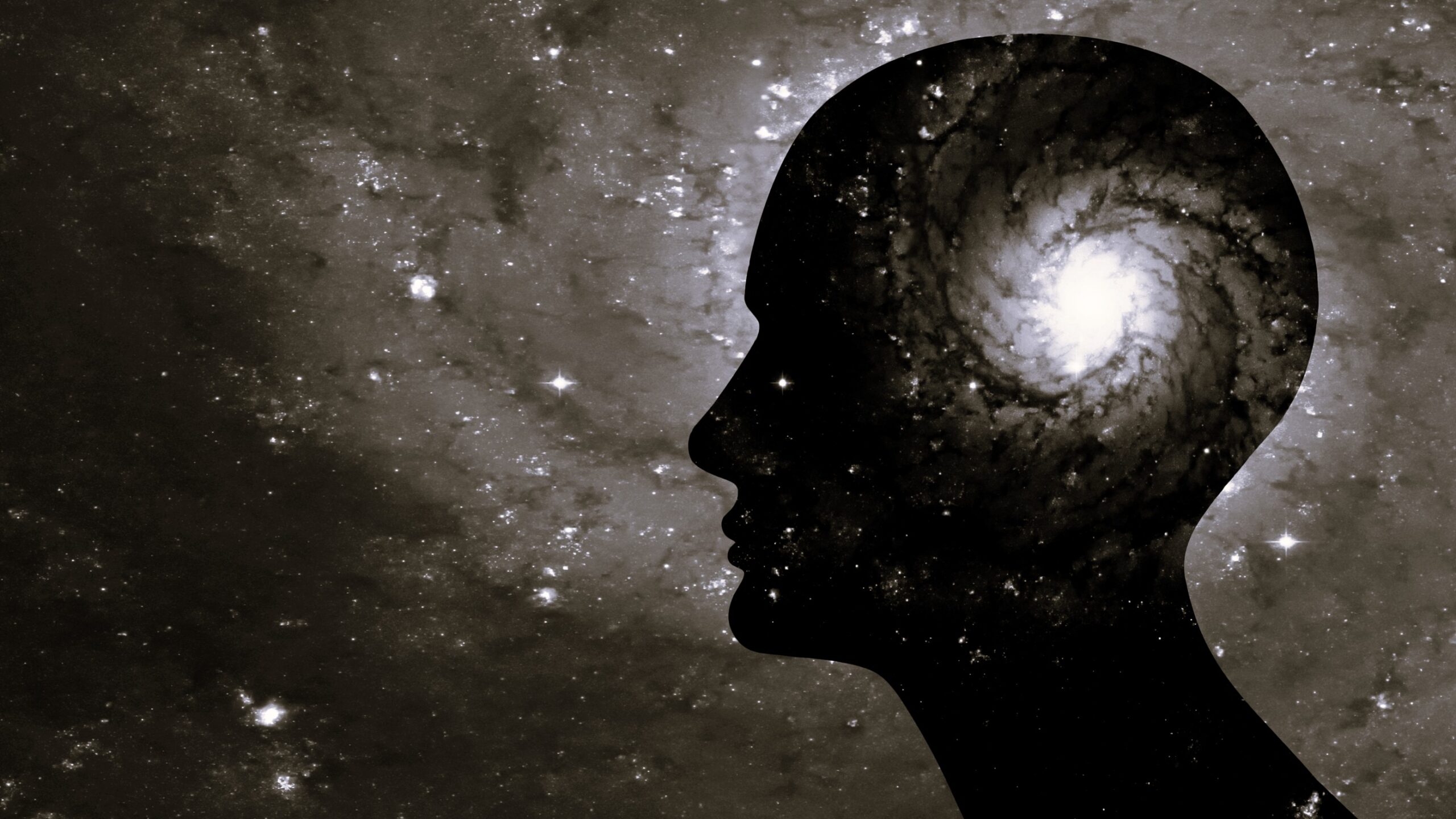
What enables human beings to think, speak, see, and hear? Are the mind and senses sufficient to explain consciousness, or does their functioning depend upon a deeper principle that cannot itself be grasped through ordinary perception? These questions lie at the heart of the Kena Upaniṣad, one of the significant philosophical texts associated with the Sāmaveda. Rather than beginning with a systematic definition of consciousness, the Kena Upaniṣad approaches it through a series of questions about the source of human awareness and the ultimate reality underlying experience.
The opening mantra establishes the direction of its inquiry: keneṣitaṃ patati preṣitaṃ manaḥ, asking by whom or through what agency the mind is directed towards its objects. The verse extends this question to prāṇa, speech, sight, and hearing. Its concern is not simply to identify the physical or psychological causes of perception, but to investigate the fundamental principle that makes perception and thought possible. In this respect, the Kena Upaniṣad offers a profound reflection on consciousness, its relationship with the mind, and the limits of intellectual knowledge.
The Conscious Principle Behind Experience
The response to the opening question appears in the second mantra, which describes the ultimate principle through a striking series of expressions: śrotrasya śrotraṃ manaso mano yad vāco ha vācam. It is the ear of the ear, the mind of the mind, and the speech of speech. It is also the life of life and the eye of the eye. These expressions do not merely suggest that an invisible power operates behind the senses. They invite the reader to reconsider the relationship between the instruments of experience and the principle that makes experience possible.
Ordinarily, consciousness is associated with the mind. We think of ourselves as conscious because we can remember, reason, imagine, and respond to our surroundings. The Kena Upaniṣad, however, directs attention towards a more fundamental question: what makes the mind itself capable of knowing? The mind may organise perceptions, form judgments, and construct ideas, but can it adequately explain the very awareness through which these activities become known?
The text’s answer points towards Brahman, the ultimate reality that cannot be reduced to any particular faculty or object. The mind and senses operate within the field of experience, whereas Brahman is presented as the principle upon which their functioning depends. It is therefore not another sensory object hidden behind the visible world. Nor is it simply a more powerful form of thought. The language of the Kena Upaniṣad directs the seeker beyond the familiar distinction between the knowing subject and the object known.
The Limits of Thought and Language
The Kena Upaniṣad develops its understanding of consciousness by emphasising the limitations of the faculties through which human beings ordinarily acquire knowledge. One of its most celebrated declarations states: yad vācānabhyuditaṃ yena vāgabhyudyate. This may be understood as referring to that which speech cannot express, but through which speech itself becomes possible. A similar formulation appears in its discussion of the mind: yan manasā na manute yenāhur mano matam, pointing towards that which the mind cannot comprehend in the ordinary manner, yet through which the mind is understood to function.
These formulations introduce an important philosophical distinction. To know something ordinarily means to apprehend it as an object of awareness. We see a tree, hear a sound, remember an event, or conceive an idea. In each instance, the object becomes available to consciousness through a particular faculty. But if consciousness itself is the condition that makes such knowledge possible, it cannot be approached in precisely the same way as an ordinary object.
The Upaniṣad does not conclude that reality is therefore meaningless or entirely unknowable. Instead, it challenges the assumption that every form of knowledge must resemble sensory perception or conceptual understanding. The failure of the mind to grasp Brahman as an object does not necessarily imply the impossibility of realising it. Rather, the seeker must recognise the limitations of the very instruments through which knowledge is ordinarily pursued.
This teaching also cautions against confusing descriptions of ultimate reality with reality itself. Words and concepts may direct understanding towards Brahman, but they cannot turn it into an object contained within language. The philosophical significance of the text lies partly in this movement from conceptual explanation towards a more fundamental inquiry into the nature of knowing.
Consciousness and the Question of the Self
Although the Kena Upaniṣad repeatedly speaks of Brahman, its inquiry also raises questions about the nature of the individual self. If the mind and senses do not constitute the ultimate source of awareness, what is the relationship between the conscious individual and the reality that enables consciousness?
The text does not present a complete psychological theory of the self in the modern sense. Instead, it encourages the seeker to examine the assumptions underlying ordinary experience. We frequently identify ourselves with our thoughts, emotions, memories, and bodily sensations. Yet these experiences change continually. Thoughts arise and disappear, perceptions vary, and emotions fluctuate. The Upaniṣad’s inquiry invites us to consider the principle in relation to which these changing experiences become manifest.
Its teaching should not be simplistically equated with the claim that an individual personality is identical with an impersonal universal consciousness in every respect. Such conclusions require careful interpretation, particularly when the text is read alongside later philosophical traditions. Nevertheless, the Kena Upaniṣad provides an important foundation for subsequent Vedāntic reflections on the relationship between ātman, the self, and Brahman, ultimate reality.
In the Advaita Vedānta tradition, Śaṅkara interprets the text as directing the seeker towards the self-luminous nature of consciousness, which cannot be adequately described through the properties of external objects. Other Vedānta traditions interpret the relationship between the individual self and Brahman differently. The diversity of these interpretations demonstrates how the Upaniṣadic inquiry became a foundation for sustained philosophical debate rather than a doctrine with only one uncontested formulation.
The Story of the Yakṣa: The Limits of Power and Knowledge
The philosophical argument of the Kena Upaniṣad is complemented by a memorable narrative. After the gods achieve victory, they become proud and attribute their success to their own greatness. Brahman appears before them in the mysterious form of a yakṣa, but they fail to recognise its identity. Agni and Vāyu approach the mysterious presence, confident in their respective powers. Agni claims that he can burn everything, while Vāyu claims that he can carry everything away. Yet neither can perform the simple task assigned to them by the yakṣa: Agni cannot burn a blade of grass, and Vāyu cannot move it.
When Indra approaches, the mysterious figure disappears. In its place appears Umā Haimavatī, who reveals that the victory belonged to Brahman, not to the gods themselves. Through this encounter, the narrative exposes the limitations of power when it becomes separated from an understanding of its ultimate basis.
The story extends the Upaniṣad’s philosophical inquiry into the realm of divine action. Even the gods, who embody extraordinary powers, cannot claim independent mastery over reality. Their capacities operate within a larger order that they do not initially understand. The narrative thus challenges the assumption that possessing power necessarily entails knowing its source.
Umā’s role is especially significant. Knowledge of Brahman emerges through her instruction to Indra, making the feminine figure the revealer of a truth that the powerful gods have failed to recognise. The narrative therefore connects philosophical knowledge with humility and the willingness to learn. Consciousness cannot be understood through self-assertion alone; genuine understanding begins when the limits of one’s presumed knowledge become apparent.
Knowing Brahman: An Experiential Transformation
Towards the conclusion, the Kena Upaniṣad describes the apprehension of Brahman through flashes of insight, comparing its manifestation to lightning and to the sudden appearance of an object before the mind. These images suggest that the realisation of ultimate reality cannot be reduced to the gradual accumulation of ordinary information. It involves a transformation in understanding through which the seeker recognises the limits of familiar modes of knowledge.
This does not mean that the text rejects reasoning or disciplined inquiry. Its own philosophical method depends upon questions, distinctions, and carefully constructed arguments. Rather, it suggests that intellectual understanding must recognise its proper limits. Knowledge of Brahman cannot be secured merely by treating ultimate reality as another object to be possessed by the knowing mind.
The distinction is crucial to the Upaniṣadic understanding of liberation. The wise person, the text suggests, becomes immortal through the realisation associated with this knowledge. Immortality here belongs to a spiritual and philosophical framework in which ordinary identification with the transient is questioned. It should not be confused with the indefinite continuation of the physical body.
The Kena Upaniṣad consequently presents the inquiry into consciousness as more than an abstract exercise. It concerns the transformation of the seeker’s understanding of self, knowledge, and reality. To recognise the source of awareness is also to question the assumption that the individual mind possesses complete independence or that sensory experience exhausts what can be known.
Conclusion
The idea of consciousness in the Kena Upaniṣad emerges through a fundamental question: what enables the mind to think and the senses to perceive? Its answer directs attention towards Brahman, the reality that cannot be reduced to an object of thought, yet through which thought and perception become possible.
The text does not offer a modern scientific explanation of consciousness, nor should its philosophical vocabulary be forced into contemporary categories without qualification. Its distinctive contribution lies in asking whether the instruments through which we know the world can, by themselves, explain the possibility of knowing. By questioning the apparent independence of the mind and senses, it opens a deeper inquiry into the relationship between awareness and ultimate reality.
For the Centre for Vedic and Consciousness Studies, the Kena Upaniṣad offers a valuable starting point for examining consciousness within the Indian philosophical tradition. Its central insight remains compelling: the search for the ground of awareness requires not merely the expansion of knowledge, but also a critical examination of the knower and the limits of knowing itself.

