
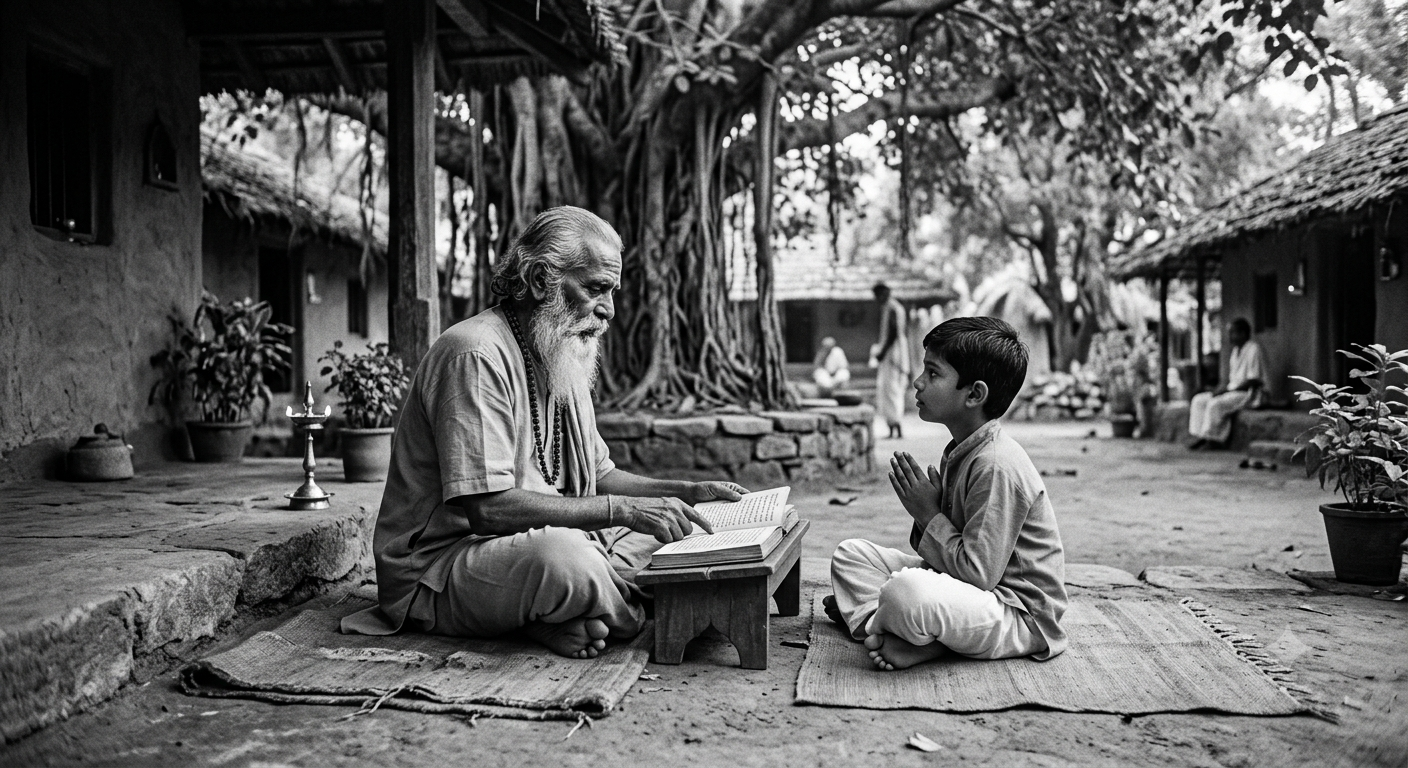
The continuity of the guru-śiṣya paramparā from the Vedic era to the present day represents one of the most enduring civilizational threads in Bhārata, a lineage of knowledge transmission that blends pedagogy, ethics, and a deep spiritual bond. In the Vedic period, learning was never merely the accumulation of information; it was a transformative process in which the guru guided the śiṣya toward inner refinement, intellectual clarity, and spiritual maturity. This intimate relationship was embedded in the gurukula system, where the student lived a life of simplicity, discipline, and service, allowing vidyā to be internalized rather than merely memorized. The scriptural texts preserve vivid episodes that highlight this ethos, among which the story of Āruṇi of the Pāñcāla region stands out. When his guru sage Āyodadhaumya asked him to prevent water from escaping a breached embankment, the young student, unable to fix the issue by many attempts, laid down in the gap with his own body until the flow was halted. When the guru later found him, soaked and shivering, but steadfast in duty, he blessed him with the words: “You are no longer Āruṇi of Pāñcāla. You are Uddālaka”, meaning the “one who has risen”. This tale symbolizes the śiṣya’s unwavering commitment to the pursuit of truth under the guidance of the guru, as well as the guru’s role in recognizing and awakening the latent brilliance within the disciple.
Even more expansive is the narrative of Dattātreya and his twenty-four gurus which goes on depict a philosophical exposition that widens the boundaries of the guru-śiṣya paramparā beyond the human realm. Dattātreya, revered as an avadhūta, perceived teachers in every facet of nature: the earth, wind, sky, water, fire, the moon, the sun, the pigeon, the python, the moth, the elephant, the ocean, and many more. Each became a source of insight into vairāgya, steadiness, self-restraint, and the subtleties of bondage and liberation. From the earth he learned patience; from the python contentment; from the ocean equanimity; from the sun and moon detachment. The story demonstrates that the essence of the guru is not confined to an individual person but resides in any experience that illumines the mind.
Throughout the Purāṇas, similar bonds between guru and śiṣya appear as civilizational exemplars. The steadfastness of Ekalavya, who fashioned a clay image of Droṇa and trained with unbroken dedication, exemplifies the śiṣya’s drive for excellence even without the guru’s physical presence. The relationship between Paraśurāma and Rāma, between Vasiṣṭha and the Ikṣvāku kings, between Droṇa and Arjuna present the paramparā not only as an educational institution but as a moral force shaping dharma in society. In the Mahābhārata, the dialogue between Bhīṣma and Yudhiṣṭhira stands as a profound example of guru-like counsel bestowed at a moment of historical crisis. These diverse portraits underline that the paramparā is not homogenous, rather it flows through ascetic, royal, martial, artistic, and household traditions, each adapting to its context while retaining the sanctity of the guru-śiṣya bond.
In the classical period, the paramparā continued to flourish through luminaries such as Ādi Śaṅkarācārya, whose relationship with Govinda Bhagavatpāda shaped the trajectory of ‘Advaita Vedānta’ philosophy; Rāmānuja and his śiṣyas, who built a lineage of learning rooted in bhakti and rigorous logic; and classical nāṭya and saṅgīta arts in which knowledge was transmitted orally with exactitude from one generation to another. The medieval period saw the blossoming of santa traditions, where figures like Kabīra and Ravidāsa emphasized the inner guru while still honouring the necessity of a living spiritual guide. The guru-śiṣya paramparā also infused the śilpaśāstra, āyurveda, jyotiḥśāstra, and various martial traditions, each preserving technical mastery through practice, proximity, and lived example rather than detached theoretical instruction.
In the modern era, though the gurukula as a residential institution has largely lessened in its traditional form (with few notes exceptions), the spirit of the paramparā persists robustly. Classical musicians still trace their gharānās through the direct teacher-student lineage; yoga traditions maintain śiṣyas who receive mantradīkṣā from their gurus; Vedic chanting is preserved through rigorous oral training; and even the so-called ‘secular’ education often unconsciously reflects this ethos in the respect accorded to teachers who shape intellectual and moral growth. Contemporary ācāryas and institutions such as the Kanchipuram Math, various Vedānta sampradāyas, yogic lineages, and modern gurukulas continue to embody the paramparā in innovative forms. The continuity of the guru-śiṣya paramparā from the Vedic age to today rests not merely on institutional structures but on the enduring human need for guidance rooted in wisdom, compassion, and experiential knowledge. It survives because it touches the deepest dimensions of learning: seeing in the guru not just a transmitter of information but a catalyst who awakens the śiṣya to the highest potential of consciousness!
