
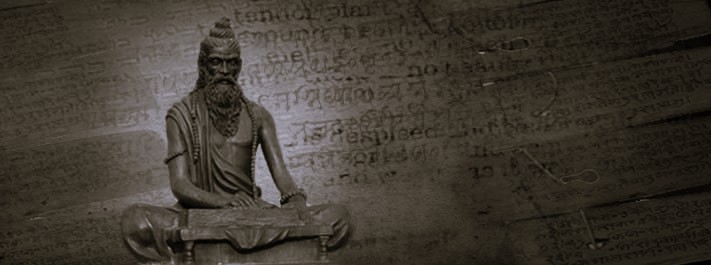
Patañjali’s Yoga Sūtra represents one of the most influential systematizations of Yoga in the Indian philosophical tradition. Composed in the form of concise aphorisms, it does not present itself as a Vedic text, nor does it reproduce Vedic ritual or cosmology in a straightforward manner. Its significance lies elsewhere: it takes a number of concerns that had developed through the Vedic and Upaniṣadic traditions—discipline, self-mastery, tapas, svādhyāya, brahmacarya, contemplation, prāṇa, the distinction between consciousness and mental activity, and liberation—and transforms them into a systematic philosophy of practice. Patañjali therefore represents not a break from the Vedic heritage but a significant furthering and interiorization of several of its central spiritual concerns.
The transformation begins with Patañjali’s famous definition: yogaś citta-vṛtti-nirodhaḥ—Yoga is the restraint of the fluctuations of citta. The statement marks a decisive movement inward. Earlier Vedic religion had placed considerable emphasis upon correctly performed ritual, mantra, sacrifice, and the maintenance of cosmic order. The Upaniṣads increasingly internalized these concerns, locating the decisive field of spiritual discovery within the human being. Patañjali carries this interiorization further: the mind itself becomes the principal field of yogic discipline. Liberation depends upon understanding and transforming the movements of consciousness rather than merely performing an external religious act.
This inward movement has an important antecedent in the Kaṭha Upaniṣad, where the famous chariot metaphor presents the senses as horses, the mind as their reins, the intellect as the charioteer, and the Self as the lord of the chariot. The implication is that spiritual progress requires mastery of the faculties. Patañjali develops this concern systematically through pratyāhāra, the withdrawal of the senses, and dhāraṇā, dhyāna, and samādhi, the increasingly refined stages of concentration. What appears in the Upaniṣad as a powerful philosophical metaphor becomes in Patañjali a carefully structured psychology of contemplative practice.
The older Vedic ideal of tapas also receives a significant development. Tapas originally carries the sense of heat and comes to signify austerity, disciplined effort, and spiritual intensity. In the Yoga Sūtra, tapas is incorporated into kriyā-yoga alongside svādhyāya and Īśvarapraṇidhāna. It also appears among the niyamas, the observances required for yogic discipline. The important transformation is that austerity is no longer simply endurance or ritual discipline; it becomes a deliberate method for purifying and transforming the practitioner. Patañjali thus gives an ancient ascetic ideal a precise place within a comprehensive path.
Similarly, svādhyāya moves from its Vedic association with disciplined study and recitation of sacred knowledge towards a broader contemplative function. In Patañjali, it forms part of the ethical and spiritual preparation of the practitioner and is associated with the study or recitation of sacred teachings and the cultivation of a relationship with the chosen form of divinity. The preservation of sacred knowledge is therefore complemented by its internalization. Knowledge is no longer simply something transmitted; it becomes something through which consciousness is transformed.
The concept of brahmacarya undergoes a related development. In the Vedic educational context, brahmacarya refers to the disciplined life of the student devoted to learning and sacred study. Patañjali places it among the five yamas, alongside ahiṃsā, satya, asteya, and aparigraha. The concept thereby becomes part of a universal ethical discipline for the yogin. This is significant because Patañjali does not regard meditation as an isolated technique. The transformation of consciousness requires transformation of conduct. Ethical discipline becomes the foundation upon which deeper concentration can be established.
The Vedic concern with prāṇa also receives a systematic extension through prāṇāyāma. Earlier Vedic and Upaniṣadic literature had already recognized breath as a fundamental life force and had explored its relationship with the senses and consciousness. Patañjali places the regulation of breath after āsana within the eightfold path. The significance of prāṇāyāma in the Yoga Sūtra should not be confused with the elaborate breath techniques developed in later Haṭha Yoga. Patañjali’s treatment is comparatively restrained, emphasizing the regulation of inhalation, exhalation, and retention and describing its effects upon the obscuring conditions of consciousness. The ancient concern with breath is thus incorporated into a disciplined psychology of meditation.
Perhaps the most profound furthering of Vedic ideas occurs in Patañjali’s conception of consciousness. The Upaniṣads had asked what the true Self is and distinguished the ātman from the changing objects of experience. Patañjali develops this concern within the dualistic metaphysics of Sāṃkhya-Yoga. Puruṣa is pure consciousness, while citta belongs to prakṛti and undergoes continual modification. The problem of human existence arises because consciousness becomes identified with these mental modifications. The famous image of the seer abiding in its own nature when the fluctuations of citta have been restrained is therefore an intensely interiorized version of the ancient search for the Self.
The Yoga Sūtra also further develops the ancient Indian concern with knowledge as liberation. Ordinary experience is conditioned by kleśas—avidyā, asmitā, rāga, dveṣa, and abhiniveśa. These afflictions generate patterns of attachment, aversion, misidentification, and fear that bind consciousness to the cycle of suffering. Yoga provides a practical method for weakening these structures through disciplined practice and discriminative knowledge. Liberation ultimately culminates in kaivalya, when puruṣa is completely disentangled from prakṛti.
Even the place given to Īśvara demonstrates Patañjali’s creative engagement with earlier Indian thought. The Yoga Sūtra describes Īśvara as a special puruṣa, untouched by kleśa, karma, and their consequences, and recommends Īśvarapraṇidhāna as a means of attaining samādhi. The concept does not simply reproduce the creator-God model found in some later theological traditions. Instead, Īśvara functions within a distinctive yogic framework as an unsurpassed principle of consciousness and an object of devotion and contemplation.
Patañjali’s eightfold path—yama, niyama, āsana, prāṇāyāma, pratyāhāra, dhāraṇā, dhyāna, and samādhi—therefore represents the culmination of a long process of systematization. Its significance lies not merely in the individual practices but in their sequence. Ethical discipline prepares the practitioner; bodily stability supports practice; breath regulation refines vitality; withdrawal turns attention inward; concentration stabilizes it; meditation deepens it; and samādhi culminates the process. The external and internal dimensions of spiritual life are brought into a single integrated discipline.
The Yoga Sūtra can consequently be understood as a major stage in the transformation of Vedic spirituality into a systematic philosophy of consciousness. Patañjali does not merely preserve Vedic ideas; he reorganizes and interiorizes them. Tapas becomes psychological discipline, svādhyāya becomes transformative self-study, brahmacarya becomes ethical restraint, prāṇa becomes an object of conscious regulation, and the ancient search for the Self becomes a precise analysis of puruṣa and citta. The Vedic aspiration towards transcendence is thus carried into a new philosophical vocabulary in which the decisive sacrifice is the surrender of mental distraction, the sacred field is consciousness itself, and liberation is achieved through the disciplined realization of the distinction between the seer and everything that is seen.

