
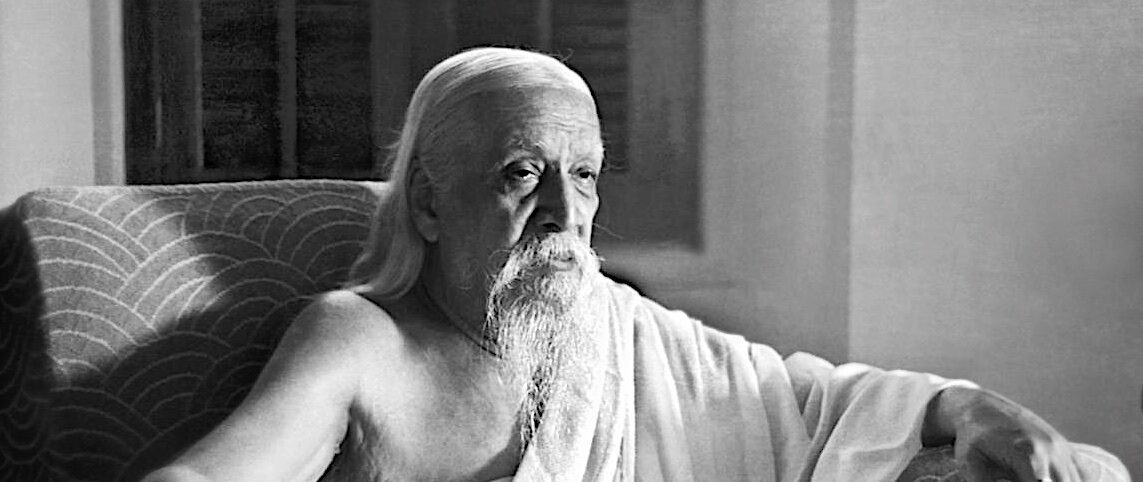
Consciousness is often understood as a faculty through which human beings perceive, think, remember, and interpret the world. Yet Indian philosophical traditions have explored a more expansive possibility: consciousness may not be merely an attribute of the individual mind, but a fundamental principle through which existence becomes manifest and capable of self-awareness. Sri Aurobindo develops this possibility into an evolutionary philosophy in which consciousness is not only the basis of existence but also the key to understanding humanity’s future.
His thought provides a distinctive approach to the Vedic idea of consciousness. Rather than treating the Vedas and Upaniṣads as collections of ancient doctrines to be accepted without examination, Sri Aurobindo reads them as expressions of profound spiritual experiences whose significance can unfold through interpretation and practice. His philosophy draws upon the Vedic vision, Upaniṣadic inquiry, and later yogic traditions while developing a distinctive account of the relationship between matter, life, mind, and spiritual consciousness.
In The Life Divine, Sri Aurobindo argues that the emergence of consciousness in the universe cannot be adequately understood if evolution is considered only as a sequence of physical and biological developments. He proposes that what appears unconscious at one stage may contain possibilities that become progressively manifest through evolution. Life emerges from matter, and mind develops through life, but the evolutionary process need not end with ordinary mental consciousness. A further transformation towards spiritual and supramental consciousness remains possible.
The Vedic Foundations of Consciousness
The Vedic literature contains several conceptions of consciousness and its relationship with existence, although these should not be collapsed into a single, fully systematised doctrine. The hymns of the Ṛgveda explore cosmic order, creation, divine powers, and the relationship between human awareness and the larger universe. The Upaniṣads develop a more explicit inquiry into the self and ultimate reality through concepts such as ātman and Brahman.
The Aitareya Upaniṣad, for instance, gives consciousness a central place in its account of creation and the human being. The Kena Upaniṣad asks what enables the mind to think and the senses to function, directing attention towards that which cannot itself be grasped as an ordinary object of knowledge. The Chāndogya Upaniṣad and Bṛhadāraṇyaka Upaniṣad explore the relationship between the individual self and the deeper ground of existence.
Sri Aurobindo interprets such passages as resources for understanding a reality in which consciousness is not confined to individual psychological activity. In his reading of the Veda, symbolic language, ritual imagery, and spiritual experience may disclose dimensions of meaning that are not exhausted by their surface interpretation. This does not mean that every Vedic reference to light, fire, or cosmic power must be understood as a technical description of consciousness. Rather, it means that the texts can be approached through multiple interpretive levels.
For Sri Aurobindo, the central insight is that existence and consciousness cannot ultimately be treated as unrelated principles. His philosophy seeks to explain how a reality understood as fundamentally conscious can appear in forms that seem unconscious, limited, and divided.
Involution and Evolution
One of Sri Aurobindo’s most distinctive contributions is his account of involution and evolution. Evolution ordinarily describes the emergence of increasingly complex forms of life and organisation. Sri Aurobindo extends this idea by proposing that the evolutionary process involves the gradual manifestation of possibilities already concealed within existence.
In his philosophical framework, consciousness is involved in matter before becoming progressively manifest through life and mind. Matter therefore represents not simply an independent reality from which consciousness inexplicably appears, but a condition in which consciousness remains concealed or unexpressed. The emergence of life and mind becomes intelligible within this broader metaphysical interpretation.
This is a philosophical and spiritual account of evolution, not an established replacement for biological evolutionary theory. Its purpose is to address a different question: even if the physical processes through which life develops can be investigated scientifically, what is the ultimate significance of the emergence of awareness, intelligence, and self-reflection?
Sri Aurobindo’s answer is that evolution has an inward dimension. Humanity is not necessarily the final expression of consciousness, but a transitional stage in its unfolding. Just as life represents a development beyond the conditions of inanimate matter, and mind represents a development beyond elementary biological existence, consciousness may possess further possibilities beyond ordinary mental functioning.
This perspective changes the meaning of human development. The cultivation of intelligence, memory, and analytical ability remains important, but it does not exhaust the possibilities of consciousness. Human evolution may also involve a transformation in the way individuals experience themselves, understand reality, and participate in existence.
From Mental Consciousness to Supermind
The distinction between mind and Supermind is fundamental to Sri Aurobindo’s philosophy. Ordinary mental consciousness operates through distinctions, comparisons, partial observations, and successive acts of reasoning. It gathers information and constructs interpretations, but it often experiences reality through fragmentation. The mind can recognise unity conceptually while continuing to experience itself as separate from the world.
The Supermind, by contrast, is Sri Aurobindo’s term for a higher principle of consciousness that unites knowledge and being. It is not simply a more intelligent mind or an extraordinary capacity for intellectual reasoning. It represents a mode of knowledge in which unity and multiplicity are understood together without the divisions characteristic of ordinary mental awareness.
The concept has affinities with Upaniṣadic descriptions of Brahman as the ground of existence and with the aspiration towards knowledge that transcends ordinary subject-object distinctions. Nevertheless, Supermind belongs to Sri Aurobindo’s own philosophical system and should not be treated as a word that the Vedic texts themselves use in precisely his technical sense.
This distinction is essential for understanding his originality. Sri Aurobindo does not merely repeat the proposition that ultimate reality transcends the mind. He asks what might happen if a higher consciousness could become an active principle in human life, transforming thought, feeling, action, and the embodied person.
Integral Yoga and the Transformation of Life
Sri Aurobindo’s philosophy leads towards a practical discipline known as Integral Yoga. Unlike approaches that place exclusive emphasis upon withdrawal from worldly existence, Integral Yoga seeks the transformation of the whole human being. Its scope includes the mind, emotions, vital energies, bodily existence, and the individual’s relationship with the world.
Self-knowledge remains indispensable, but liberation is not understood solely as an inward escape from the conditions of earthly life. The aim includes making human existence more receptive to a spiritual consciousness that can transform ordinary patterns of thought and action. This aspiration distinguishes Sri Aurobindo’s approach from interpretations of liberation that primarily emphasise release from worldly identification.
The practical implications are considerable. If consciousness can develop beyond its habitual limitations, education must concern more than the accumulation of information. Ethical development must extend beyond external conformity, and human progress must be evaluated through the quality of awareness and the capacity to overcome ego-centred existence.
This vision also demands caution. Experiences of expanded awareness do not automatically establish the metaphysical claims associated with them, and spiritual development cannot simply be measured through the standards of conventional intellectual achievement. Sri Aurobindo’s framework is best understood as a philosophical and yogic proposal whose claims invite careful study, reflection, and disciplined practice.
Conclusion: Consciousness as an Unfinished Possibility
Sri Aurobindo offers a dynamic interpretation of the Vedic and Upaniṣadic vision of consciousness. He treats consciousness not merely as an instrument through which human beings encounter reality, but as a principle whose possibilities may unfold through the evolutionary process. His distinction between involution and evolution, his account of the Supermind, and his vision of Integral Yoga combine metaphysical inquiry with a practical aspiration towards human transformation.
For the Centre for Vedic and Consciousness Studies, his work opens an important line of investigation: what if the study of consciousness requires not only an explanation of how the mind functions, but also an examination of the possibilities through which awareness may be transformed?
The Vedic and Upaniṣadic traditions provide important foundations for this inquiry, while Sri Aurobindo develops them in a modern philosophical context. His distinctive contribution is to envision consciousness as an unfinished possibility within human existence. The future of humanity, in this view, depends not only upon what human beings can know about the world, but also upon what they may become through a deeper realisation of consciousness itself.

