
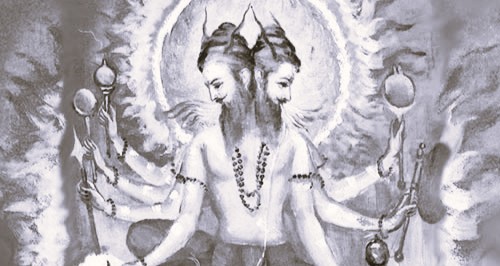
Among the four Vedas, the Ṛgveda is foremost in the variety and depth of its thought, and we find the original form of Vedic spiritual practice within it.
The collection of nearly ten and a half thousand mantras has been arranged in ten mandalas to form a Samhita. In the mandalas from the second to the seventh, the collection of mantras prevalent in the lineage of six rishis, including Gritsamada and Vishvamitra, is found. The mantra-seers of the eighth mandala belong to various lineages, but the Kanvas are the most prominent among them. The ninth mandala is not an ārṣa-saṃhitā (collection of rishi-preached mantras) but a daivata-saṃhitā (collection of mantras preached by various rishis for one deity) – the deity is ‘Pavamāna Soma’. The number of suktas in the first and tenth mandalas is the same (191); the size of both is almost equal, and like the eighth mandala, the mantra-seers are from various lineages. For all these reasons and based on comparative analysis of the language, modern scholars have concluded that the six lineage-mandalas are the most ancient part of the Ṛgveda.
It should be remembered that while this determination of the chronological order of the mantras may be a source of amusement for the historian, the utility of this conclusion in determining the significance of the mantras is very slight. I will discuss this matter in detail elsewhere.
Except for the eighth mandala, every ārṣa-mandala (mandalas attributed to specific rishis) begins with an Agni-sukta, and Indra is extensively praised in each. On the whole, the subject matter of the ārṣa-mandalas is similar, so any one mandala can be taken as a model for the others. Therefore, a general introduction to Vedic religion can be obtained from the interpretation of one mandala.
Nevertheless, the third mandala has a special significance for us. The mantra-seers of this mandala are Rishi Vishvamitra and his descendants. Vishvamitra’s Savitri ṛk, or the Gayatri mantra, is included in the last sukta of this mandala. The study of the Vedas has almost disappeared from this country, but even now this mantra is the daily prayer of every dvija (twice-born) in India. Gayatri is their chosen deity, and the initiation into Savitri is the first lesson of their spiritual practice. Not only that, following the ideal of this Vedic Gayatri, many tantric Gayatris for various deities have been composed and are still being composed in this country for the common people. In a word, the Brahmavādini (speaker of Brahman), the rhythmic mother Gayatri, is still the ‘queen’ of the spiritual empire of Āryāvarta (northern India) in the form of eternal speech, ‘saṃgamanī vasūnām – cikituṣī prathamā yajñiyānām’ (Ṛgveda 10.125.3); from the source of Vedic practice, she has maintained our connection with the past until today.
In the hymns of praise to Indra’s invincible victory-song, pervading the earth and the heavens, Rishi Vishvamitra, with a resounding voice, declared, “viśvāmitrasya rakṣati brahmidaṃ bhārataṃ janam”* I am Vishvamitra, the conscious power of my vast thought protects the people of Bharata (cf. 3.53.12; also cf. the Indra ṛk of the victor of the Vishvamitra lineage, 1.11.2). On that day, the object of this Brahma-declaration of the rishi was perhaps a handful of the Bharata lineage, – those whom he mentioned as ‘bharatajana’. But his definition has today denoted a great nation – a vast sea of people extending from Kanyakumari to the Himalayas. Puranic tradition remembers that the suzerainty of the grandson of this Vishvamitra led to the naming of a vast landmass as Bharatavarsha – what we know as our motherland. In later ages, there was debate whether Vishvamitra was a brahmin or a kshatriya. But in Vedic thought, there is no conflict between Brahma and Kshatra; these two are two divisions of the same conscious being. Whatever the reality of these traditions, viewed subtly, the expression of one idea is very clear in this case – Vishvamitra is the arbiter of India’s destiny even today; the Savitri mantra discovered by him is our chosen mantra even today, his Gayatri is our wisdom-measuring deliverer even today, his all-harmonious, wonderful non-dualistic thought is even today the unsurpassed guide of the seeker of perfect non-duality.
We currently live in the Vishvamitra era, whose invisible influence has brought the spiritual consciousness of India to a crossroads, at the gateway of a new dawn. That ancient Brahma-declaration of Vishvamitra is the utterance of a radiantly bright future divine vision, the responsibility to make which successful we have received as an inheritance.
For all these reasons, the interpretation of the third mandala or the Gayatri mandala of the Ṛgveda has been given precedence over the interpretation of other mandalas. As usual, the third mandala begins with an Agni-sukta. The first sukta is generally addressed to Agni, in which there is a description of the mystery of Agni’s birth as a living being in this base from the supreme void, or the account of the eternal virgin birth. The next two suktas describe Vaishvanara Agni, that is, how the flame of the conscious fire of this base spreads, becoming universal and transcending the universe. In these three suktas, a complete outline of spiritual practice has been given in a brief statement of the union of the individual soul and Brahman.Rishi Vishwamitra and his descendants are the Rishis of the third Mandala.

