
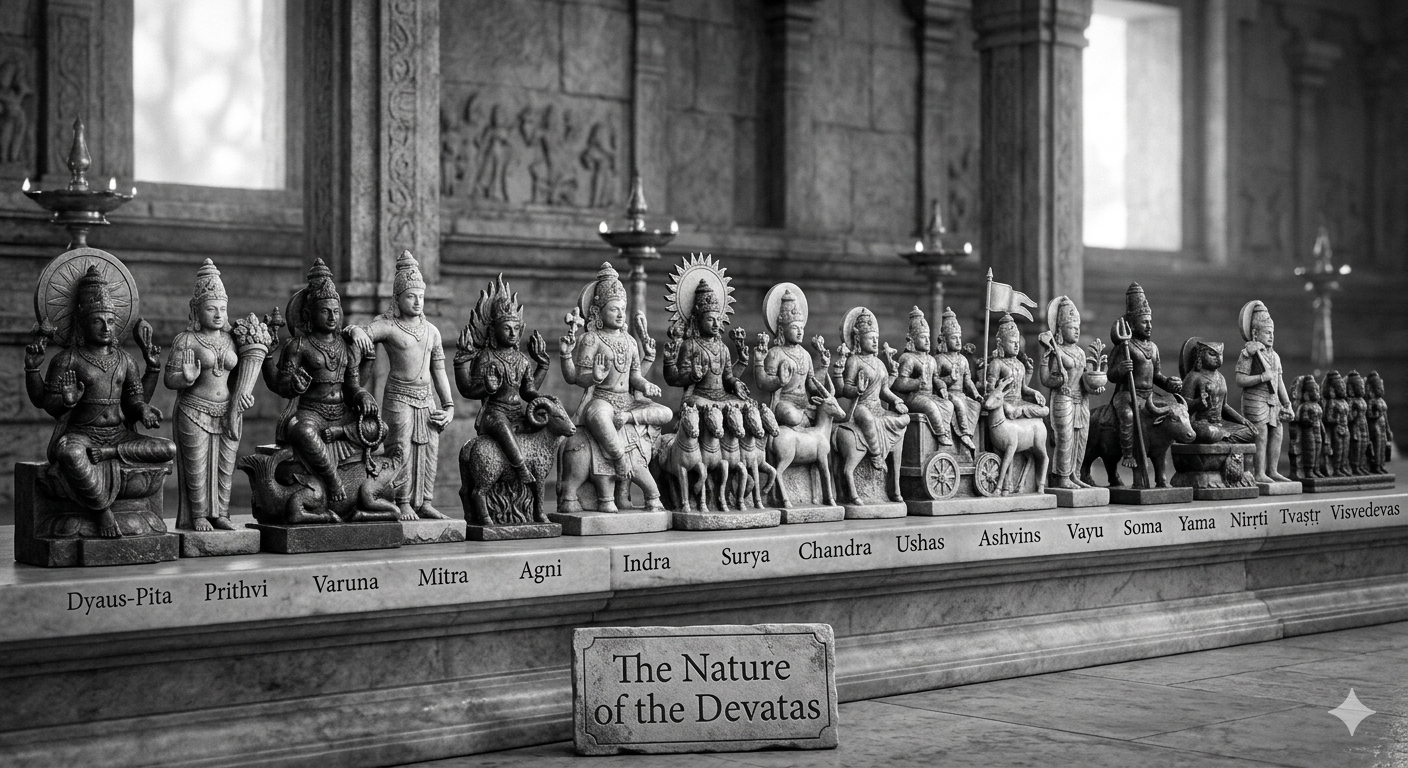
In Veda Mīmāṁsā, Śrī Anirvan unveils a profound metaphysical understanding of the Vaidika gods, interpreting them not as mythological figures but as cosmic powers of consciousness. Each deity (called devatā in Saṃskṛta) is a symbolic manifestation of the single super-reality expressing itself at multiple levels— adhidaivika (cosmic), adhibhautika (physical), and adhyātmika (psychological/spiritual). The Ṛgveda pantheon is therefore a “polycentric monism” where many divine powers radiate from the same infinite consciousness. Their distinctiveness is not ontological separation but functional specialization. In Anirvan’s view, the deities are principles— each a luminous node in the self-articulation of the supreme Brahma— whose interplay constitutes the evolution of the soul and cosmos. The Vaidika seers perceived these gods as inner presences, forces shaping the soul’s journey from ignorance to truth, from fragmentation to integral vision. To explore them is to decode the structure of consciousness itself, for each deity reveals one aspect of the human spirit reflected upon the cosmic screen.
At the base of this divine hierarchy stands Agni, the fundamental energy linking the mortal and the immortal. Agni is the divine initiative within matter, the spark urging evolution forward. In the physical world he is fire, digestion, warmth, and life; in the psyche he is enthusiasm, courage, tapas— everything that burns impurities and pushes the soul toward the higher. Agni is the will, ardour, and aspiration that represent the “flame of consciousness” which rises upward through all existence. Agni symbolizes the energy of transformation: he receives the offerings of life and carries them to the gods, just as aspiration elevates human experience into spiritual growth. He is the inner ‘yajamāna’ (the facilitated) as well as the ‘purohita’ (the facilitator), the symbol of the self-offering that fuels evolution of consciousness. Without Agni, there is no movement from the inert to the conscious, no bridge between earth and heaven.
Now, above Agni rises Indra, the lord of this luminous consciousness. Indra is the ‘mind in its divine clarity’, the power of illumination, intuition, and the ‘heroic’ insight. The readers might note in this context that in Bharata’s Nāṭyaśāstra, Indra is the presiding deity of the vīra rasa (the heroic sentiment). When Anirvan interprets Indra as the wielder of the vajra (thunderbolt), he sees in it the symbol of the penetrating power of truth that shatters the enclosures of ignorance, represented by the demon Vṛtra in the story (mythos/allegory). Indra’s battles are the struggles of consciousness breaking through the clouded and inert layers of existence to release the fountains of knowledge. Psychologically, Indra is the boldness of intellect, the courage of self-awareness, and the flash of insight that reorganizes the inner world. Indra is the champion of the ‘ṛta’, the cosmic truth, because he constantly restores the free flow of life and thought. He is the ever-expanding intellect which is dynamic, heroic, and luminous. If Agni lifts consciousness upward, Indra expands it outward, clearing the path for growth by overcoming limiting forces within and without.
From heroic action and illumination, the soul turns to serenity and bliss in Soma, the nectar of immortality. Anirvan interprets Soma as the principle of delight (ānanda), the rasa underlying our existence. Soma is not merely a plant or drink but he represents the inward ecstasy that arises when consciousness harmonizes with truth. In the cosmos, he is the moon— the cool, nourishing light; in nature he is the sap of growth and healing; in the psyche, he is joy, inspiration, and mystical absorption. Soma symbolizes the inner sweetness of spiritual realization, the communion of the soul with its own immortal essence. For Anirvan, Soma completes the triad of “Agni–Indra–Soma” who together stand for will, knowledge, and bliss—the three of the most fundamental movements of consciousness that underlie both cosmic process and the spiritual evolution.
When these three forces integrate, the figure of Prajāpati emerges. He is the divine urge for the ‘creative’ consciousness behind the universe. Prajāpati is the supreme being’s self-sacrifice, the eternal one dividing itself into the many. His mythic dismemberment is the metaphysical act by which unity becomes multiplicity. Prajāpati may be seen as the horizon where the absolute first turns toward its own manifestation. He is the primal architect of the cosmos, yet his creation is not like a command, but rather like a yajña where he is pouring out of himself, sacrificing himself while he creates. Take for example the pain of an instrument player, a guitarist. We might enjoy the melody of the strings, but never tend to notice the countless times the player had bloody fingers as he learnt the craft, mastered the tune. Prajāpati is like that artist-like divine agency who sacrifices himself, who aches himself, for the sake of creation. Psychologically, Prajāpati represents the creative centre of the personality, the inner lord who shapes the individual through the sacrifice of his own self to experience the cosmic unity. In Prajāpati, one sees the archetype of all creativity, where suffering, fragmentation, and self-transcendence form a single sacred movement.
From this, the creative self emerges as the Viśvakarmā, the cosmic architect. Whereas Prajāpati is the creative will-to-manifest, Viśvakarmā is the creative idea— the divine mind that gives structure to the being. Viśvakarmā is the principle of cosmic artistry, the intelligence that shapes chaos into cosmos. His forms are geometrical, harmonious, and precise. Every symmetry in nature, every organic pattern, every law of science is an expression of his divine vision. Psychologically, he is the ‘shaping intelligence’ that turns intuition into expression, the inner craftsman who builds meaning within the psyche. Viśvakarmā symbolizes order, measure, and design, showing that creation is not arbitrary but an expression of deep conscious structure.
Now, we must understand that any manifestation requires polarity (for light cannot exist without darkness and good cannot be identified devoid of the existence of the evil) and this cosmic duality appears as Dyāvā-Pṛthivī, the heaven and the earth. They are not spatial entities but principles of transcendence and immanence, spirit and matter, light and form. Dyauḥ, the sky, is the infinite reach of consciousness; Pṛthivī, the earth, is its stable ground. Their union symbolizes the cosmic marriage that produces life. Psychologically, they represent the higher mind and the physical consciousness, whose harmony is essential for spiritual integration. In other words, the fact that I am writing this and you are reading it is only possible because of this harmony of the Dyāvā–Pṛthivī. The spiritual must descend into life, and the material must ascend toward light. They embody the creative tension that sustains the universe, where the divine touches the earthly and the earthly receives the divine.
In the midst of these harmonies stands Rudra, the fierce purifier. Rudra is the power of transformation, the intensity that breaks through stagnation. His arrows are the piercing experiences that shatter ego and ignorance. Rudra burns, destroys, and heals; he is the ascetic energy of tapas operating in both the cosmos and the individual soul. One must understand that Rudra’s ferocity is actually his flooding compassion in disguise: he destroys not to punish but to liberate. Psychologically, Rudra is the inner spirit that compels growth through crisis, suffering, and catharsis. When Rudra’s strife is endured, it reveals its inner nature as Śiva, the peace beyond the pain. Rudra thus symbolizes the purifying pain of evolution, the storm that precedes spiritual clarity. An analogy of a mother delivering her child may be taken into this account. She suffers pain only to see the smile of the new-born babe.
It is always out of the fire and the storm that arises the serene flow of Sarasvatī, the goddess of wisdom just like the mineral gold is purified into the shiny, precious metal by the process of burning. Sarasvatī is the “stream of consciousness” that brings intuition into expression. She is the power behind the ‘vāk’, the utterance/word. In the cosmos, she is the vibration that manifests ideas into creation; in nature, she is the sacred river (now extinct/hidden?); in the psyche, she is intelligence, eloquence, inspiration, and the subtle music of thought. To Anirvan, Sarasvatī is the mediator between the spirit and the speech— the goddess who turns mystical experience into articulate knowledge. She symbolizes clarity, creativity, and the luminous flow of understanding. She is the reason why we have the Veda in the first place.
Now that we have discussed of too many deities, one might get confused and ask: where do these varied manifestations of the so-called cosmic oneness emanate from? To answer this, one must perceive that the holistic sense of the infinite wholeness comes through Aditi, the mother of the deities. The meaning of ‘Aditi’ in Saṃskṛta etmology is ‘the one who sees not in duality’ or ‘the absolute non-dual one’. Aditi is the unbounded, infinite space of consciousness out of which each and every deities arise. She is the symbol of integral unity, the completeness that holds all distinctions within itself. Cosmically, she is the vastness of the firmament; in nature she is the sustaining field of life; psychologically she is the inner openness in which thoughts and experiences are contained without bondage. Aditi’s essence is freedom: she liberates by dissolving fragmentation. She represents the boundless self, the infinite background of all being. This Aditi of the Vedas is none other than the Ādi-Śakti of the tantra, the eternal feminine out of which all is born.
The divine order birthed/established by Aditi finds its sovereign guardian in Varuṇa, the lord of the ṛta. Varuṇa embodies cosmic law, moral truth, and universal justice. He is the vast, all-seeing consciousness that keeps the cosmos aligned with truth. His “bonds” are not punitive but the moral forces that hold the universe together. Psychologically, Varuṇa is the voice of conscience, the inner pull toward truthfulness and transparency. When the psyche is clouded, he restrains us; when the psyche is purified, he frees us. Varuṇa symbolizes the moral dimension of existence, the truth that permeates both cosmos and consciousness. Complementing Varuṇa is Mitra, the deity of harmony and luminous friendship. The word itself means ‘friend’ or ‘companion’. Mitra is the gentle stabilizing force of the ṛta— the power of relationship, love, and concord. If Varuṇa is the stern sovereignty of the truth, Mitra is its sweet necessity or protection. Psychologically, Mitra represents empathy, goodwill, and the emotional intelligence that creates unity. Together, Mitra and Varuṇa maintain the moral-spiritual fabric of the world: one as law, the other as harmony. Mitra symbolizes the principle of cohesion, showing that truth is not only cosmic law but also human relationship.
In Anirvan’s reading, all these deities are symbolic articulations of one reality. Their interactions, connecting stories, and dedicated hymns describe the movements and rhythms of consciousness. The Vaidika pantheon is therefore a spiritual almanac: Agni ignites aspiration; Indra illumines; Soma delights; Prajāpati creates; Viśvakarman shapes; Dyāvā–Pṛthivī polarize; Rudra purifies; Sarasvatī inspires; Aditi liberates; Varuṇa upholds truth and Mitra harmonizes it. Each deity is a lens through which the seeker apprehends the absolute. Ultimately, Anirvan insists that the gods are inner presences. Their battles are psychological struggles; their marriage is the harmonization of energies; their birth are awakenings of new states of consciousness. To invoke them is to activate their principles within oneself. The Vaidika seers did not worship anthropomorphic figures but experienced cosmic powers in states of heightened awareness. Thus, the gods are not objects of belief but realities of experience. Through them, the human being discovers the layered richness of his own consciousness and its deep kinship with the universe.
In concluding this interpretation, we may say that Anirvan offers us a vision of the Vaidika deities as multidimensional symbols— cosmic, natural, and psychological all at once. They reveal the unity behind multiplicity and the multiplicity within unity. They show that the universe is not merely matter but consciousness expressing itself through fire, light, bliss, rhythm, law, transformation, and infinity. The deities teach that human life itself is a yajña, a sacred journey of aspiration, illumination, delight, integration, purification, harmony, and the return to boundless wholeness. To understand the deities is to understand the structure of consciousness; to invoke them is to participate in the cosmic evolution of undivided truth.
