
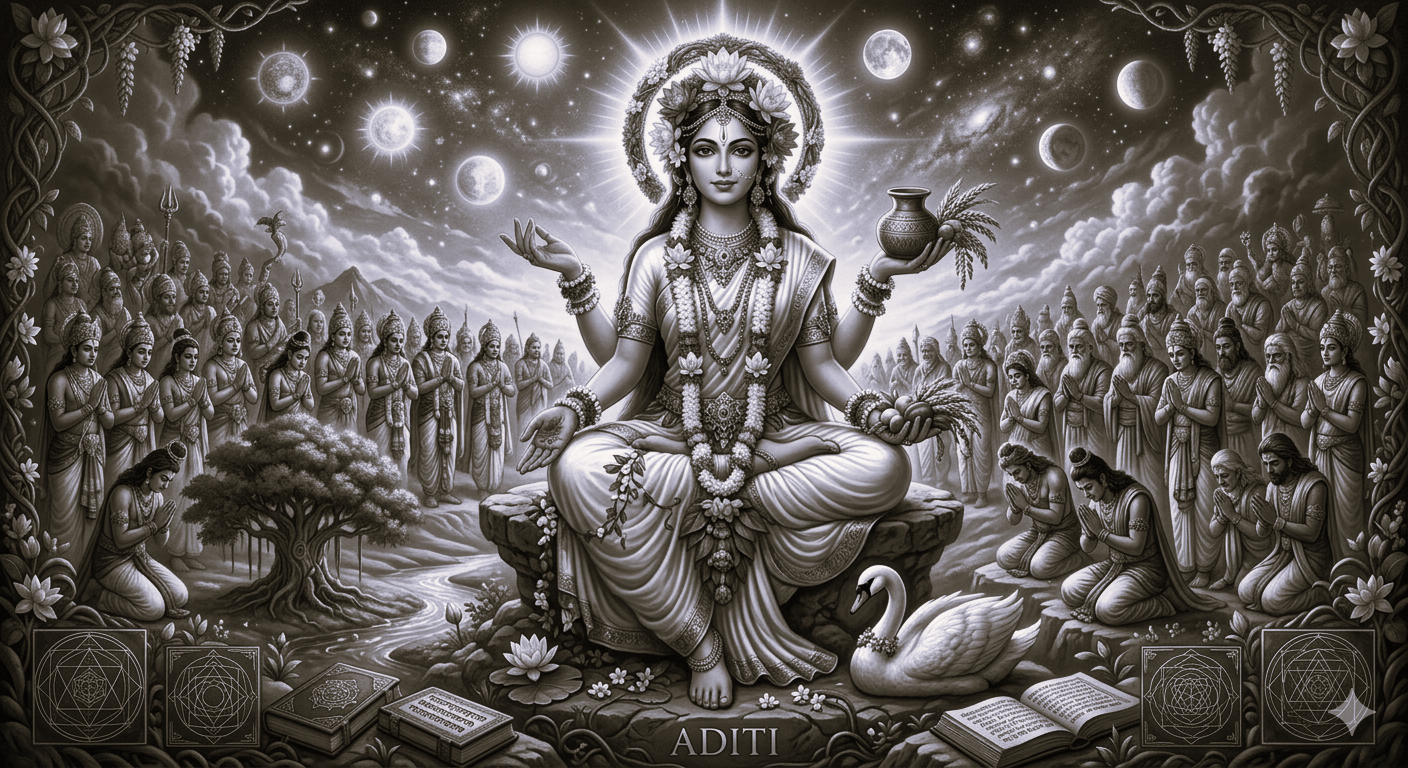
Aditi is the principle of infinite consciousness, the boundless mother who is both the origin and the container of all existence. The very name “Aditi” means “unbounded” or “non-divided” (a-diti). She is the cosmic wholeness from which all the gods are born and into which they return— the mahā-mātṛ, the universal matrix of being. If Prajāpati is the creative will and Viśvakarman the creative intelligence, then Aditi is their infinite background— the womb of pure existence in which creation happens without boundaries.
- Adhidaivika: Cosmically, Aditi is the supreme principle of totality, the boundless consciousness (Brahman in its maternal form) that gives birth to the Ādityas, the divine powers of the infinite. She is the undivided unity behind the play of multiplicity — “the sky that holds all worlds.” The Ṛgveda (1.89.10) invokes her as “Aditir dyauḥ, Aditir antarikṣam, Aditir mātā, pitā, putraḥ” — declaring her the totality of heaven, atmosphere, mother, father, and child. For Anirvan, this passage expresses the non-dual vision of the seers, who intuited the one consciousness behind all forms.
- Adhibhautika: On the natural plane, Aditi symbolizes the spatial vastness and nurturing expansiveness of the universe— the sky that encloses, the earth that sustains, the cycles of birth and rebirth that uphold life. Every rhythm of protection, every field of wholeness in nature, is an expression of her motherly aspect. Her presence is not of form but of space and embrace— the openness that allows things to be.
- Adhyātmika: Within the human being, Aditi represents the expansive consciousness of the self, the state of inner freedom where fragmentation ends. When the mind ceases to divide experience into “mine” and “not mine,” Aditi awakens as the vast awareness that includes all opposites. Anirvan identifies her with the mahā-ākāśa of the yogī’s vision, the infinite field in which thought, emotion, and sense are unified. In the silence of the heart when all barriers fall, the soul rediscovers its ‘adititva’ (boundlessness).
Symbolically, Aditi stands for wholeness, unity, and liberation. She is the Ādi-śakti in her purest, most inclusive form— not merely force that acts, but also the consciousness that contains all action. To realize Aditi is to know oneself as part of the infinite, to live from the awareness that nothing can truly be cut off from the whole. In her, Anirvan concludes, “existence becomes compassion, and the infinite smiles through every finite form”.
