
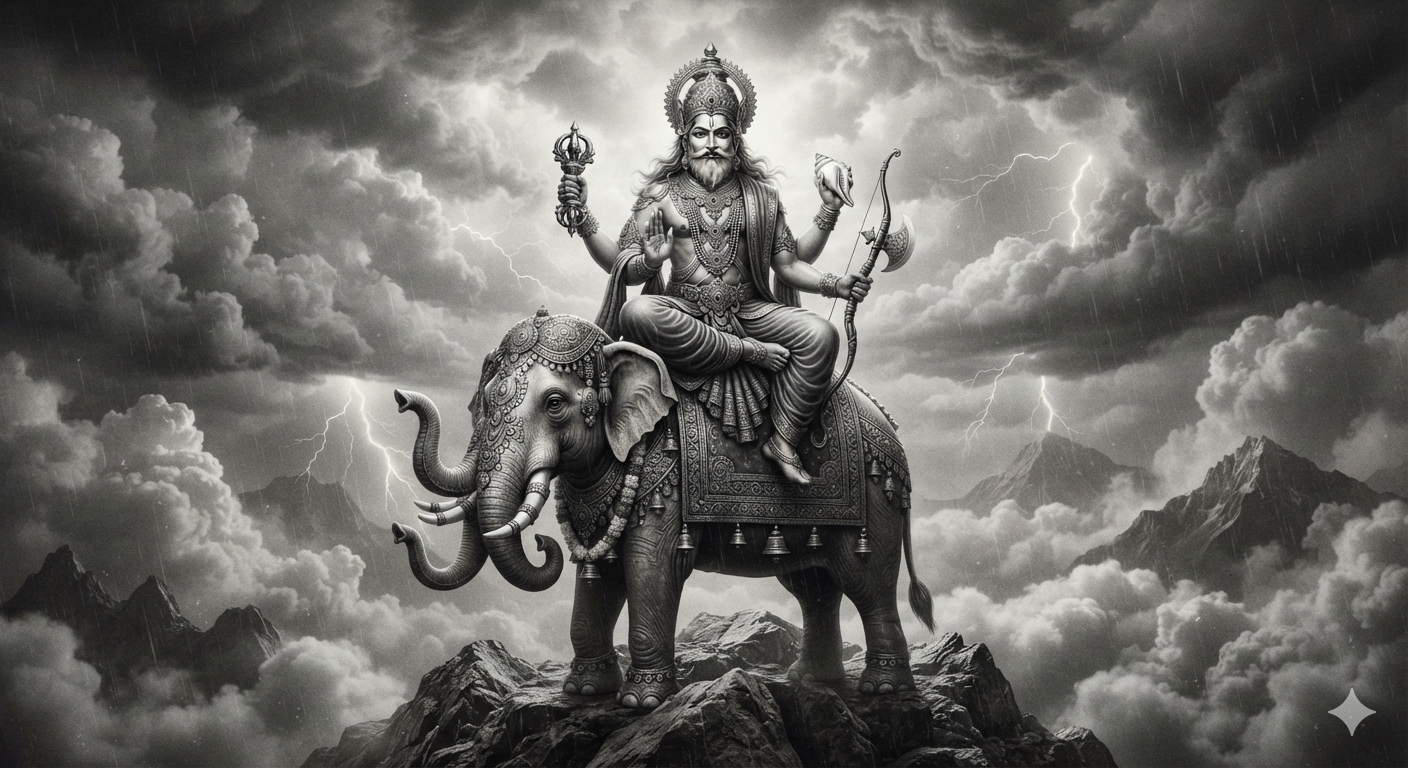
Śrī Anirvāṇ, in his monumental Veda-Mīmāṁsā, offers one of the most philosophically rich interpretations of the Vedic devatās, insisting that they are not mythological figures but symbolic expressions of psychocosmic principles. Among these devas, none occupies a more central place than Indra, the most invoked god of the Ṛgveda, the wielder of the vajra, the slayer of Vṛtra, and the hero who releases the waters. For Anirvāṇ, Indra is fundamentally the principle of dynamic consciousness, cit-tejas, the luminous force of awareness as it moves outward, breaks obstructions, organizes energies, and manifests ṛta, the cosmic order. The Vedic hymns celebrate Indra repeatedly— “indrasya nu vīryāṇi pravocam” (ṚV 2.12.1), “Let me proclaim the heroic powers of Indra”— but these powers are not, in Anirvāṇ’s interpretation, physical feats of a mythic warrior. They are movements of consciousness, movements within the seeker, expressions of the inner luminous will that strives toward clarity, freedom, and expansion.
Anirvāṇ begins his reading by establishing that all Vedic deities are expressions of consciousness. They are cit-prakāśa, lights or modalities of awareness. Indra, as the most invoked of them, represents the force of luminous action, the surge of conscious energy that breaks through inertia. His “strength” (bala), “force” (ojas), and “heroism” (vīrya)— terms that are repeatedly used in the Ṛgveda—are not physical attributes but psychological and spiritual ones. The Veda itself hints at this deeper meaning. In Ṛgveda (3.32.1), Indra is described as “vyañjan,” the one who reveals, who makes manifest. For Anirvāṇ, this is the defining feature of Indra: he is the principle through which the hidden becomes manifest, the latent becomes active, and the obstructed becomes free. The famous battle between Indra and Vṛtra, so central to the Ṛgveda, is therefore not an ancient meteorological myth but a symbol of the inner struggle of consciousness. Vṛtra, the “enveloper,” represents obstruction— tamas, contraction, stasis. He holds back the waters, the apāṃ, which the Veda describes as sources of life, joy, inspiration, and flow. When the Ṛgveda says, “saṃ cid vṛtraṃ jaghanvān apāṃ siṁham” (Ṛgveda 1.32.1)— “He struck down Vṛtra and released the waters”— Anirvāṇ interprets this as the moment when consciousness breaks through its own inertia, releasing the free flowing energies of life and inspiration within the seeker. Thus, the Vedic myth is simultaneously cosmic and psychological: it describes both the release of cosmic energies and the liberation of inner consciousness.
Indra’s vajra, forged by Tvaṣṭṛ, is central to this symbolism. For Anirvāṇ, the vajra is not a physical thunderbolt but the diamond-sharp power of discriminating insight, viveka-śakti. It is the brilliance of consciousness that can cut, pierce, and break through obstructions. The Ṛgveda refers to the vajra as śatamūti (Ṛgveda 1.80.12), “hundred-powered,” suggesting an infinite potential for penetration and revelation. Indra’s vajra “makes openings,” abhiṣṭi-karaṇa, an image that Anirvāṇ reads psychologically: the force of insight opens up closed spaces within the mind, allowing the waters of inspiration and life-energy to flow. The fashioning of the vajra by Tvaṣṭṛ, the cosmic artisan, is significant for Anirvāṇ. It indicates that the instrument of clarity is not arbitrary but crafted from the deepest creative layers of being, the subtle forces that weave, shape, and articulate reality. Thus the vajra, in its deepest symbolic sense, is prajñā in action, insight applied to life, clarity functioning as force.
An equally important dimension of Indra in Anirvāṇ’s interpretation is his intimate connection with Soma. No deity drinks Soma as copiously and as eagerly as Indra, and the hymns often portray him as dependent on it. “somaṃ manyate papivāṃ indraḥ” (Ṛgveda 8.77.3)— “Indra thinks he has drunk Soma”— is a repeated motif. Anirvāṇ emphasizes that Soma is not an intoxicant in the modern sense but the rasa of heightened consciousness, the delight, essence, and luminosity that expands the faculties of awareness. Soma energizes Indra not by providing brute force but by expanding consciousness, making it richer, more vibrant, more intense. Anirvāṇ interprets Soma as ānanda-rasa, prāṇa-rasa, and jñāna-rasa, the delight, energy, and essence of heightened awareness. Without this deepened consciousness, Indra’s action would be mechanical; with it, action becomes luminous and inspired. Indra’s dependence on Soma therefore symbolizes a profound psychological truth: dynamic clarity (Indra) requires the fuel of inspiration (Soma). Spiritual effort is not achieved by austerity alone; it must be sustained by delight.
Another important aspect of Indra in Anirvāṇ’s analysis is his relationship with the Maruts. The Maruts, the storm-gods, are described in the Veda as young, energetic, rhythmic, and organized. They accompany Indra in many of his exploits, and their collaboration is essential. Ṛgveda repeatedly says “indraḥ marudbhiḥ” (ṚV 1.64.1)— Indra with the Maruts. For Anirvāṇ, Indra represents the central dynamic consciousness, while the Maruts represent the structured energies of prāṇa and thought that support and implement that dynamism. They are the rhythmic, coordinated impulses that allow the force of consciousness to be expressed effectively. Thus, Maruts correspond to mental organization, the shaping of prāṇa, the harmonization of internal energies. Indra without the Maruts would be mere intensity; with them, he becomes intelligent, organized power. This psychological symbolism is reinforced by hymns such as Ṛgveda (5.52.6), which says of the Maruts, “manuṣvat”—they act with intelligence. Together, Indra and the Maruts represent the harmonious union of force and rhythm, the luminous will supported by ordered vital energies.
Anirvāṇ also connects Indra to the deeper metaphysics of the Self (puruṣa). If Varuṇa represents the vastness of being and Mitra the principle of harmony, Indra represents the executive action of the Self, the outward movement of inner consciousness into the world of kriyā. The Ṛgveda describes Indra as “puruṣṭutaḥ” (ṚV 1.7.1), praised by persons, and as “puruṣāṇāṃ saṃkratuḥ” (Ṛgveda 6.47.3), the one who unites the thoughts of persons. Anirvāṇ sees in these verses the idea that Indra is not an external deity but an inner power of the human puruṣa. When the Self becomes dynamic, when it seeks to manifest its luminosity in action, it assumes the form of Indra. Thus, Indra is the force of the Self projected into life, the power through which the inner being exerts itself in the domain of thought, breath, and action.
Indra’s role in the Vedic worldview extends beyond the psychological and spiritual; it shapes the ethos of Vedic culture itself. Anirvāṇ argues that Vedic civilization is fundamentally a culture of luminous action, where ṛta (cosmic order), satya (truth), and kriyā (action) are harmoniously integrated. Indra is the deva who enables this integration. He brings the dawn, releases the waters, destroys the obstructors, energizes yajña, supports truth, and manifests order. The Ṛgveda calls him “ṛtasya gopā” (ṚV 3.34.4), “guardian of ṛta,” and “ṛta-vr̥dh” (ṚV 5.29.1), “enhancer of ṛta.” These descriptors reinforce Anirvāṇ’s view that Indra is the deva who bridges inner illumination and outer action, making spiritual truth operative in life. Vedic spirituality, in Anirvāṇ’s reading, is therefore not world-denying. It is heroic, demanding engagement, discipline, and inner battle. Indra embodies this ethos: he is the god of tapas, of inspired struggle, of the soul’s effort to manifest the truth it has realized.
This brings us to the metaphysics of conflict that is central to Anirvāṇ’s interpretation. The Veda does not shy away from depicting conflict; indeed, it sees conflict as inherent in manifestation. The devas and asuras symbolize opposing tendencies— forces of openness versus forces of constriction, luminosity versus obscuration, flow versus blockage. Indra stands at the center of this conflict. The Ṛgveda says, “yo vṛtrāya pradadāv indra ojaḥ” (Ṛgveda 1.80.2), “Indra gave his force to strike down Vṛtra,” and “vṛtrasyāsya bhedaṃ vavakṣa” (Ṛgveda 1.32.10), “He desired the breaking of Vṛtra.” These verses describe not external violence but the metaphysical necessity of breaking limitation. For Anirvāṇ, the Vṛtra-myth is the eternal drama of consciousness: to grow, consciousness must break its own limitations, transcend its own inertia, and reclaim the flow of its energies. Indra’s battles therefore symbolize the soul’s struggle for freedom, the mind’s effort to rise from darkness into illumination.
In yogic experience, as Anirvāṇ repeatedly emphasizes, Indra is not merely a symbol but a lived reality. When consciousness rises in meditation, becomes luminous, and breaks through inner blockages, one experiences the ‘Indra-tattva’ (theory of Indra). When sudden clarity dawns, when prāṇa expands, when will becomes steady and luminous, Indra is at work within. In this sense, Indra represents various yogic experiences: prāṇa-vikāsa (expansion of prāṇa), manas-tejas (illumination of mind), buddhi-prabhā (radiance of discernment), and icchā-pravāha (flow of will). Indra is thus the inner warrior, the spiritual hero who fights the aspirant’s battles, breaks the inner Vṛtras, and releases the rivers of consciousness.
In sum, Anirvāṇ’s interpretation of Indra presents the Vedic deity not as a mythological thunder-god but as a profound philosophical symbol of dynamic conscious power. Indra represents the luminous force of the Self, the heroism of consciousness, the clarity that becomes force, and the force that becomes aligned with ṛta, the cosmic truth. He is the principle of breakthrough, the destroyer of obstruction, the energizer of inspiration, the organizer of vital and mental energies, and the embodiment of the Vedic ideal of enlightened action. In this light, the Ṛgveda becomes not a primitive collection of hymns but a psychological scripture, a record of the soul’s struggle to manifest its inner light. Indra is its central hero—not of external battlefields, but of the inner war of illumination. In this deeply spiritual, psychologically rich, and philosophically nuanced interpretation, Śrī Anirvāṇ restores Indra to his rightful place as the deva of awakened dynamism, the eternal warrior of the soul, the luminous will through which consciousness grows, evolves, and manifests the truth of being.
