
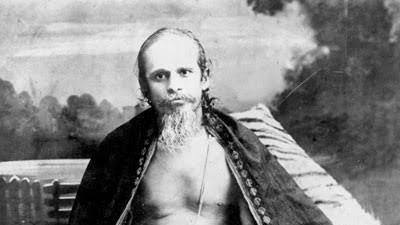
Śrī Gaṇapati Muni presents additional identifying markers demonstrating that the Mahābhārata narrative itself belongs to the Ṛgvedic horizon. In the Itihāsa, Kṛṣṇa and Arjuna are described as being of identical form (tulyarūpau), and Arjuna is therefore also known by the name Kṛṣṇ a. Expressions such as “kṛṣṇāv ekarathe sthitau” (“the two Kṛṣṇas standing on the same chariot”) are prominent in this regard. The Muni shows that this motif is already present in the Nigama, particularly in Ṛgveda 4.16.10, thereby reinforcing the Vedic foundation of this dual identity.
In the same section, Śrī Gaṇapati Muni identifies Satyābhāmā with Indrāṇī, citing two key Ṛgvedic sūktas. The first, Ṛgveda 10.145, is a hymn of herb-invocation in which the plant Uttānaparṇā (also called
Sahamānā) is invoked to secure exclusive possession of the husband and to overcome rival wives, paralleling the conflict between Satyā and
Rukmiṇī. Verses such as Ṛgveda 10.145.2 and 10.145.6 explicitly express this intent. The second sūkta, Ṛgveda 10.159, is Indrāṇī’s self-praise, wherein she declares her power, sovereignty, and triumph over co-wives, as seen in statements such as “ahaṁ ketur ahaṁ mūrdhā’ham ugrā vivācanī” (10.159.2) and “samajaiṣam imā ahaṁ sapatnīr abhibhūvarī” (10.159.6). These traits—particularly her fierce (ugrā) nature and rivalry with sapatnīs—align closely with the Bhāmā aspect of Satyā.
The Muni further identifies a direct Vedic precursor to the Purāṇic episode of Kṛṣṇa abducting Rukmiṇī in Ṛgveda 5.37.3, suggesting that the Vedic name Iṣirā served as the origin or synonym of the later Rukmiṇī figure in the Mahābhārata.
Similarly, the episode of Kāliyamardana is traced to multiple Ṛgvedic references. Citing Ṛgveda 1.51.6, the Muni reinterprets the term Arbuda—often glossed in Nirukta as “cloud”—as a serpent, based on its etymology (arbu dadāti, “that which bites”) and corroborated by
Atharvaveda 11.9.3, which explicitly identifies Arbudi as a Nāga deity. Indra’s battle with Arbuda, described in Ṛgvedic hymns such as 2.14.4 and 8.32.3, employs expressions like avabadhé (“he subdued”) and kṛṣé tat paumsyam (“he exercised his heroism”), reinforcing the motif of serpent-conquest. The grouping of Śuṣṇa, Śambara, and Arbuda as defeated adversaries further supports the continuity between the Vedic Indra narratives and the Itihāsa account of Kṛṣṇa subduing Kāliya.
Śrī Gaṇapati Muni also affirms that Ṛgveda 8.45.26 unmistakably anticipates the later Purāṇic episode of Kṛṣṇa’s victory over Bāṇa. The reference to sahasrabāhu is interpreted not as poetic exaggeration but as a Vedic signature foreshadowing the rescue of Aniruddha and the subjugation of Bāṇa’s power.
Determination of the Vedic Origins of the Sons of Pāṇḍu and Their Consort
In sections seventeen to twenty-two, the Muni traces the Vedic origins of the five sons of Pāṇḍu and their single wife Draupadī. Drawing upon Ṛgvedic mantras such as 1.100.16–19, 5.12.1, 10.99.9, 1.174.7, 7.56.23, 10.102.9, and 1.167.5–6, he identifies Śvitra as Pāṇḍu, Vṛṣṇi as Kuntī, Ambarīṣa as Yudhiṣṭhira, Bhayamṛṇa as Bhīma, Surādhas as Nakula, Sahadeva as Sahadeva, Upamanyu as Abhimanyu, and Ghoṣā, the daughter of Kakṣīvat, as Draupadī. These sections also address additional issues related to the Pāṇḍava lineage, further consolidating their placement within a Vedic continuum.
Determination of the Vedic Identity of Kuyava as Duryodhana, and the Origin of the Dice Narrative
The twenty-third section of Bhārata Caritra Mīmāṁsā is devoted to establishing that the Vedic figure Kuyava is identical with Duryodhana of the Mahābhārata. Citing Ṛgvedic mantras such as 1.104.5 and 1.102.4, Śrī Gaṇapati Muni corroborates the Mahābhārata’s historical explanation that the war arose from the denial of the Pāṇḍavas’ rightful share of the kingdom. In these hymns, Ṛ. ṣi Kutsa prays to Indra for the protection and victory of their encroached aṁśa and for deliverance from the repeated injuries inflicted by Kuyava, thereby providing a Vedic parallel to Duryodhana’s aggression.
In the same section, the Muni traces the Vedic origin of the Mahābhārata’s dice episode (dyūta-kathā) to Ṛgveda 10.43.5. The term śvaghnī, denoting a deceitful gambler, is identified as the etymological precursor of the later name Śakuni. The Muni proposes that śvaghnī evolved through Prākṛta into Śakuni, indicating that the Vedic passage already contains the seed of the epic’s gambling narrative.
Determination of the Vedic Identities of Droṇa, Aśvatthāmā, Bhīṣma, and Kṛpa
In the twenty-fourth section Muni cites several Rg Vedic mantras 6.20.8, 6.26.4, 10.49.4, 8.12.16, 10.16.3, 1.106.6 etc. and examines the Vedic origins of Droṇācārya, Aśvatthāmā, Bhīṣma, and Kṛpācārya. Here, the Muni identifies the Vedic Tugra with Droṇ.a, Smadibha with Aśvatthāmā, Vaibhūvasa with Bhīṣma, and Kṛpa with the Vedic Kṛpa.
Determination of the Number, Origin, and Lineage of the Kaurava Clan
In the twenty-fifth section, the Muni argues—on the basis of both Ṛgvedic mantras and Mahābhārata verses—that Duryodhana had twenty brothers rather than one hundred. In this context, he identifies the Vedic Pārśu with Gāndhārī.
The subsequent section elaborates on the term Pārśu and the origin of Gāndhārī, concluding that she did not belong to the Ārya lineage. The region of Gandhāra (modern Kandahar) is shown to have been non-Ārya even in antiquity. The argument rests on the identification of her brother as a śvaghnī, understood not merely as an individual gambler but as the designation of a tribe or caste of deceitful gamblers. Thus, śvaghnī denotes the ruler of the śvaghna tribe, and Duryodhana and his brothers, being sons of Pārśu, are identified as Pārśavas.
Determination of the Vedic Identities of Dhṛtarāṣṭra and Kavaṣa
The twenty-seventh section establishes that the Vedic figure Dṛk corresponds to Dhṛtarāṣṭra of the epic. In the following section, the Muni cites Ṛgveda 10.33.1–3 to show that Kavaṣa (Kavaṣeya) was aligned with the Pāṇḍava side, owing to his equal enmity toward the Kauravas. This
inference is strengthened by the fact that Kavaṣ.a reuses a mantra originally associated with Kutsa, a known enemy of the Kauravas, and completes it with his own half-verses. Since Kavaṣeya is described as having served as the royal priest (purohita) of Janamejaya, the Muni concludes that Kavaṣa functioned as the purohita of the Pāṇḍavas.
Determination of the Seed-Mantra of the Dice Narrative
In the twenty-ninth section, the Muni traces the origin of the Mahābhārata’s gambling episode to Ṛgveda 10.34.2, attributed to Kavaṣa Ailūṣa or Akṣa Maujavat. The ṛk describes the loss of a devoted wife through gambling. The Muni reasons that if the mantra belongs to Kavaṣa, then Kavaṣa cannot be Yudhiṣṭhira, since Kavaṣa later seeks wealth from King Kuruśravaṇa. He therefore interprets Akṣa as a title for one addicted to dice, referring to Yudhiṣṭhira, and Maujavat not as a person but as a mountain name, likely the Śataśṛṇga range associated with Soma extraction. Despite ambiguities, the Muni asserts that this mantra is unquestionably the bīja of the Mahābhārata narrative concerning the staking of one’s wife, and that Vyāsa identified Maujavat Akṣa with Yudhiṣṭhira.
Determination of the Identity of Sons and Daughter of Indra Revealed in the Veda
In this remarkable thirtieth chapter, Muni unveils the forgotten identities of Indra’s children as preserved in the Ṛ.gveda, identifying seven sons and one daughter of Indra (Krsna) & Indrāṇī (Satyā). Through mantra-linguistic analysis, cross-referencing genealogies, and discerning historical overlays in the epics and Purāṇ.as, the Muni reveals how many key figures of the Mahābhārata are in fact divine incarnations—descended directly from Indra and his consort.
- Vimadaḥ is identified with Sāmba, the youthful warrior who abducted the daughter of Duryodhana’s brother, invoking divine protection from the Aśvins during a battle.
- Vasukraḥ is a profound seer and kavi, deeply aligned with Kutsā and possessed of great visionary insight.
- Sarvahariḥ, an alternate seer of the Hari Sūkta, is counted among Indra’s sons.
- Apratirathaḥ, a powerful warrior, is interpreted by Muni to be none other than Sātyaki, not Kṛṣṇa’s cousin as later Purāṇas suggest, but actually his son, linked to Indra through birth and
- Jaya, known as Jayanta in Purāṇic lore, is confirmed to be the heroic son of Indra and Satyā.
- Lava, identified as a potent Soma-drinker and self-praising hero, is equated by the Muni with Pradyumna, suggesting a luminous divine descent.
- Virāṭ, the only daughter mentioned, is named in the Veda as the daughter of Satyā, echoing divine feminine presence in Indra’s lineage. Muni further exposes inconsistencies in Purāṇ.ic and epic genealogies—such as the error of listing Jaya as Sātyaki’s son, or falsely attributing Sātyaki to a cousin-relationship with Kṛṣṇa—showing instead that all these personalities are direct emanations from the Indra–Satyā avatāra, and their identities can only be reconciled by returning to the mantric revelations of the Ṛgveda.
Determination of the Unity of Karṇa, Narakāsura, and Bhagadatta
In chapters thirty-one to thirty-three, Śrī Gaṇapati Muni presents one of his most radical conclusions, identifying Karṇa, Narakāsura, and Bhagadatta as manifestations of a single personality fragmented by later epic and Purāṇic imagination. Through mantra-linguistic analysis and
Vedic avatāric theory, he argues that Naraka was not an independent
asura slain by Kṛṣṇa. Rather, Kṛṣṇa merely reclaimed symbolic insignia—such as the kuṇḍalas and chatra—from Naraka, who was in fact his own son Karṇa, born through Rādhā, identified in the Veda as Menā.
Menā, through tapas and divine grace, is said to have borne a son of the Sun, known as Bhagadatta—etymologically bhagena dattaḥ, “given by Bhaga.” Citing Ṛgvedic mantras such as 10.86.9 and 6.47.18, the Muni explains that Kṛṣṇa and Rādhā (Menā) represent two equal halves (ardhārdhatā) of Indra’s avatāric descent, and that Karṇa, as their son, fulfills Indra’s cosmic mission across multiple narrative forms—as Karṇa in the epic, Naraka in the Purāṇas, and Bhagadatta in later tradition.
According to the Muni, episodes such as Kṛṣṇa’s slaying of Naraka or the abduction of sixteen thousand maidens are not literal historical events but symbolic representations of inner conquests and māyā-siddhis, later misunderstood and re-cast as external narratives. For him, the distinction between myth and history is not merely chronological but epistemic, grounded in levels of consciousness. Through this inquiry, Karṇa is restored to his central place as the divine offspring of Kṛṣṇa and Rādhā, the heroic bearer of the Indra-avatāra, and the unifying link between Vedic, epic, and Purāṇic traditions.
Determination of the Origin of Balarāma (Ahirbudhnya) and Related Identities
In the final section of Bhārata Caritra Mīmāṁsā, Śrī Gaṇapati Muni examines the origin of Balarāma and his relationships within the epic framework. He identifies the Vedic Ahirbudhnya with Balarāma of the Mahābhārata and authoritatively addresses the identities of Śeṣ.anāga, Revatī, and Rohiṇī, along with Balarāma’s relationship with Karṇa. This section completes the Muni’s systematic demonstration of the Vedic continuum underlying the epic narrative.
The Grandeur and Authoritative Validity of Bhārata Caritra Mīmāṁsā
Bhārata Caritra Mīmāṁsā is the outcome of rigorous and authentic research into both the Vedas and the Mahābhārata. It represents a bold and methodologically challenging effort to re-establish the Vedic origins of the Mahābhārata and its characters. The diction of Śrī Gaṇapati Muni bears the mark of distinctive elegance and intellectual authority, and the work as a whole stand as a testament to his exceptional scholarly and spiritual capacities.
Several well-attested facts underscore the extraordinary intellectual siddhi that enabled this work. In 1904, the Muni mastered the entire Ṛgveda with correct svara in just one year under a Ṛgvedic scholar in Tiruvannamalai—over ten thousand mantras—and soon began elucidating subtle meanings even to his own teacher. At a time when books were scarce and costly, he relied primarily on libraries, as evidenced by his intensive reading at St. Mary’s Library in Tiruvottiyur in 1907. He possessed an extraordinary power of retention, enabling him to recall with precision everything he read, heard, or studied—an ability that proved indispensable in the composition of this treatise. During his tapasya at Gokarna around 1913, the Muni expressed his intention to train scholars in Veda-manthana, a method for extracting the inner meanings of Vedic mantras. Even seasoned Vedic pundits there acknowledged their inability to sustain this discipline for more than a brief duration. While at Gokarna, he consulted Vedic Saṁhitā manuscripts locally available, further deepening his engagement with primary sources.
Most strikingly, Bhārata Caritra Mīmāṁsā was composed between 1932 and 1934 while the Muni resided in Sirsi and the remote forest village of Kuluve—locations devoid of libraries or reference collections. Yet the
work cites with remarkable accuracy hundreds of mantras from the Ṛ.gveda, Atharvaveda, Yajurveda, Brāhmaṇ.as, Upaniṣads, along with verses from the Mahābhārata, Purāṇas, and Bhāgavata. Such scholarship ordinarily presupposes access to extensive libraries, but the Muni composed entirely from memory on loose sheets of paper. Even for accomplished Vedic reciters, correlating a single mantra-pada with an episode from Itihāsa or Purāṇa demands deep mastery of mantra-text, ṛṣi, devatā, maṇḍala, sūkta, and numerical indexing—yet the Muni achieved this repeatedly and systematically.
This work therefore stands as a compelling demonstration of the power of tapasya and, in the Muni’s life, of the living presence of Lord Gaṇapati expressed through human agency. His achievements resist full verbal description and must be apprehended through careful study of his works.

