
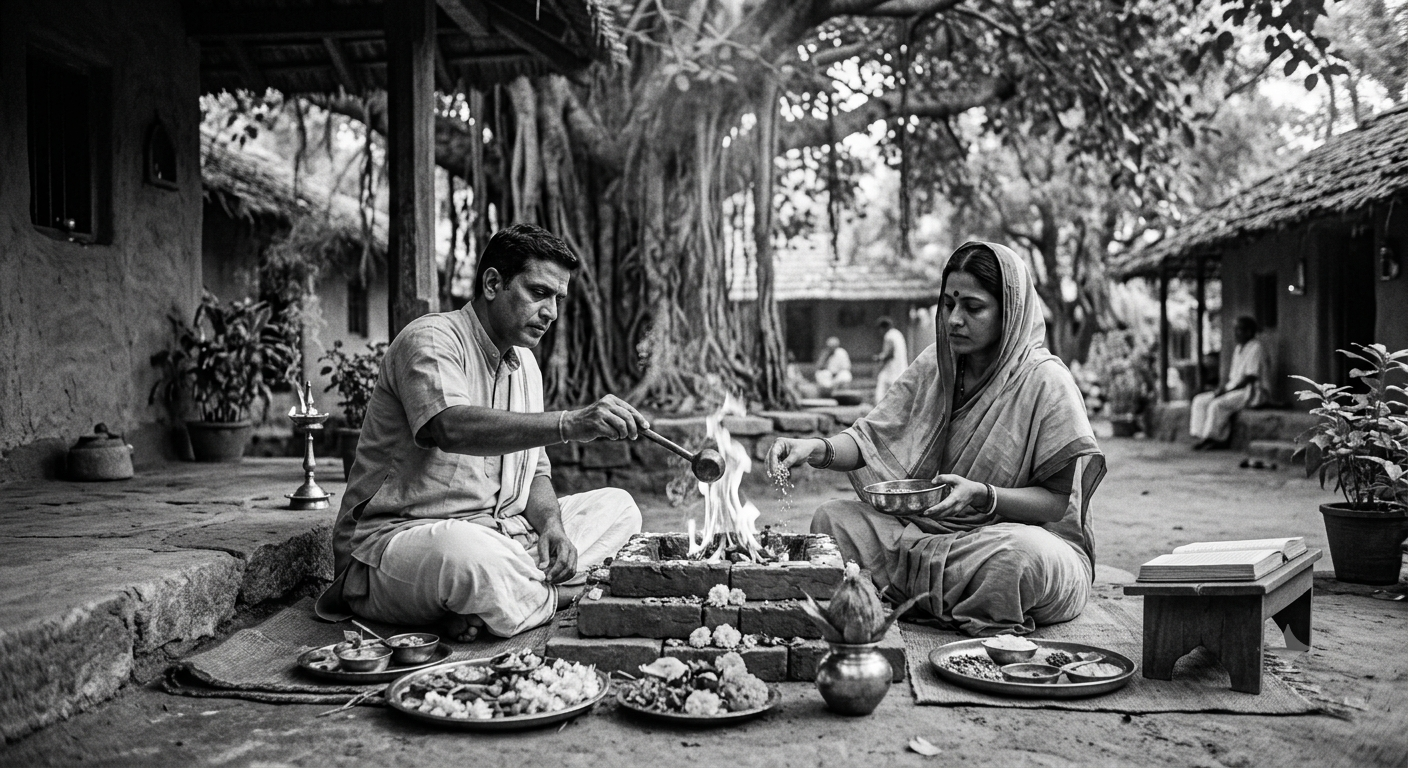
In the Vedic worldview, yajña is never a solitary act. It is a sacred cooperation between complementary forces: the divine and the human, the masculine and the feminine, the cosmic and the domestic. Just as the devatās are rarely envisioned without their śaktis, the human performer of the yajña, known as the yajamāna, is incomplete without his wife who is called the sahadharminī (the co-participant in holy deeds). The presence of the wife is not symbolic but essential, for the Vedic tradition sees creation, prosperity, and auspiciousness as arising from dual principles working together. Therefore, the Vedas insist that a yajamāna without his wife cannot complete a yajña, for she is the co-owner, co-recipient, and co-offerer of the sacred act.
This principle is reflected profoundly in the divine realm. Agni, the recipient deity of all yajñas, is paired with Svāhā, whose very name is uttered while making offerings into the fire. Without chanting “svāhā”, the oblation does not reach Agni, showing that the deity’s śakti is inseparable from the ritual’s effectiveness. Indra, the king of deities, is accompanied by Śacī and similarly Varuṇa is accompanied by Varuṇānī, Sūrya by Uṣā (or Sañjñā), Rudra by Umā; Bṛhaspati by Tārā; Viṣṇu by Lakṣmī; Brahmā by Sarasvatī. Even deities who appear solitary in mythology take on complementary forms in ritual contexts. This pairing signifies that divine action in the cosmos is always a union of puruṣa (consciousness) and prakṛti (matter).
In the human sphere, this cosmic truth translates directly into ritual practice. The wife shares half of the reward of the yajña, participates in specific rites, and ensures auspiciousness. Many mantras are addressed to both husband and wife together. During certain rituals, she sits to the right of the yajamāna, performs circumambulation, ties ritual threads, or makes offerings. Her presence ensures balance, continuity, and fertility. The yajña is not merely an offering but a symbolic regeneration of the world, something only a united couple can enact.
A crucial responsibility of the wife is the provision of the gārhapatya-agni (the domestic/kitchen fire of the household), one of the five kinds of fire required for a yajña. This is not an ordinary flame but the sacred fire kept perpetually in the home. For a yajña, this fire is carried to the ritual enclosure and used to ignite the āhavanīya-agni, the primary fire in which offerings are made. In this way, the wife literally brings the living flame of the household into the spiritual arena, connecting daily life with cosmic order. Without the gārhapatya-agni, the yajña cannot begin; without the wife, the husband has no authority or access to the gārhapatya-agni.
The Vedic seers recognized that the world is sustained by partnership, not isolation. Just as the deities depend on their śaktis, the yajamāna depends on his wife to complete the sacred cycle. The involvement of the wife affirms the Vedic insight that creation arises from cooperation and that spiritual fulfilment requires unity, harmony, and shared intention. Thus, in every yajña, the presence of the wife is not optional, rather it is the very embodiment of completeness, prosperity, and cosmic balance.
