
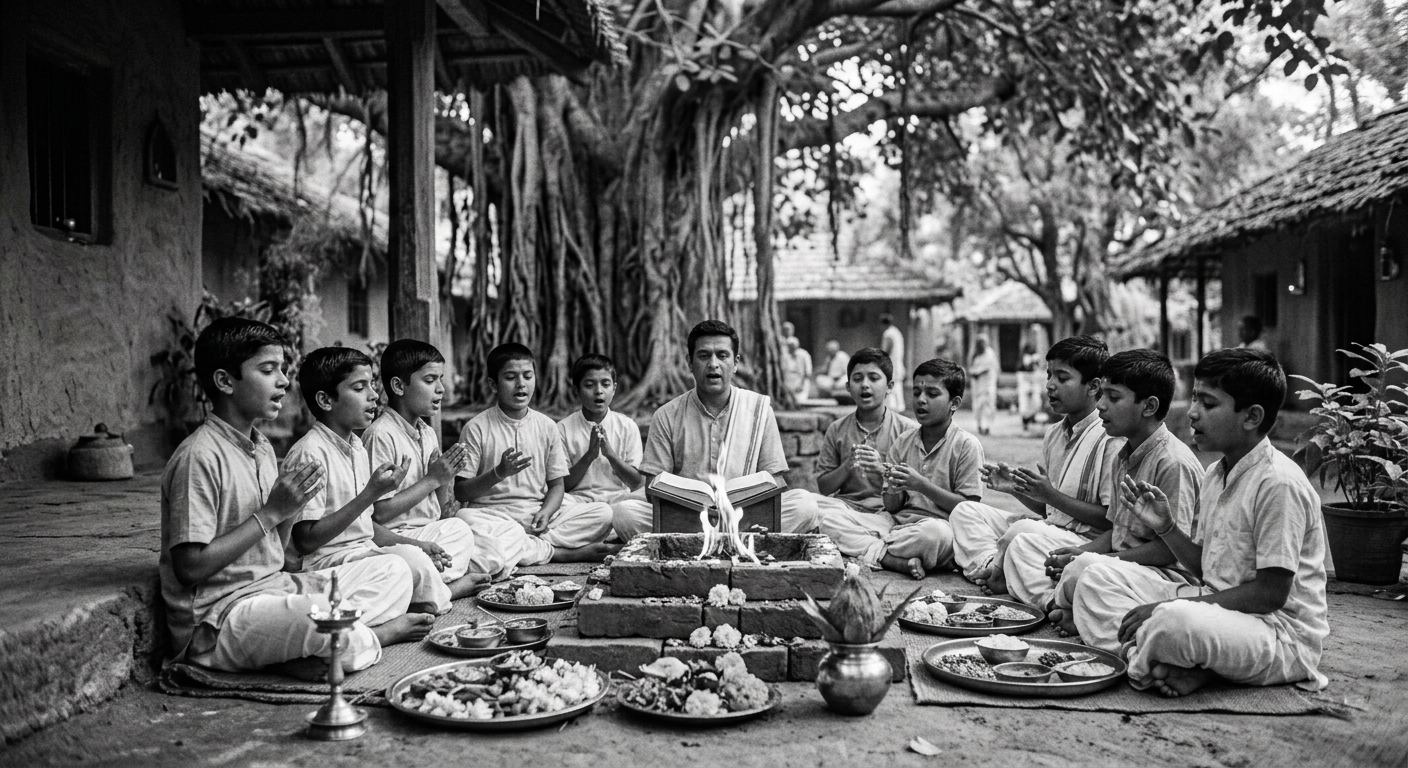
In a defining moment for the cultural heritage of India and for the world’s recognition of its ancient oral traditions, Vedic chanting was formally inscribed on UNESCO’s Representative List of the Intangible Cultural Heritage of Humanity in 2008, marking it as one of the most venerable living cultural expressions known to humankind. This declaration, rooted in UNESCO’s 2003 Convention for the Safeguarding of the Intangible Cultural Heritage, was the culmination of concerted efforts to highlight the extraordinary nature of Vedic chanting as a practice that predates most written records and survives even till this date through meticulous oral transmission since generations after generations. UNESCO’s recognition affirms that the śruti tradition of the Vedas is not merely an artefact of antiquity but a vibrant, breathing tradition that continues to shape communities, spiritual practice, and linguistic heritage in India and beyond.
The Vedas (viz. Ṛgveda, Sāmaveda, Yajurveda, and Atharvaveda) comprise one of the most foundational corpus of (early?) Sanskrit literature and Hind u philosophical thought, embodying hymns, rituals, metaphysics, and cosmological insights that are among the oldest extant expressions of human inquiry and spiritual aspiration. These texts were preserved for millennia through rigorous tonalities (viz. anudātta, udātta, and svarita), intricate phonetic methods, and recitation techniques designed to safeguard not only meanings but precise sounds. The discipline of gāna-pāṭha or jaṭā-pāṭha, where texts are woven into elaborate patterns of recitation forwards and backwards, are one such method that showcases an astonishing cognitive and mnemonic mastery.
UNESCO’s 2008 inscription did more than acknowledge a set of chants, it validated an entire civilizational commitment to śabda (sound) and śruti (what is heard) which in turn go on to shape the relationship between human cognition and sacred language. The declaration was first proclaimed in Paris on 7 November 2003, when the Director-General of UNESCO at the time, Koïchiro Matsuura, and an international jury described Vedic chanting as “an outstanding example of heritage and form of cultural expression”, emphasizing that in the face of globalization and cultural homogenization, such diversity is invaluable. A formal inscription followed in 2008 on the aforementioned Representative List, reflecting sustained international consensus about its significance.
To contextualize the weight of this recognition, one must understand th at intangible cultural heritage, as defined by UNESCO, encompasses living traditions, practices, knowledge, and skills that communities recognize as part of their cultural heritage. Unlike monuments or museum artefacts, intangible heritage lives in ritual, performance, and everyday practice. Vedic chanting, with its roots in the gurukula system, where a guru transmitted sound and meaning through disciplined practice to a śiṣya, represents one of the oldest unbroken oral traditions in the world.
For practitioners, educators, and traditional ācāryas, this UNESCO status has practical implications: it raises awareness of the threats facing Vedic chanting, including diminishing numbers of practitioners, competing priorities in modern education, and the challenges of maintaining exacting standards of pronunciation and intonation. It also opens avenues for support from governmental, cultural, and international bodies to document, teach, and transmit these traditions in their authentic forms. Governmental efforts such as those by the Indira Gandhi National Centre for the Arts (IGNCA), formerly headed by Kapila Vatsyayan who was a scholar of international repute, have been instrumental in preparing documentation, audio-visual records, and action plans to preserve this heritage. The portal of Vedic Heritage (https://vedicheritage.gov.in/) is an immense contribution by the Ministry of Culture, Govt. of India, to preserve and promote this intangible heritage.
Culturally, the UNESCO declaration reinforces a sense of pride in India’s philosophical and linguistic contributions to world heritage. It reaffirms the relevance of the Vedas not only as religious scriptures but as living cultural expressions that continue to inform Indian ritual, philosophy, music, linguistics, and even scientific thought. In a world increasingly dominated by written documentation and digital media, Vedic chanting stands as a testament to the power of oral transmission to maintain fidelity over millennia. Beyond its symbolic value, the listing encourages inclusive cultural diplomacy: it signals India’s role as a custodian of intangible heritage that continues to inspire, educate, and bridge cultures. Thus, UNESCO’s recognition of Vedic chanting as an intangible heritage of humanity is not merely a milestone in cultural policy, but a living affirmation of the enduring power of human voice, devotion, and memory across the ages.
