
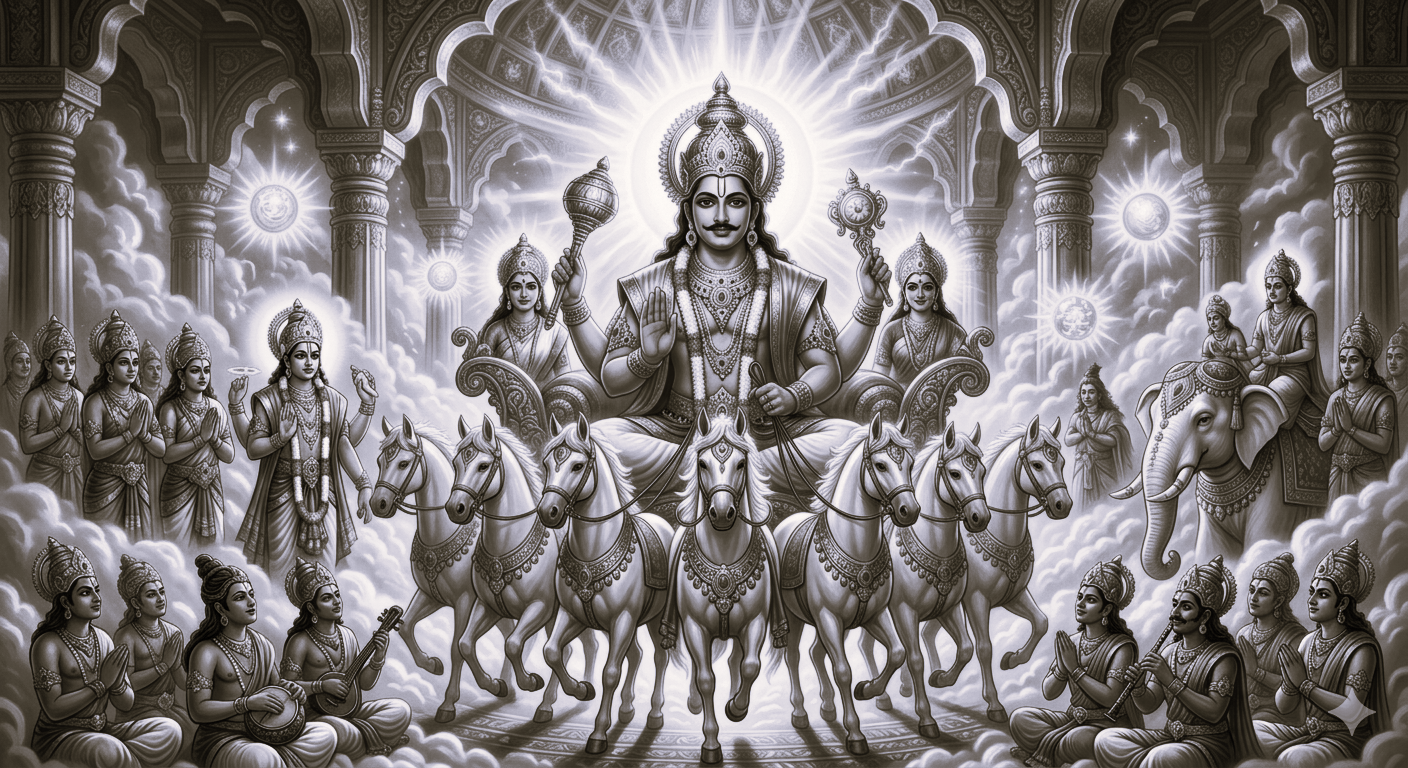
Sūrya and Savitṛ are two aspects of the same solar principle: the supreme consciousness as light and as life. Sūrya (the visible orb) represents the manifest radiance of awareness, while Savitṛ (the inspirer) symbolizes its creative impulsion from the transcendent. Together they express the rhythmic polarity of revelation: the movement of light from the unmanifest to the manifest. Anirvan says, “Savitṛ is the stir of the unborn; Sūrya is its form in manifestation”.
- Adhidaivika: On the cosmic plane, Savitṛ is the divine impulsion that sets all worlds into ordered motion— the ṛta in act. Sūrya is tapas, the conscious heat by which the universe sustains itself. The daily journey of the sun thus becomes the archetype of the cyclic revelation of consciousness, ever renewing the relation between ‘being and becoming’. The Gāyatrī mantra—“tat savitur vareṇyaṃ bhargo devasya dhīmahi”—is, for Anirvan, the quintessential Vaidika prayer for illumination: the invocation of bharga, the solar splendour that purifies and awakens the mind to its source.
- Adhibhautika: On the material plane, Sūrya is the source of all energy— the life-giver, time-maker, and sustainer of the biosphere. He represents the vital rhythm of creation, the balance of day and night, activity and rest, expansion and withdrawal.
- Adhyātmika: Within man, Sūrya is the light of consciousness (caitanya-prakāśa) that illumines the intellect; Savitṛ is the inner impulse that drives the seeker towards realization. When the Gāyatrī is recited inwardly, it becomes a process of aligning the individual buddhi with the cosmic prajñā. Thus, Savitṛ is the initiator of spiritual awakening, while Sūrya is its realized vision— the ātma-jyoti or light of the self.
Anirvan interprets the solar deities as symbols of self-revelation: consciousness manifesting itself as world, thought, and spirit. In man’s ascent, they represent the final illumination wherein the inner light (antarjyotiḥ) becomes identical with the universal Sūrya, “the eye of truth in all beings”.
