
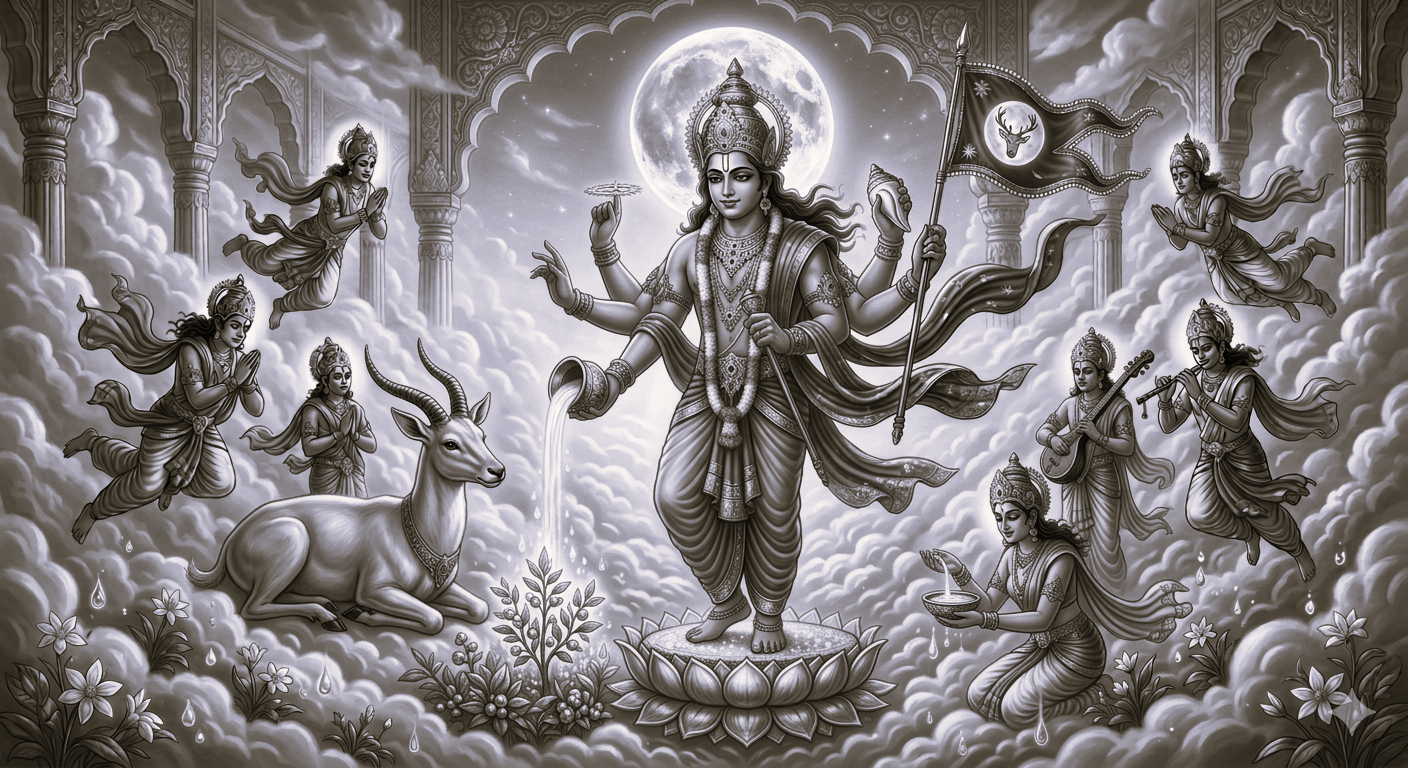
Soma is not merely the sacred plant or intoxicant of ritual; he is the principle of divine delight (ānanda-tattva), the nectar of consciousness distilled from existence itself. If Agni symbolizes the flame of aspiration and Indra the illumined mind, Soma is the ecstasy of realization that completes the triad. Anirvan writes: “Soma is the rasa of existence— where consciousness, having known itself, tastes its own immortality”.
- Adhidaivika: Cosmically, Soma represents the lunar essence that nourishes the gods— the cool, reflective counterpart to Sūrya’s radiance. The moon is his body, and his milk-like effulgence symbolizes the ambrosial sap of life circulating through the universe. Anirvan interprets the Vaidika imagery of the Soma-pressing as the perpetual process of creation: the compression of the infinite into form, releasing the bliss (ānanda) latent within being.
- Adhibhautika: On the material level, Soma is the essence of vegetation, vitality, and nourishment— the “sap” (rasa) of organic life. He embodies the principle of synthesis, integrating energies into harmonious rhythm. Every sweetness of existence, every power of regeneration in nature, is a reflection of the Soma principle.
- Adhyātmika: Within the individual, Soma manifests as mental poise, joy, and intuitive illumination. When Agni (will) and Indra (intellect) unite in the seeker, Soma arises as the bliss of inner realization— the sweetness of harmony between thought and being. Anirvan connects this with the higher ānanda of the Upaniṣads: “When the mind becomes transparent, it is filled with the taste of its own essence—this is Soma”. The ritual pressing of Soma thus becomes a metaphor for the compression of experience into consciousness, transforming life into a sacrament.
Symbolically, Soma is the sublimation of experience into bliss, the inward nectar that unites knowledge, love, and power. He is the divine wine of immortality, the elixir that nourishes the gods within man. In Anirvan’s metaphysics, Soma is the final consummation of yajña— the joy through which the finite recognizes its eternal source.
