
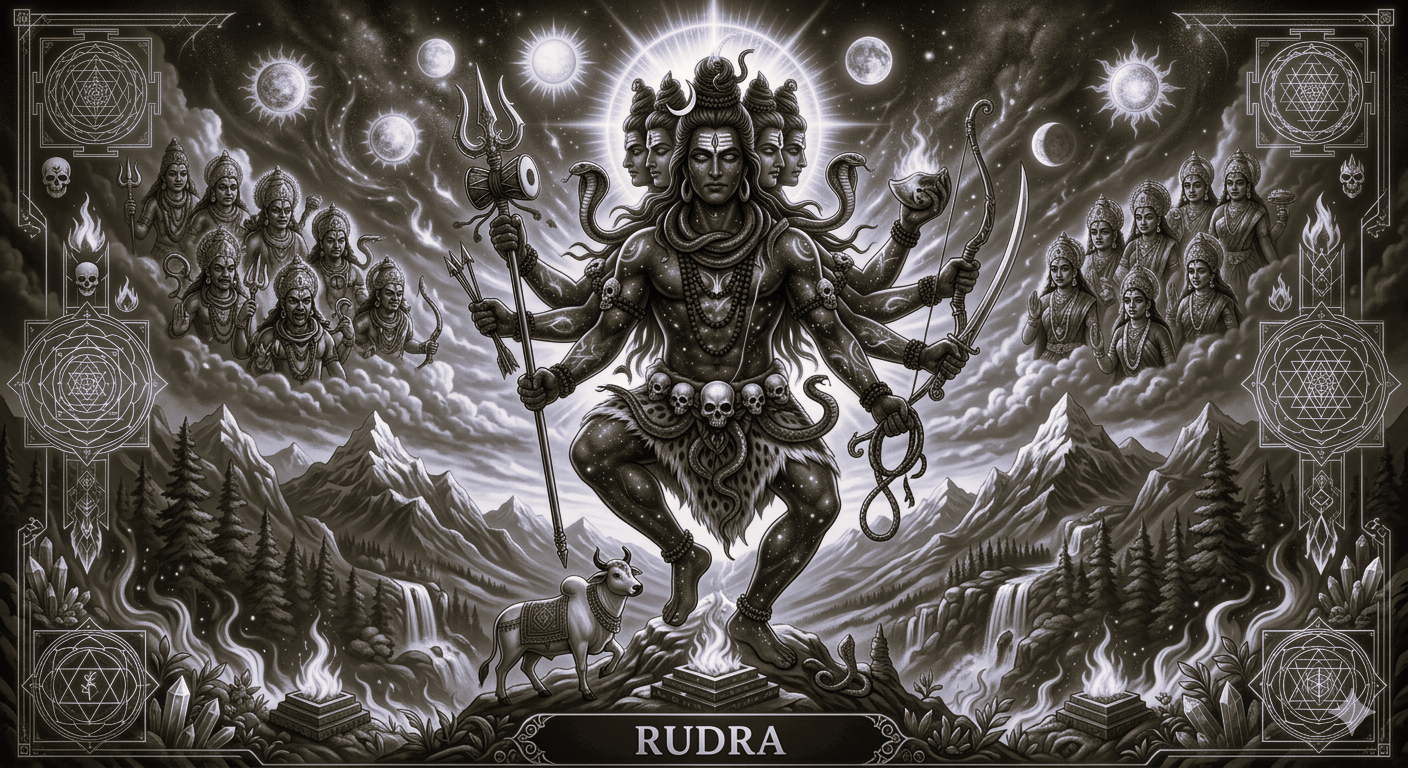
Rudra is the principle of divine intensity and inner transformation, the power that destroys limitation so that higher consciousness may be born. He is the storm and stillness within, fierce yet compassionate, the “physician of the gods” (bhīṣak), who heals through purification. “Rudra is the pain of growth,” writes Sri Anirvan, “the anguish of the finite touched by the infinite”.
- Adhidaivika: On the cosmic plane, Rudra is the force of dissolution that renews creation. He is the tapas of the universe, the heat that consumes form to release energy. The hymns call him śivaṁ rudraṁ, “the auspicious terrible,” a paradox expressing his dual aspect: destroyer of obstructions and source of healing grace. Anirvan interprets this duality as the fundamental rhythm of evolution—death and renewal as one process. Rudra is not opposed to Prajāpati or Viśvakarman; he is their complement, the power that clears the old to make way for the new.
- Adhibhautika: In nature, Rudra manifests as the storm, lightning, and fiery cataclysm— forces that appear destructive but are creative in a larger sense. Fire regenerates soil, thunder awakens the sky, and death nourishes life. These correspondences reveal Rudra as the śakti of transformation working through the cycles of nature. His raudra-bhāva, the fierce aspect, is the universe’s way of self-purification.
- Adhyātmika: Within the individual, Rudra is the inner fire of yoga, the ascending energy (kuṇḍalinī) that burns ignorance and awakens higher awareness. His “arrows” are the penetrating movements of consciousness that strike through ego and attachment. As tryambaka, the “three-eyed one,” he represents the vision that sees through past, present, and future, uniting them in timeless awareness. Anirvan writes: “When suffering ceases to be personal and becomes luminous, Rudra has entered the heart”.
Symbolically, Rudra stands for the purifying aspect of the Divine, the power that shatters illusion to reveal essence. He is both wrath and mercy. To realize Rudra within is to understand that pain is not punishment but purification; that destruction is transformation, and in the depth of every crisis lies the seed of grace. As Anirvan concludes, “In the thunder of Rudra is the silence of Śiva”.
