
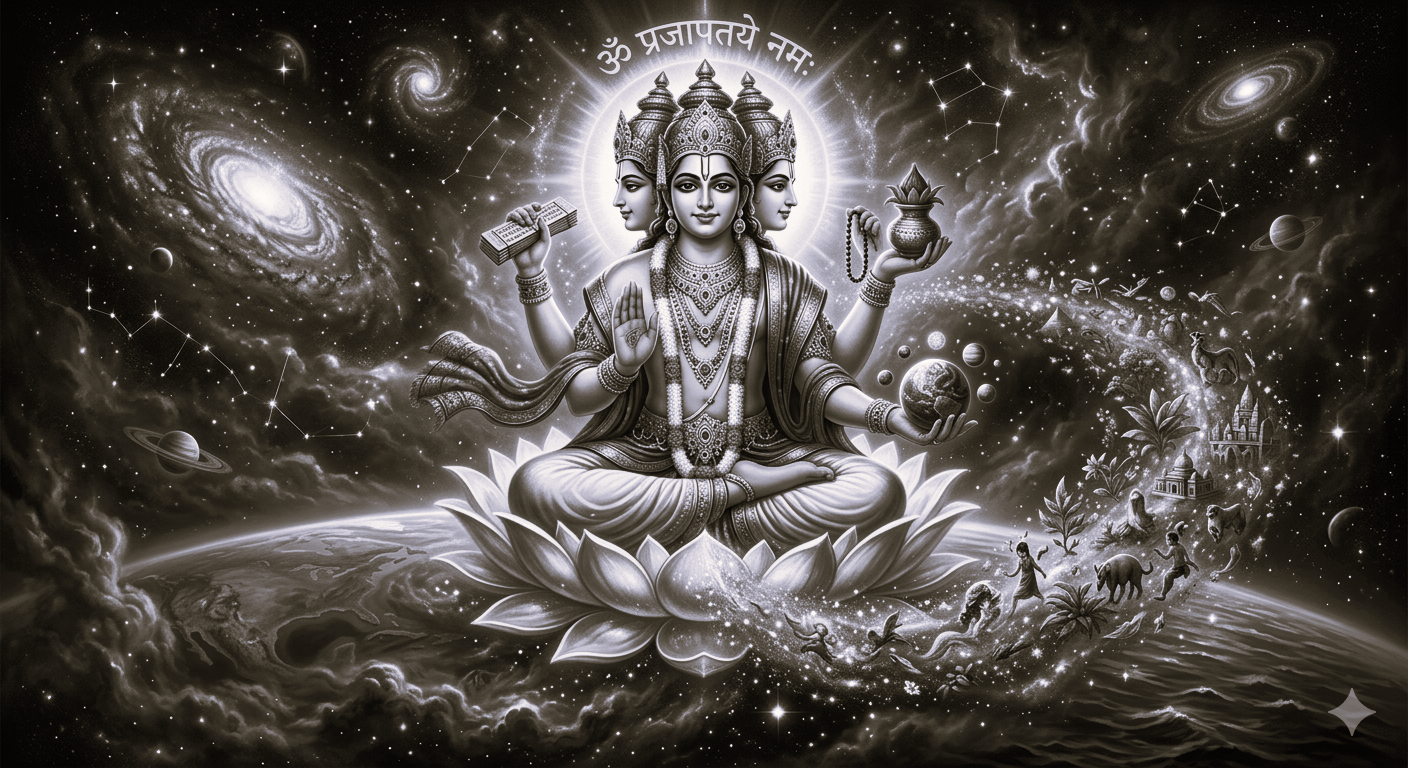
Prajāpati is at a pivotal point in the Vaidika hierarchy— the principle of creative self-sacrifice, through whom the one becomes the many. If Agni is will, Indra knowledge, and Soma bliss, then Prajāpati is the integration of these as creative consciousness itself. He is not a deity among others, but the cosmic person called ‘puruṣa’ who contains them all in potential. Prajāpati is the being’s will to become, the eternal subject entering time through the act of self-offering.
- Adhidaivika: On the cosmic plane, Prajāpati is the lord of progeny and manifestation, the first sacrificer who creates the worlds through his own dismemberment (yajñena yajñam ayajanta devāḥ– qtd. from Ṛgveda 10.90.16). For Anirvan, this is not mythology but metaphysics: Prajāpati’s sacrifice signifies the divine act of differentiation by which unity becomes multiplicity. The ṛta becomes cosmos through his tapas, his concentrated self-giving. Hence, all creation is a continuous yajña— the self-expression of the infinite in finite forms.
- Adhibhautika: In the physical universe, Prajāpati corresponds to the formative intelligence of nature—the organizing rhythm that shapes life from inert matter. Every reproductive and generative force reflects his principle, for he is the śṛṣṭi-śakti or creative aspect of the absolute manifesting through law and order.
- Adhyātmika: Within man, Prajāpati is the creative self in the soul, the inner lord (antaryāmin) who builds the individual personality through the sacrifice of his own unity. The ego’s growth, suffering, and transcendence mirror the divine act: through fragmentation, the self becomes conscious of itself. Anirvan writes, “To know Prajāpati is to see that one’s life itself is a yajña where each thought and act is an oblation into the fire of being”.
Symbolically, Prajāpati is the Divine Maker and the inner sacrificer, the archetype of self-giving that sustains existence. His realization brings the understanding that creation and sacrifice are one act, and that spiritual evolution is the conscious continuation of that primordial yajña. In man, this manifests as the offering of individuality into universality— the self’s becoming one with its source through creative surrender.
