
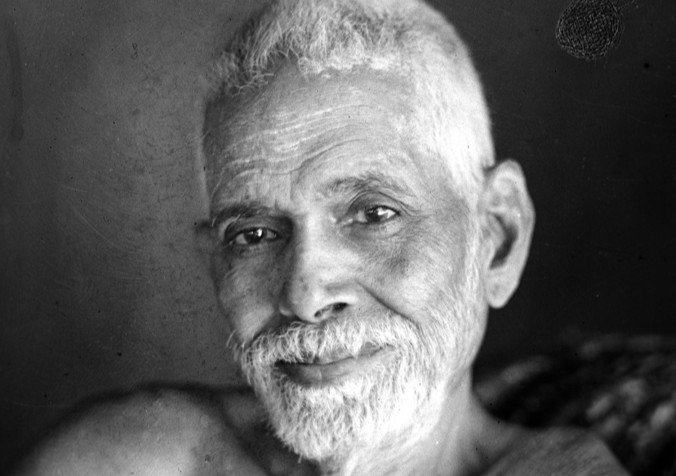
Human beings spend much of their lives seeking knowledge of things outside themselves. They study the natural world, investigate the mind, construct philosophical systems, and develop technologies to understand their surroundings. Yet one question often remains unexamined: who is the one to whom all these experiences appear? Ramana Maharshi places this question at the centre of his teaching. His approach to consciousness begins not with a theory about the universe, but with an investigation into the nature of the experiencer.
The question ko’ham, meaning “Who am I?”, expresses the central movement of this inquiry. It is not intended merely as a philosophical puzzle or an invitation to construct a description of one’s personality. Rather, it directs attention towards the source of the first-person sense of existence, the feeling that “I” am the one who thinks, acts, perceives, and experiences.
Ramana Maharshi’s teaching belongs principally to the tradition of Advaita Vedānta, although his approach is marked by its emphasis on direct investigation rather than elaborate intellectual argument. His work Nāṉ Yār?, commonly known as Who Am I?, presents self-inquiry as a means of discovering the nature of the self beyond identification with the body and mind. It describes pure awareness as the reality that remains when the mistaken identification of the self with its changing attributes is examined.
The Difference Between the Self and the Mind
Ordinary identity is constructed through a succession of experiences. An individual may identify with a name, a body, a profession, a family, a memory, or a particular set of beliefs. These features contribute to one’s practical identity, but they are neither permanent nor unchanging. The body develops and ages, memories change, emotions fluctuate, and opinions are revised.
Ramana Maharshi asks the seeker to examine whether any of these changing features can constitute the essential self. If the body is experienced, can the self be reduced entirely to the body? If thoughts arise and disappear, must the self be identical with each thought? If emotions change, does the underlying sense of existence change in precisely the same manner?
The inquiry does not require denying the practical reality of the body or the ordinary functions of the mind. Instead, it challenges the assumption that these functions provide a complete account of the experiencer. The mind is capable of observing, classifying, remembering, and reasoning, but self-inquiry asks whether the mind can be treated as the ultimate source of the awareness through which its activities are known.
Ramana Maharshi’s response is associated with the Advaita understanding of ātman as the true self, distinct from the changing conditions with which it is ordinarily identified. The task is not to create a new self or acquire a previously absent form of awareness. It is to recognise what remains when mistaken identification is investigated.
This distinction also separates self-inquiry from introspection in the ordinary psychological sense. Introspection may involve examining memories, motives, emotional responses, and unconscious patterns. Self-inquiry, as Ramana teaches it, turns attention towards the very sense of being the one who experiences these phenomena.
The ‘I’-Thought and the Source of Awareness
Ramana Maharshi frequently directs attention towards the ahaṃ-vṛtti, the mental movement associated with the sense of “I”. In ordinary experience, the sense of “I” quickly becomes connected with other thoughts: I am this body, I possess this object, I remember this event, or I desire that outcome.
His method asks the seeker to trace these movements back to their source. Instead of following each thought towards another object or explanation, one asks who is experiencing it. When a thought arises, the question is not merely what the thought means, but to whom it appears. The attention is then directed towards the sense of “I” itself.
The method is not meant to produce an endless repetition of the question. Repeating “Who am I?” mechanically would simply create another mental activity. The purpose is to turn attention away from the continuous movement of thoughts and towards the source of the experiencer’s apparent individuality.
This is a distinctive form of contemplative investigation. It treats the first-person sense of existence as something that can be examined directly rather than accepted as self-explanatory. The seeker discovers that the familiar ego is constituted through changing identifications, while the awareness through which those identifications are known cannot be described in the same way as an ordinary mental object.
Ramana Maharshi therefore places experiential investigation at the centre of philosophical understanding. Scriptural study and reasoning may assist the seeker, but they cannot substitute for the actual investigation of the self. His approach reflects a broader concern in Indian philosophical traditions with the relationship between conceptual knowledge and direct realisation.
Waking, Dream, and Deep Sleep
The analysis of consciousness becomes especially interesting when considered through the changing conditions of waking, dreaming, and deep sleep. In waking life, individuals experience a world of objects and social relationships. In dreams, a different world may appear, complete with its own events, emotions, and sense of personal identity. In deep sleep, ordinary mental activity and the familiar experience of an external world are absent.
These conditions raise a fundamental question: what is the relationship between the changing contents of experience and the continuity of the self? If identity depended entirely upon the thoughts and perceptions available during waking life, the disappearance of those activities would present a philosophical difficulty.
Ramana Maharshi uses the investigation of these conditions to question the assumption that the self is simply the waking personality. His teaching encourages the seeker to distinguish the changing activities of the mind from the deeper awareness associated with the realisation of the self.
This inquiry has an important connection with the Māṇḍūkya Upaniṣad, which analyses waking, dreaming, and deep sleep before discussing turīya, the reality that cannot be adequately described as merely another ordinary state. The comparison is philosophically illuminating, although Ramana Maharshi’s practical method should not be confused with a complete restatement of every doctrine found in the Upaniṣad.
Nor should the argument be taken as an empirical demonstration that personal awareness continues unchanged during deep sleep. Ramana’s inquiry belongs to a philosophical and contemplative framework concerned with the nature of the self, rather than a neuroscientific account of sleep and consciousness.
Self-Knowledge and Liberation
In Ramana Maharshi’s teaching, self-knowledge is inseparable from liberation. The apparent bondage of the individual arises through identification with the body, mind, desires, and the separate ego. As long as these identifications are taken to define the whole self, experience is structured by attachment, fear, and the constant effort to protect an apparently independent identity.
Self-inquiry seeks to expose the assumptions underlying this condition. The aim is not simply to improve the ego or make it more successful, but to investigate whether the ego represents the deepest truth of the individual. In the Advaita framework, the realisation of the self involves the recognition of ātman as not ultimately separate from Brahman.
This does not mean that self-realisation necessarily produces an immediate disappearance of all practical responsibilities or human emotions. Ramana Maharshi’s teaching concerns the transformation of fundamental identification. Ordinary activities may continue, but the understanding of the agent who claims exclusive ownership of those activities is radically reconsidered.
The ethical significance of this teaching follows from its challenge to ego-centred existence. If the self is not confined to the ordinary personality, the compulsion to defend that personality as an absolute identity may diminish. Compassion, equanimity, and a less possessive relationship with the world become intelligible within this framework.
Self-inquiry therefore connects metaphysical reflection with a transformation in how life is experienced. The question “Who am I?” is not answered adequately by a verbal definition. Its significance lies in the change it brings about in the seeker’s relationship with thoughts, desires, and the world.
Conclusion: Consciousness as Self-Revelation
Ramana Maharshi’s contribution to the study of consciousness lies in the simplicity and radical depth of his method. Rather than beginning with a theory of how consciousness emerges from matter, he asks the seeker to investigate the identity of the one who experiences. The method of ātma-vicāra, or self-inquiry, directs attention towards the source of the “I”-thought and challenges the assumption that the self is identical with the changing activities of the mind.
His teaching provides a significant point of entry into the Upaniṣadic concern with the relationship between the individual self and ultimate reality. The Kena Upaniṣad asks what enables the mind to think, while the Māṇḍūkya Upaniṣad investigates the conditions of experience. Ramana Maharshi develops a practical method through which the seeker can investigate the experiencer directly.
For the Centre for Vedic and Consciousness Studies, this approach raises an essential question: can consciousness be understood completely by observing its objects and functions, or must the inquiry also examine the nature of the observer?
Ramana Maharshi’s answer is that the investigation remains incomplete until it turns towards the self. His teaching does not replace scientific research into the brain and mind. Instead, it introduces a different philosophical and contemplative question, one concerned with the first-person nature of experience and the possibility that the deepest understanding of consciousness requires the direct investigation of the one who knows.

