
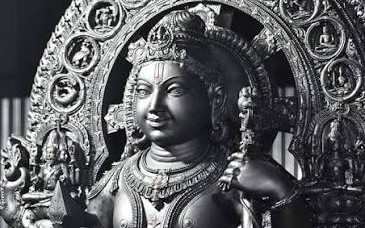
The Rāmāyaṇa is often approached as the story of Rāma, Sītā, exile, abduction, war, and return. Yet beneath its narrative architecture lies another layer: the continued presence of Vedic ideas within epic storytelling. The Rāmāyaṇa does not reproduce the Ṛgveda as a philosophical treatise, nor does every episode have to be read as an encoded Vedic doctrine. But its world is unmistakably shaped by yajña, tapas, dharma, ṛta, devatāḥ, sacred geography, cosmic weapons, and the recurring tension between order and disruption.
This is particularly significant because the epic often transforms ideas that appear in the Vedic corpus into stories that can be understood through character, action, conflict, and symbolism. The transition from the Vedic hymn to the epic narrative is therefore not simply a transition from “religion” to “literature.” It is also a movement from symbolic and ritual language into a narrative language through which philosophical ideas become accessible to a wider human imagination.
One of the clearest examples is the episode of the golden deer in the Araṇya Kāṇḍa. When Sītā encounters the extraordinary creature, the text describes it as possessing a body adorned with golden and silvery colours, jewels, and an almost supernatural beauty (Rāmāyaṇa, Araṇya Kāṇḍa 3.42.32–35). The creature is explicitly described as māyāmaya, “formed of illusion,” and is eventually revealed to be Mārīca in disguise (3.42.34; 3.44.20–21).
At the narrative level, the golden deer is a rākṣasa’s deception. But the episode also lends itself to a deeper symbolic reading. The deer is beautiful precisely because it is deceptive; its attraction draws Rāma away from the hermitage and creates the circumstances through which Sītā is abducted. Mārīca does not overpower Rāma by physical strength. He diverts him through appearance.
This makes the episode an evocative illustration of the Vedic concern with māyā as a power of extraordinary manifestation, transformation, or concealment. One should not claim that Vālmīki is simply inserting a fully developed later philosophical theory of māyā into the story. The epic itself calls the deer māyāmaya, and the symbolism emerges from the narrative: what appears desirable may conceal another reality. The golden exterior becomes a test of discernment.
A second important example is the journey of Hanumān across the ocean in the Sundara Kāṇḍa. Before beginning his leap, Hanumān turns toward the east and salutes his father, Vāyu, and then expands his body in preparation for the immense journey (Rāmāyaṇa, Sundara Kāṇḍa 5.1.9–11). The text describes the ocean as one hundred yojanas across and presents Hanumān’s leap as an extraordinary feat undertaken for Rāma’s purpose.
Yet the most interesting part of the episode begins even before the leap. In the preceding Kiṣkindhā Kāṇḍa, Hanumān has remained silent while the vānarāḥ are overwhelmed by the enormity of their task. Jāmbavān then reminds him of his extraordinary birth, strength, brilliance, and learning (Rāmāyaṇa, Kiṣkindhā Kāṇḍa 4.66.1–3).
The symbolism here is striking. Hanumān possesses the capacity before he consciously recognises it. What is required is not the creation of a new power but the awakening of a power already present. The subsequent expansion of his body and crossing of the ocean can therefore be read, at the symbolic level, as an image of the expansion of latent śakti through remembrance, discipline, purpose, and devotion. The Rāmāyaṇa itself does not explicitly formulate this as a theory of consciousness; nevertheless, the narrative provides fertile ground for such a reading.
The ocean then becomes more than geographical distance. It represents an apparently immeasurable obstacle between the seeker and the object of the quest. Hanumān’s leap transforms the impossible into the possible—not through arbitrary miracle, but through the recovery and direction of his own inherent capacity.
A third example appears in the encounter between Rāma and Paraśurāma. After Rāma has broken the great bow associated with Śiva, Paraśurāma arrives carrying the Vaiṣṇava dhanuḥ, the bow associated with Viṣṇu, and challenges Rāma to demonstrate his power (Rāmāyaṇa, Bāla Kāṇḍa 1.75.1–3). The narrative then recounts the earlier contest between Śiva and Viṣṇu and the extraordinary power associated with their respective bows (1.75.13–20).
The episode can be read as more than a contest of physical strength. The bow is an instrument of focused power: it gathers potential energy, directs it, and releases it toward a chosen end. Rāma’s successful handling of the Vaiṣṇava dhanuḥ consequently marks a transition in the narrative. Paraśurāma represents an older and fierce manifestation of kṣatra and ascetic power, while Rāma embodies a new mode of righteous kingship. The encounter becomes a symbolic passage from one form of power to another.
The Vedic background is particularly visible in the epic’s persistent relationship between power and dharma. Strength by itself is never presented as sufficient. Tejas, bala, tapas, weaponry, kingship, and divine favour acquire legitimacy only when placed within a larger moral and cosmic order. This is one reason why the Rāmāyaṇa repeatedly juxtaposes ṛṣis and kings, yajña and warfare, forest and city, asceticism and political authority.
The forest itself becomes a particularly important Vedic space. Rāma’s exile takes him into an environment populated by ṛṣis, āśramas, yajñas, tapasvins, animals, rākṣasas, and forces of nature. The destruction of sacrificial activity by the rākṣasas is not merely a series of local acts of violence. It represents an assault upon an ordered sacred world. When Rāma protects the ṛṣis and their yajñas, his role is therefore connected to the restoration of order.
Here the epic approaches the older Vedic conception of ṛta: the principle of order that encompasses cosmic, ritual, and ethical dimensions. The Vedic world is one in which human beings participate in a larger order rather than exist independently from it. The Rāmāyaṇa translates this vision into narrative form. Dharma becomes something that characters must embody, choose, defend, and sometimes suffer for.
This is why the Rāmāyaṇa should not be read only as a collection of moral stories or heroic adventures. Its narrative imagination retains traces of an older symbolic universe. The golden deer speaks to the danger of appearances; Hanumān’s leap evokes the awakening and direction of latent power; the encounter of Rāma and Paraśurāma dramatises the transformation and rightful ordering of power.
The epic thus performs an important cultural function. Ideas that were once expressed through mantra, yajña, devatā, and cosmic symbolism enter the realm of story. The philosophical is given a human face; the cosmic is placed within the drama of individual choice.
The Vedic elements of the Rāmāyaṇa are therefore not merely fragments borrowed from an earlier age. They are part of a continuing intellectual and symbolic tradition in which the relationship between the human, the cosmic, and the divine is repeatedly reimagined.
To read the Rāmāyaṇa through its Vedic elements is consequently to see the epic not as a departure from the Vedic world, but as one of the ways in which that world continued to speak.

