
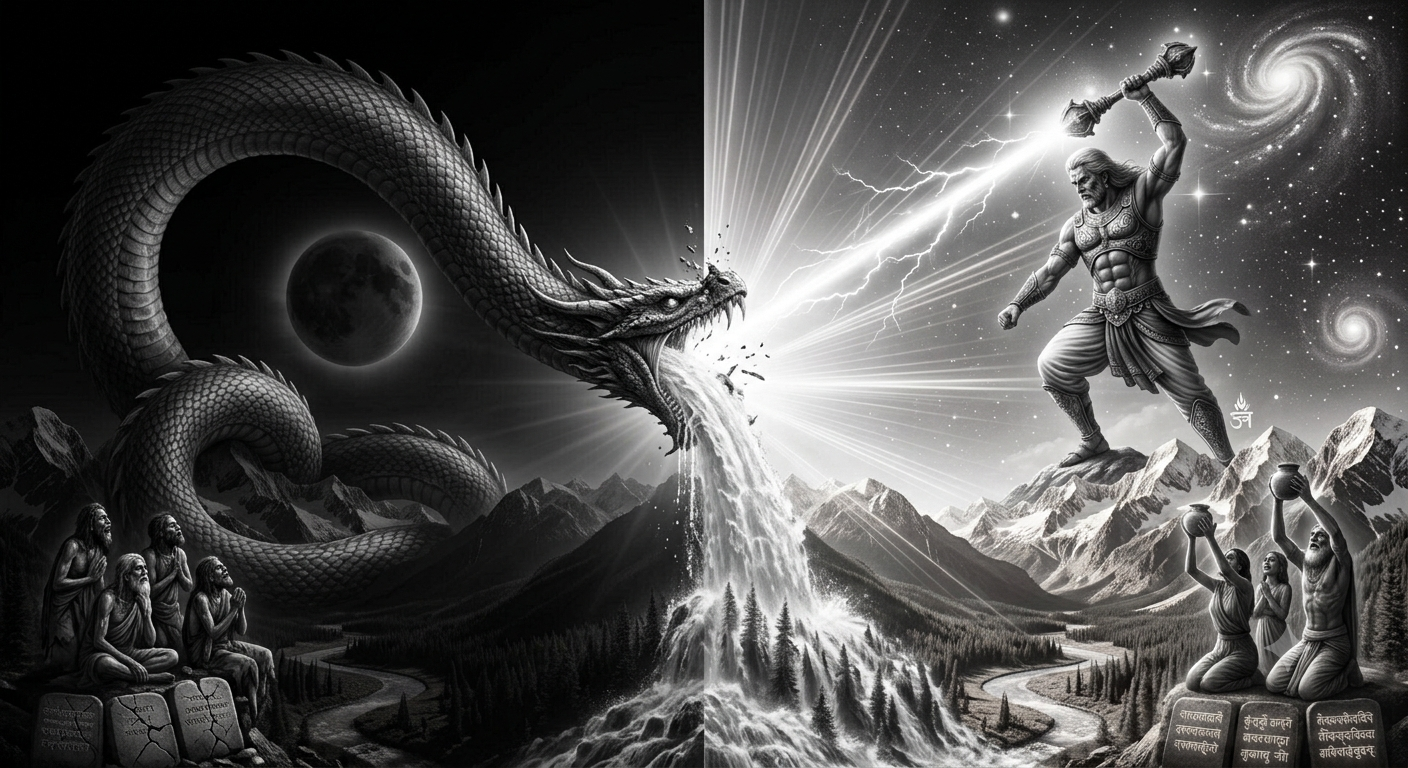
Among the most powerful recurring narratives of the Ṛgveda is the encounter between Indra and Vṛtra. It is a story of conflict, but also of release: the confrontation between a force that withholds and a power that breaks through obstruction. In the most extensive account, Ṛgveda (1.32), Indra slays the serpent Ahi, identified with Vṛtra, releases the imprisoned waters, and opens the pathways through which they flow towards the ocean. The episode is so central to the Vedic imagination that the achievement is recalled in numerous other hymns, including Ṛgveda (1.80 & 2.12).
The narrative begins with the poet announcing that he will proclaim the heroic deeds of Indra, the vajrin, the wielder of the Vajra: “Indrasya nu vīryāṇi pra vocaṃ yāni cakāra prathamāni vajrī”, meaning “I will declare the heroic deeds of Indra, the first that he performed, the wielder of the vajra” (Ṛgveda 1.32.1). The hymn immediately identifies the essential event: Indra slew Ahi, released the waters, and split open the mountains (Ṛgveda 1.32.1).
The figure whom Indra confronts is repeatedly associated with obstruction. Ṛgveda (1.32.5) calls Vṛtra the great obstructer and describes him as aṃhīṣṭham, the formidable or most oppressive obstruction. He is also described as ahí, the serpent, and his body is depicted as lying across the landscape after Indra strikes him with the vajra (Ṛgveda 1.32.5–7). The imagery is deliberately dramatic: the serpent is not merely defeated but broken apart, while the waters that had been held back are finally liberated.
The vajra itself is central to the episode. In Ṛgveda (1.32.2), the weapon is said to have been fashioned by Tvaṣṭṛ for Indra. With this weapon, Indra strikes the serpent resting upon the mountain. Immediately afterwards, the waters rush forth “like lowing cows” and proceed towards the ocean (Ṛgveda 1.32.2). The simile is significant. The waters are not represented as inert matter suddenly released from a container; they possess movement and vitality, as though they had been waiting to return to their proper destination.
The hymn repeatedly returns to the liberation of the waters. Ṛgveda (1.32.10) compares the withheld waters to cows confined by a robber, while Vṛtra guards the opening through which they might escape. Once Vṛtra has been overcome, the waters move freely, passing over his fallen body (Ṛgveda 1.32.10). The imagery of imprisoned cows and released waters is characteristic of the Vedic poetic imagination, in which valuable realities are frequently conceived as being concealed, enclosed, or obstructed and subsequently brought into manifestation.
The victory of Indra is not limited to the release of water. Ṛgveda 1.32.4 states that after Indra slew the firstborn of the serpents, he brought forth the sūrya, the dyauḥ, and the uṣas— the Sun, the sky, and the dawn. The victory therefore coincides with the restoration or manifestation of illumination and cosmic openness. The defeat of the obstructing force is simultaneously associated with the appearance of light and the re-establishment of an ordered world.
This connection between Vṛtra, obstruction, and the waters becomes even clearer in Ṛgveda (1.80). There, Indra is repeatedly praised for striking Vṛtra and releasing the waters. The hymn associates the deed with Soma and with svarājya, a term that can convey the idea of self-sovereignty or autonomous sovereignty (Ṛgveda 1.80.1–5). In verse 10, the poet declares that Indra overcame the strength of Vṛtra, slew him, and set the waters free while manifesting his own svarājya (Ṛgveda 1.80.10).
The presence of Soma is also significant. In Ṛgveda (1.80.2), the Soma brought by the śyena, the falcon, empowers Indra in his confrontation with Vṛtra. The hymn therefore places the victory within a wider ritual and sacrificial context: strength, inspired consciousness, sacred offering, and heroic action converge in the act of releasing the waters. The text does not present Indra as an isolated warrior but as a figure operating within the larger economy of yajña, Soma, brahman, and divine-human participation.
The same achievement appears in a more expansive theological frame in Ṛgveda (2.12). This hymn repeatedly asks the listener to recognise Indra through his cosmic deeds: he strengthens the trembling earth, stabilises the heavens, and performs the acts by which the ordered cosmos becomes habitable (Ṛgveda 2.12.1–2). The Vṛtra episode should therefore not be isolated from the wider Vedic conception of Indra as a power associated with expansion, strength, protection, and the establishment of cosmic order.
For the modern reader, however, one of the most important questions is whether Vṛtra should simply be understood as a “demon.” Such a translation can be convenient, but it risks importing later categories into the Ṛgvaidika imagination. The hymn itself offers more precise imagery: Vṛtra is Ahi, the serpent; he is the one who obstructs and withholds; he confines the waters and stands against Indra. The essential opposition is therefore not simply “god versus demon” but release versus confinement, movement versus obstruction, manifestation versus concealment.
This does not mean that Vṛtra should automatically be transformed into a purely psychological symbol of “ignorance,” nor does the Ṛgveda explicitly formulate the story as an allegory of inner development. Such readings belong to later or modern interpretive traditions. Yet the imagery undeniably invites reflection upon a universal human experience: there are forces that impede movement, conceal possibility, and prevent what is latent from becoming manifest. The Vedic poet expresses this experience through the dramatic language of waters held back and subsequently released.
The symbolism of water is particularly rich. In the immediate narrative, āpaḥ, the waters, are physically and cosmically significant. They flow towards the ocean once the obstruction has been removed (Ṛgveda 1.32.2). Other Vedic passages associate released waters with nourishment and life. Ṛgveda 1.80.4, for instance, calls them jīvanīyāḥ (life-sustaining or life-giving waters) as they are released following Indra‘s victory (Ṛgveda 1.80.4).
The event can therefore be approached on several interconnected levels. At one level, it is a powerful Vedic account of Indra‘s heroic victory and the release of the waters. At another, it belongs to a cosmological imagination in which the overcoming of obstruction restores light, movement, fertility, and order. At yet another level, the imagery provides fertile ground for contemplating the human experience of blockage and release. The Vedic text itself does not require us to collapse these dimensions into a single interpretation.
This is precisely what makes the story so important for understanding Vedic symbolism. The Ṛgveda does not merely tell us that Indra killed Vṛtra. It repeatedly returns to what follows the act: the waters flow, the Sun appears, dawn emerges, the world expands, and sovereignty is established. The true significance of the victory lies not in destruction for its own sake but in what becomes possible when obstruction is removed.
The story of Indra and Vṛtra therefore remains one of the defining images of Vedic thought. The vajra breaks the obstruction; the waters regain their movement; light returns; the cosmos becomes open once again. Whether approached through ritual, cosmology, philology, or symbolism, the episode invites the seeker to look beyond the battle itself and ask the more fundamental Vedic question: What is being withheld, what obstructs its release, and what power is required to make it flow again?

