
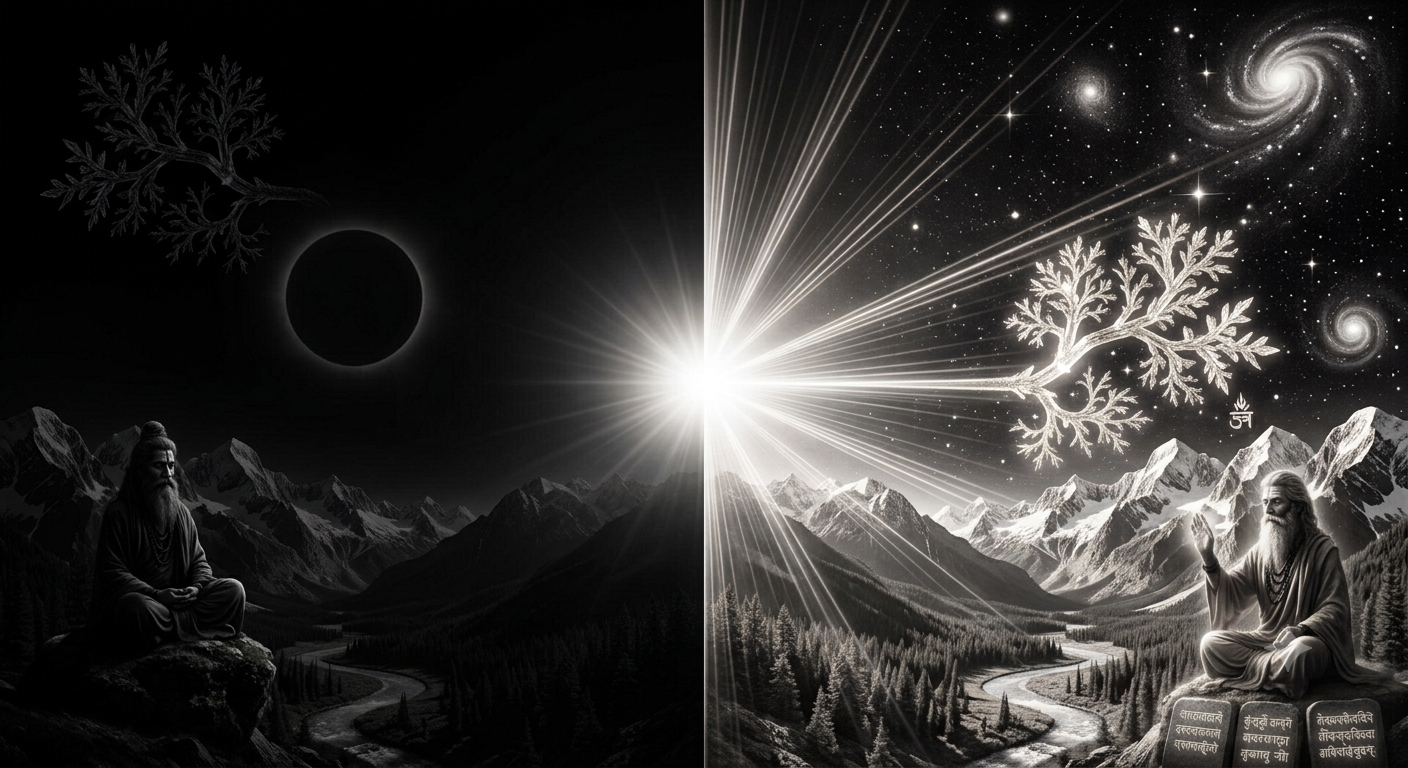
Among the most striking episodes preserved in the Ṛgveda is the mysterious disappearance of the Sun. In Ṛgveda (5.40), the poet describes Sūrya being enveloped in darkness by a figure named Svarbhānu, leaving the world bewildered and disoriented. The episode culminates in the intervention of Indra and the Atris, through whose sacred knowledge and brahman the hidden Sun is discovered and restored. Compressed into only a handful of mantras, the episode combines celestial observation, ritual action, divine agency, and symbolic imagery in a manner characteristic of Vedic thought.
The episode begins with an invocation to Indra, the powerful Vṛtrahan, in the first four mantras of the sūkta. Indra is repeatedly invited to partake of Soma and is celebrated through a series of epithets associated with strength, sovereignty, and the overcoming of obstruction (Ṛgveda 5.40.1–4). The narrative then changes dramatically. The fifth mantra addresses Sūrya directly: “yát tvā sū́rya svàr-bhānus támasā́vidhyad āsuráḥ”, meaning “when Svarbhānu, the āsura, struck the Sun with darkness”. The consequences are equally striking: the beings of the world become bewildered, unable even to recognise where they stand (Ṛgveda 5.40.5).
The Vedic poet does not describe this simply as the ordinary coming of night. The language emphasises an extraordinary disruption of the natural order. The Sun, whose presence provides orientation and illumination, has been obscured; consequently, the world itself becomes disoriented. The comparison in Ṛgveda (5.40.5) is particularly evocative: living beings are likened to someone who does not know the kṣetra, the field or place in which they stand. Darkness here is therefore not merely an absence of light. It is a condition of disorientation, in which the relationship between the observer and the world becomes uncertain.
The sixth mantra introduces the decisive intervention of Indra and Atri. Indra is said to strike down the māyā of Svarbhānu, while Atri discovers the Sun concealed in darkness through his turīya brahman, his “fourth” sacred formulation (Ṛgveda 5.40.6). The language is significant. The restoration of the Sun is not represented merely as a physical event brought about by force. It involves brahman, the sacred formulation, prayer, or potent utterance, and the insight of Atri. The hymn therefore places ritual knowledge and sacred speech at the centre of the restoration of cosmic illumination.
The following mantra shifts into direct speech, apparently giving voice to Sūrya himself. Sūrya appeals to Atri and asks that he not be overwhelmed by the threatening force associated with darkness and fear; he invokes Mitra and Varuṇa as powers of protection (Ṛgveda 5.40.7). The narrative thereby becomes unexpectedly intimate. The cosmic event is not presented from a detached astronomical perspective but through a dramatic encounter among divine powers and the seer.
The eighth mantra provides perhaps the most important clue to the role of Atri. It describes the brahman Atri engaging with the pressing stones, worshipping the devas, and then declares: “atriḥ sūryasya divi cakṣur ādhāt” (Atri placed or established the eye of Sūrya in heaven). He also causes the māyā of Svarbhānu to disappear (Ṛgveda 5.40.8). The image of Sūrya’s “eye” being restored is especially powerful. The Sun is not merely a luminous object; it is represented through the imagery of vision itself. Its restoration means that the celestial eye has once again become manifest.
The final mantra reiterates the achievement of the Atris: “yaṃ vai sūryaṃ svarbhānus tamasāvidhyad āsuraḥ / atrayas tam anv avindan”, meaning “the Sun whom Svarbhānu had pierced with darkness was found again by the Atris, and no others were able to accomplish this” (Ṛgveda 5.40.9). The repetition is significant. The concluding emphasis is not simply that the darkness vanished, but that the hidden Sun was found. The language turns restoration into an act of discovery. What had disappeared from ordinary vision was not destroyed; it remained concealed beneath darkness.
The episode has consequently attracted considerable attention as an early Vedic description of a solar eclipse. Modern scholarship has specifically discussed Ṛgveda (5.40.5–9) in relation to an eclipse, since the sudden obscuration of Sūrya, the bewilderment of living beings, and his subsequent reappearance correspond strikingly with the experience of such an event. Yet it is important not to reduce the hymn to an astronomical record. The Vedic poet is not writing a scientific report. The physical phenomenon becomes the setting for a much larger meditation upon darkness, vision, knowledge, sacred utterance, and restoration.
This distinction is essential for understanding Vedic symbolism. The darkness associated with Svarbhānu is tamas, while Sūrya embodies visible illumination. At the literal level, the hymn speaks of the obscuration of the Sun. At the symbolic level, however, the imagery readily invites reflection upon the relationship between illumination and concealment. The person who cannot identify the kṣetra in Ṛgveda 5.40.5 is not merely someone standing in physical darkness; the image also evokes the condition of one who has temporarily lost orientation. When the Sun is recovered, vision and order return. The text itself does not explicitly formulate this as a psychological allegory, and therefore such an interpretation should remain an interpretive possibility rather than a claim about the hymn’s only meaning.
Atri’s role is particularly important in this regard. He does not simply defeat darkness through physical strength. The hymn repeatedly associates him with brahman, sacred formulation, worship, and the discovery of the concealed Sūrya (Ṛgveda 5.40.6, 8–9). The restoration of light therefore involves a convergence of divine power, ritual action, sacred speech, and insight. Indra destroys Svarbhānu’s māyā; Atri discovers the hidden Sun; Sūrya’s eye is restored. The event unfolds through cooperation among different dimensions of Vedic power.
There is also a profound lesson here for the modern seeker. The Vedic imagination does not always oppose light and darkness as simple moral categories. Darkness can conceal rather than annihilate. What is hidden may still exist, awaiting discovery. The Sun is not recreated; it is found again. The distinction matters. The Vedic event suggests a movement not from non-existence to existence, but from concealment to revelation.
This is perhaps why the story remains so compelling. The disappearance of Sūrya can be read as a celestial event, a ritual narrative, a poetic account of cosmic disruption, or a symbolic meditation upon the loss and recovery of vision. The Ṛgveda itself permits these dimensions to coexist without reducing the event to any single modern category.
In the world of the Vedic seers, light is not merely something that falls upon objects. It makes seeing possible. And when that light disappears, the world itself becomes difficult to recognise. Atri’s achievement, therefore, is more than the restoration of the Sun in the sky. It is the restoration of the possibility of seeing.
The episode leaves us with an enduring Vedic image: the light was never truly destroyed. It was concealed. The task of the seer was to discover it.

