
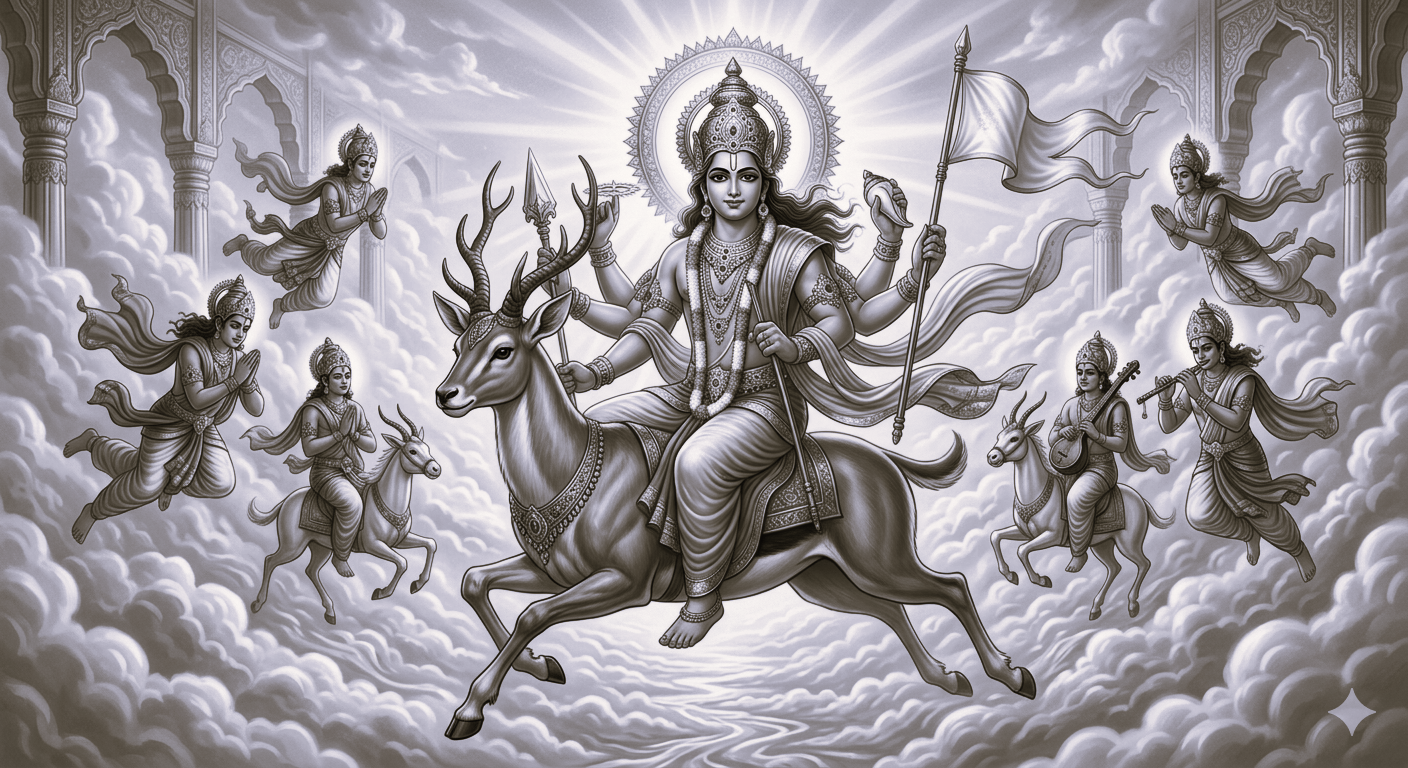
Vāyu embodies the principle of movement, breath, and life-energy (prāṇa-śakti). If Agni is the fire of transformation and Indra the light of consciousness, Vāyu is the bridge between matter and spirit, the cosmic current through which life circulates. He is the soul of motion, the unseen force that pervades all space and animates all beings.
- Adhidaivika: On the divine plane, Vāyu represents the invisible substratum of movement within the cosmos. He is the dynamic rhythm of ṛta, sustaining the flow of energies between the celestial and terrestrial realms. As prāṇa of the gods, Vāyu mediates between Agni (fire) and Indra (mind): Agni rises upward through Vāyu, and Indra receives his strength through him. Thus, Vāyu is the cosmic breath that connects will and intelligence, matter and consciousness.
- Adhibhautika: On the physical level, Vāyu is air and wind— the tangible manifestation of motion and energy. But Anirvan emphasizes that the Vaidika vāta is not mere meteorological wind; it symbolizes the living continuum of space, the field of all activity. Every pulse of nature (viz. growth, decay, vibration) is a modulation of Vāyu’s presence.
- Adhyātmika: Within man, Vāyu becomes prāṇa, the vital energy that sustains life and mediates between body and consciousness. Anirvan interprets the five primary vāyus (viz. prāṇa, apāna, samāna, udāna, and vyāna) in the self as five modalities of the soul’s energy moving through the organism. Spiritually, Vāyu represents the discipline of breath and movement, the inner regulation of energy that leads to clarity and expansion. When our breath becomes rhythmic, our consciousness discovers its cosmic rhythm.
Symbolically, Vāyu stands for freedom, dynamism, and the subtle power of transition. He is the messenger who carries Soma to Indra, the mediator between thought and ecstasy. In the aspirant’s journey, Vāyu signifies the awakening of the subtle life-force— the motion of consciousness that unites the inner and outer worlds.
