
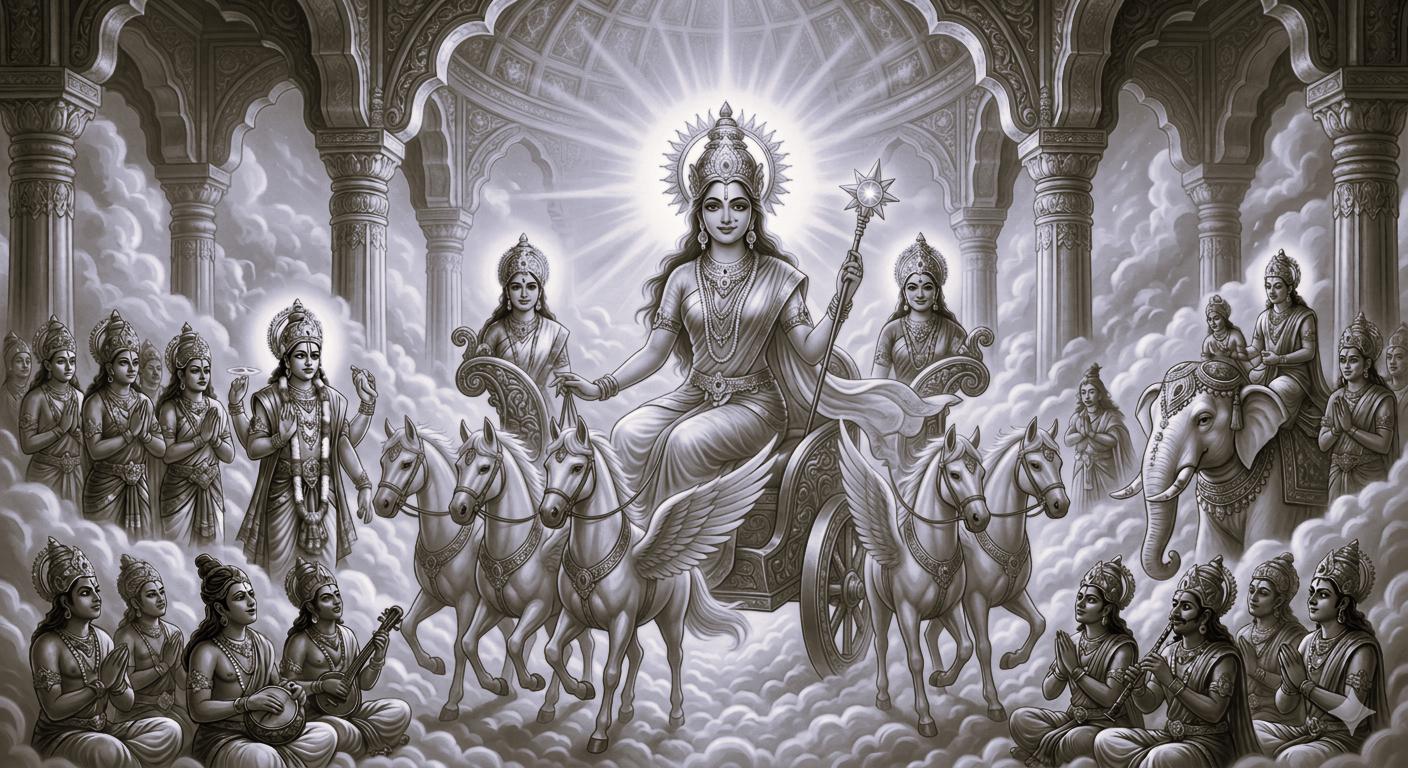
Uṣā (literary meaning ‘the dawn’) is not merely the goddess of the morning sky, but the principle of awakening itself, the first stirring of consciousness after the long night of unawareness. She represents the transition from darkness to light, from sleep (tamas) to perception (jyotiḥ). Anirvan calls her “the gentle unveiling of consciousness before the sun of truth arises”.
- Adhidaivika: On the cosmic plane, Uṣā is the herald of Sūrya, the ever-recurrent dawn that prepares creation for the revelation of light. She is ṛta in its first movement— the order emerging from chaos, rhythm from inertia. In the hymns of the Ṛgveda, she “opens the gates of heaven,” awakening the gods and setting the cosmic functions into play. Anirvan interprets this as the periodic renewal of consciousness in the universe— each dawn being a symbol of creation’s eternal rebirth.
- Adhibhautika: In the physical world, Uṣā is the daily dawn, the luminous gradient where darkness softens into light. She embodies the principle of transition, the balance between the inert and the active, the sleeping and the awakened. This in-between condition mirrors the subtle transformations in nature where new beginnings gestate.
- Adhyātmika: Within the individual, Uṣā is the first glimmer of inner awareness, the subtle intuition that precedes full knowledge. She awakens the inner faculties, disperses the lethargy of the mind, and prepares the aspirant for the solar consciousness (sūrya-caitanya). Thus, Uṣā is the dawn of sādhanā—the state in which aspiration (ārambha) takes form. “She is the first thought of the soul toward its divine day”.
Symbolically, Uṣā represents spiritual renewal, hope, and the continuous possibility of awakening. Each dawn in the Veda signifies that consciousness never truly sleeps—it only awaits its own unveiling. For Anirvan, Uṣā is the eternal promise of the new, “the smile of Being breaking upon the face of the finite”.
