
The continuity of Indian civilization is most visible not merely in texts or rituals but in the symbols that have travelled across millennia, carrying with them layers of meaning from the Vedic age to contemporary life. Symbols have always served as bridges between philosophical ideas and daily practice, and in India they have retained a remarkable longevity. From the haṁsa (swan) that glides gracefully across ancient hymns to the cakra (discus) that appears on the national flag, these forms reveal how the Vedic imagination continues to animate the present. Their survival is not accidental: it reflects the enduring Indian inclination to embed metaphysical concepts into simple, visual, and memorable motifs that remain relevant across ages. These symbols are not static; they have adapted, evolved, and been reinterpreted, yet their fundamental essence remains intact.
See the very logos of the Indian Knowledge Systems Division of the Ministry of Education, the National Institute of Mental Health and Neurosciences, the National Council of Educational Research and Training (NCERT), and the Ramakrishna Mission founded by Swami Vivekananda. What do you find common in them?

The symbol of the swan, right? It is called haṁsa in Sanskrit and it is one of the earliest symbols from the Vedic corpus that is still in use. In the Ṛgveda and later Upaniṣads, the concept of haṁsa represents purity, discrimination, and transcendence. The idea of the haṁsa separating milk from water symbolizes the ability to distinguish the eternal from the ephemeral, the true from the false. The term ‘paramahaṁsa’, used for the highest spiritual seeker, is rooted in this symbolism. In modern India, the haṁsa continues to appear in temple motifs, classical dance iconography, literature, and even in everyday objects such as textiles and jewellery. Its image is used in educational institutions, spiritual organizations, and as a decorative emblem in homes, showing how a Vedic symbol of inner wisdom has effortlessly permeated daily visual culture.
Similarly, another enduring symbol is that of the kūrma, the tortoise. In Vedic cosmology, the kūrma embodies stability, grounding, and the ability to withdraw one’s senses. The idea of pratyāhāra in Yoga is often compared to the kūrma drawing its limbs inward. The later narrative of the Kūrma-avatāra during the samudra-manthana (churning of the ocean) builds upon an older symbolism: the tortoise as the steady axis on which the universe can churn. Even today, kūrma motifs are found in temple foundations, ritual objects, vāstu diagrams, and household items. Many homes keep a brass kūrma for auspiciousness, believing that it stabilizes energy and protects the household from imbalance. Through such practices, an ancient philosophical metaphor becomes a familiar presence in domestic life.
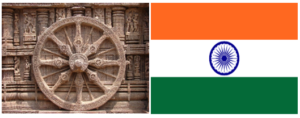
Another powerful symbol that has persisted from the Vedic age is the cakra. In the Ṛgveda, the cakra signifies cyclical time, order, and the wheel of the cosmos. It later becomes associated with divinity and kingship, exemplified in the cakra of Viṣṇu, which represents both protection and the preservation of dharma. Today, the cakra is among the most visible Vedic symbols in the modern world. The Aśoka-cakra at the centre of the Indian national flag traces its symbolic lineage to the dharma-cakra and further back to Vedic imagery of the sun’s wheel. Its 24 spokes represent ethical motion and the continuous turning of moral effort. Road signs, government seals, educational logos, and currency notes display the cakra, making it perhaps the most widely recognized continuity of a Vedic symbol into contemporary civic life.
The lotus, or padma, is another symbol whose journey spans millennia. Though often associated with later Paurāṇika traditions, its roots appear in Vedic hymns describing creation emerging from cosmic waters. The lotus symbolizes purity rising above the muddy world, untouched by it. This imagery is still deeply woven into Indian consciousness: the padmāsana posture in Yoga, the lotus-throne in temple sculpture, the padma-mudrā in classical dance, and the use of lotus motifs in rangolī and textile designs all point to an unbroken cultural thread. Moreover, the padma continues to appear in political symbols, corporate logos, and educational emblems, demonstrating its enduring cultural significance.
The śaṅkha, or conch, also originates in Vedic ritual contexts where it functioned as a sacred sound-producer. The Vedas describe the symbolic importance of sound as vibration, creation, and order. The śaṅkha produced a sound that invoked purity and called attention to the sacred. Today, it is blown during pūjās, marriages, and temple rituals across India. But even outside ritual practice, the śaṅkha appears in home décor, jewellery, and state emblems. The Government of India’s official emblem for certain departments incorporates the śaṅkha, linking governance with the idea of sacred duty. Its form is so iconic that even children recognize it easily, proving its long cultural durability.
The triśūla (trident), though more explicitly connected with Rudra-Śiva in later literature, has conceptual roots in the Vedic trinity of powers: icchā-śakti, jñāna-śakti, and kriyā-śakti. It symbolizes the mastery over the three guṇas— sattva, rajas, and tamas. Today, the triśūla is an instantly recognizable symbol found on temples, vehicles, clothing, and household shrines. It is used by sādhus, painted on doors for protection, and incorporated into art and sculpture. What began as a symbolic representation of cosmic forces is now part of everyday visual culture.
Another pervasive symbol is the kalaśa, a water-filled pot often crowned with mango leaves and a coconut. While kalaśa usage is Paurāṇika and ritualistic today, its origins lie in Vedic practices where water was regarded as a carrier of ritual potency. The kalaśa embodied abundance, continuity, and sacredness. Today it is used in marriages, festivals, housewarming rituals, shop inaugurations, and even in secular ceremonies. Its image decorates letterheads, architecture, and textile borders, revealing its transformation from a Vedic ritual object to a cultural motif.
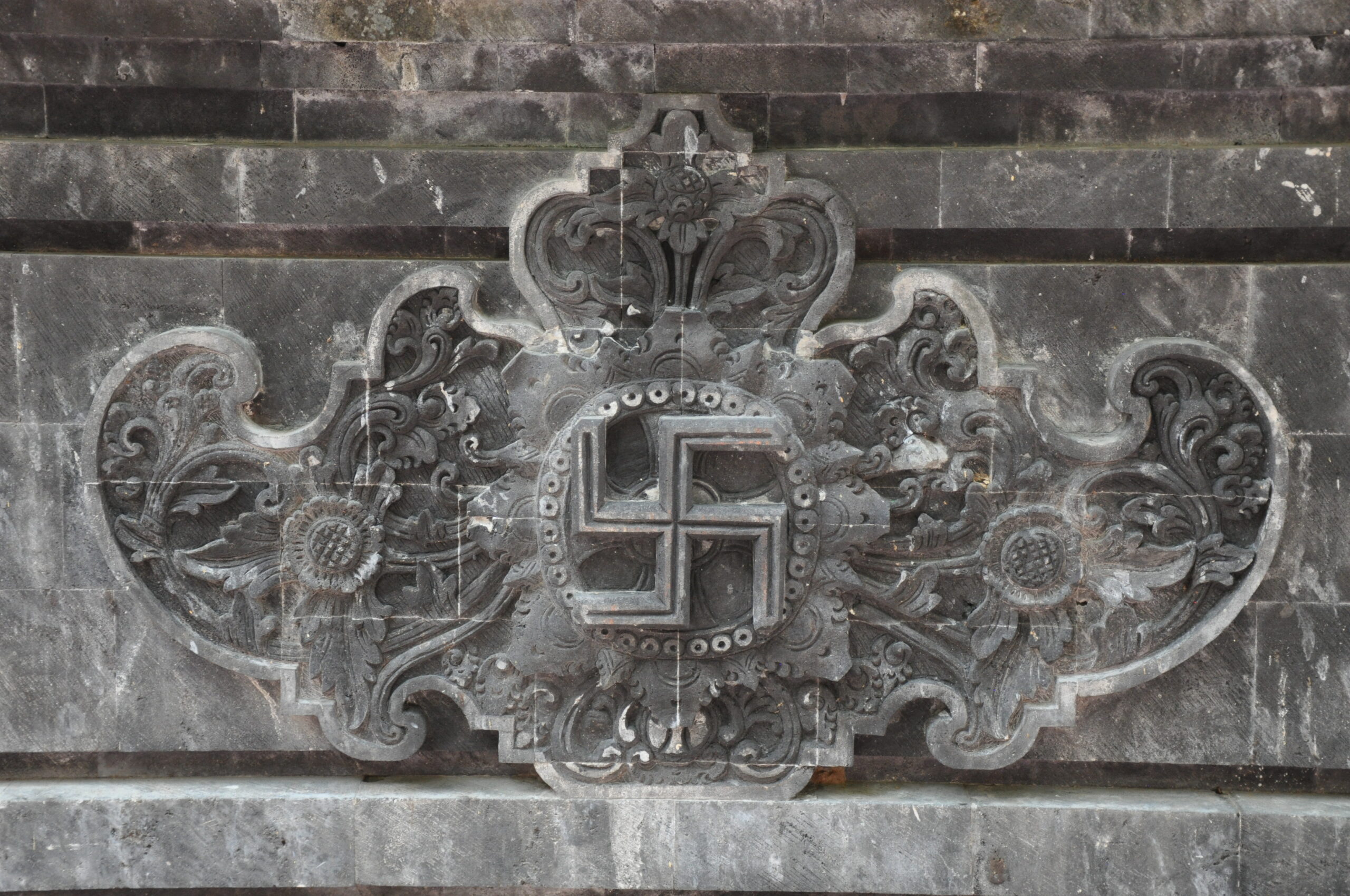
Even geometric symbols from the Vedic period have persisted. The svastika, meaning well-being, appears in the Śrauta tradition as a sign of auspicious beginnings and cosmic harmony. Despite misappropriation elsewhere, in India the svastika remains widely used: drawn on thresholds, during festivals, on notebook covers, business ledgers, and vehicles. Its original meaning of prosperity and harmony remains unchanged. On an interesting note, we must understand that the symbol of svastika and the symbol called the ‘hakenkreuz’ used by Adolf Hitler as the Nazi symbol are not same. The Hindu symbol stands for prosperity and bliss as opposite to the Nazi ideology of hate and prejudice. So, this is a misconception that calls for debunking!

The aśvattha or peepal tree is another symbol with deep Vedic roots. It was revered in the Vedas as a cosmic tree representing life, breath, and continuity. Even today, people circumambulate the tree, tie threads to its trunk for vows, and see it as a life-giver. Its leaves appear in art, and its form is used in logos and ritual diagrams.
These symbols, whether natural forms like the haṁsa and kūrma, cosmic motifs like the cakra, or ritual emblems like the śaṅkha and kalaśa, continue to thrive because Indian civilization has always viewed symbols not as aesthetic ornaments but as carriers of philosophical insight. They serve as reminders of the deeper truths embedded in daily life: the purity of the haṁsa, the steadiness of the kūrma, the dynamic motion of the cakra, the purity of the padma, the cosmic sound of the śaṅkha, and the auspicious fullness of the kalaśa. Their survival shows that beneath the changes of time, technology, and social life, the Indian mind continues to perceive the world through lenses crafted thousands of years ago. The continuity of these symbols demonstrates a remarkable civilizational instinct: to preserve the eternal through the familiar, to carry forward metaphysical ideas in forms that live alongside us. This unbroken tradition connects the modern Indian directly with the Vedic seer, making the distant past not remote, but vividly present.
