
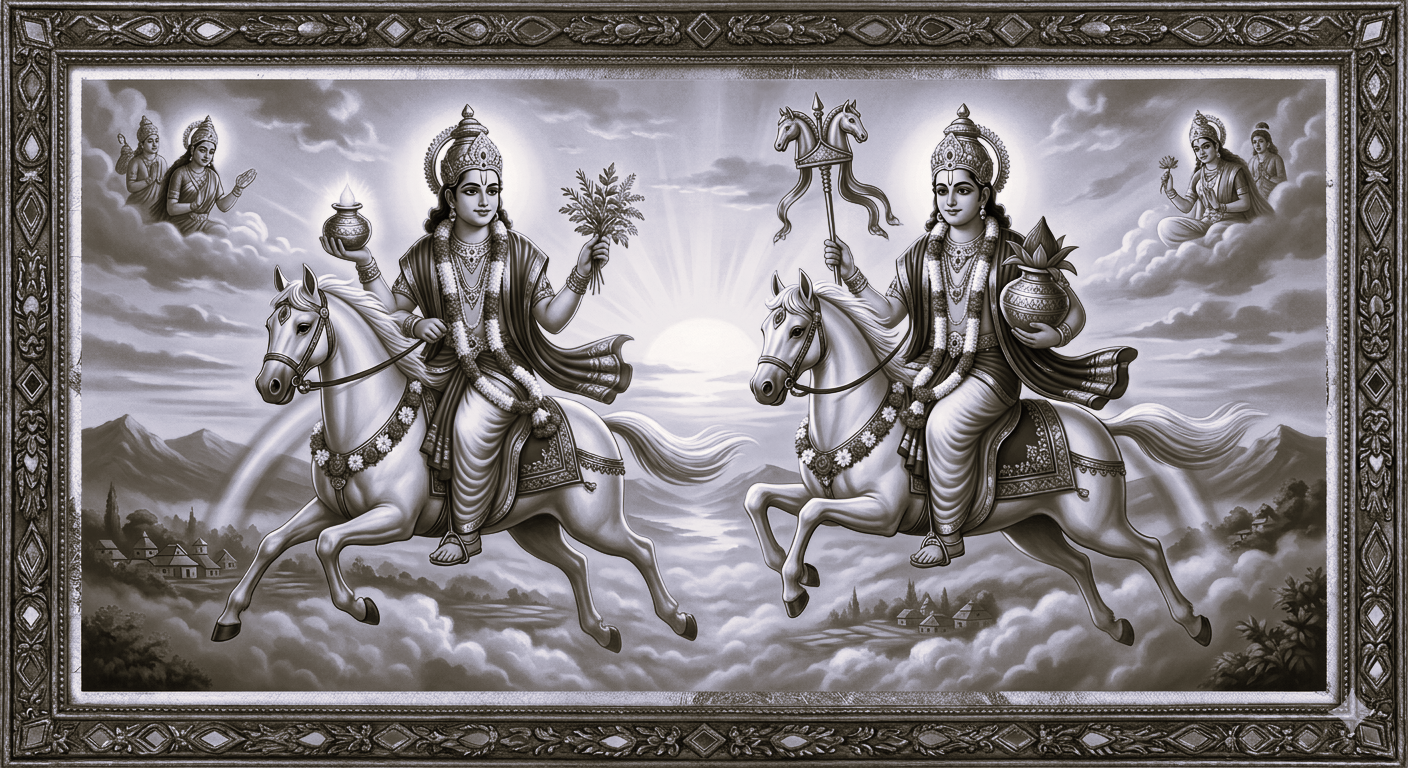
The Aśvinau, the divine twins, are the powers of transition and healing, bridging darkness and light, ignorance and knowledge, matter and spirit. They are divo narā, “the men of heaven”, symbols of dual forces working in harmony to restore balance. “In them,” Anirvan writes, “the movement of the finite becomes the chariot of the infinite”.
- Adhidaivika: On the cosmic level, the Aśvins embody the dawn’s mediating power: they precede Uṣā and prepare the world for illumination. As twin horsemen, they represent the twofold rhythm of ṛta: contraction and expansion, descent and ascent. They are physicians of the gods (divyau vaidyau), healing through equilibrium. For Anirvan, the mythic healing acts of the Aśvins (viz. restoring youth to Cyavana, sight to Rijraśva, or wholeness to Viśpalā) symbolize the cosmic restoration of harmony whenever duality falls into disarray.
- Adhibhautika: In the natural world, the Aśvins represent the life-principle in motion, the twin forces of polarity— positive and negative, day and night, inhalation and exhalation— whose balance sustains all organic life. Their horses (aśva) signify vital energy, the prāṇa that carries creation forward. Thus, they are the divine mechanics of vitality, ensuring continuity between matter and life.
- Adhyātmika: Within man, the Aśvinau are the twin faculties of intuition and vitality that awaken with the dawn of consciousness. They operate in the subtle body (sūkṣma-śarīra) as the harmonizing powers that heal fragmentation within the psyche. Their chariot is the mind itself, drawn by the energies of life and thought moving in rhythmic balance. Anirvan calls them “the first yogīs”, for they reconcile opposites and lead the seeker toward unity.
Symbolically, the Aśvins represent the dynamic duality of evolution— the perpetual reconciliation of contraries that sustains creation. In the human journey, they symbolize integration: the healing of the divided self, the restoration of wholeness before illumination. “When the inner chariot moves in balance,” writes Anirvan, “the Aśvins have entered the soul”.
