
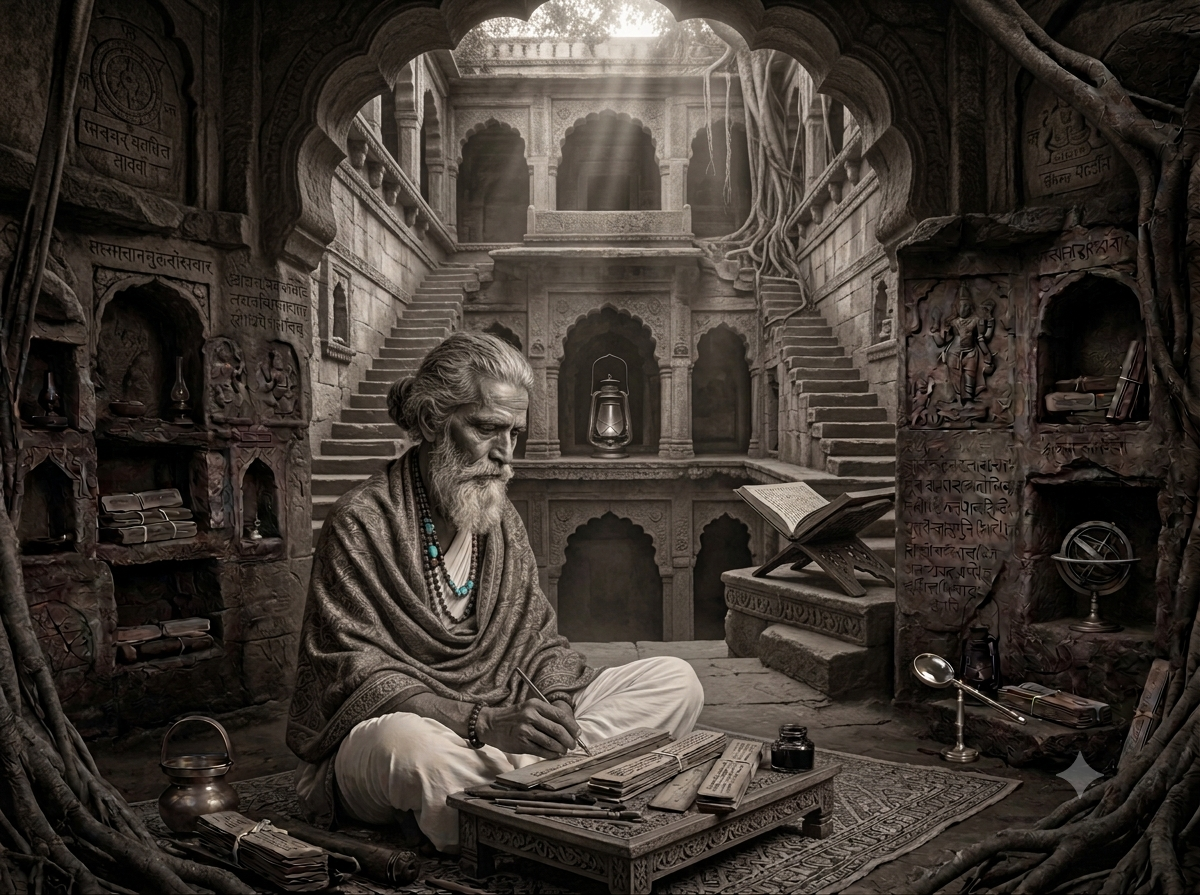
The history of Vedic interpretation is not the story of a single scholar but of a continuous intellectual tradition spanning centuries. If Yāska laid the foundations of Vedic hermeneutics through his Nirukta, then it was Durga who ensured that those foundations were neither forgotten nor misunderstood. Although, perhaps his name rarely appears outside specialized circles of Sanskrit scholarship, Durga still occupies an indispensable place in the history of Vedic studies. Without his commentary on Yāska’s Nirukta, many of the subtle linguistic, grammatical, and philosophical insights of ancient India might have remained obscured and inaccessible to later generations. In many respects, Durga served as the bridge connecting the earliest science of Vedic interpretation with the medieval and modern traditions of Sanskrit learning.
Unlike Yāska, very little is known about Durga’s personal life. Like many ancient Indian scholars, he left behind no autobiography, nor do historical records preserve details regarding his birthplace, family, or teachers. Internal evidence suggests that he probably flourished between the 6th – 8th centuries CE, though some scholars have proposed slightly earlier or later dates. Whatever the precise chronology, there is broad agreement that Durga lived many centuries after Yāska but long before the great Vedic commentator Sāyaṇācārya. Now, while we shall delve into his commentaries, we ought to keep in mind that his historical importance lies not in founding a new school of interpretation but in preserving and elucidating an older one.
Durga’s principal work is his celebrated commentary on the Nirukta. By his time, the language of the Vedas had become even more distant from everyday Sanskrit than it had been in Yāska’s era. Consequently, Yāska’s own explanations required timely clarification. Durga undertook this demanding task with remarkable scholarship. His commentary explains difficult grammatical constructions, justifies Yāska’s etymologies, cites parallel Vedic passages, and records alternative interpretations whenever he felt necessary. For modern scholars, his work is invaluable because it often preserves traditions of interpretation that would otherwise have disappeared forever.
One of Durga’s greatest contributions was his insistence that Vedic interpretation must rest upon multiple disciplines rather than isolated speculation. Like Yāska, he too recognized that no single method could adequately explain every mantra. All six Vedāṅgas vyākaraṇa (grammar), nirukta (etymology), kalpa (rituals), śikṣā (phonetics), chanda (metre), jyotiṣa (astrology) and traditional usage all had to be consulted together and only then shall we get a holistic understanding of the true import of the mantras. This interdisciplinary approach became a defining characteristic of the latter generations of classical scholarship.
Although originating in the Nirukta, Durga repeatedly demonstrates this principle in practice. He does not treat words as isolated dictionary entries but as living expressions whose meaning emerges through grammatical form, ritual setting, and literary context. His commentary repeatedly illustrates that understanding a mantra requires understanding the world in which it was composed. Unlike many later commentators who sought primarily theological or sectarian meanings, Durga generally remained faithful to Yāska’s philological method. He carefully analyzed the verbal roots, examined the variant readings, and compared the parallel passages before reaching interpretative conclusions. In doing so, he preserved the scholarly spirit of inquiry that distinguished the earliest exegetes.
Perhaps Durga’s most significant achievement was his defence of traditional interpretation without descending into dogmatism. Whenever Yāska records multiple explanations for a difficult Vedic word, Durga often discusses the strengths and weaknesses of each interpretation before indicating which appears most convincing. This balanced method reflects a very advanced academic culture (like the one we have today) in which reasoned debate was encouraged rather than suppressed. For example, while discussing words whose derivations admit several possibilities, Durga frequently reminds readers that etymology alone cannot determine meaning. Context (prakaraṇa), grammatical construction, and the intention of the ṛṣi (seer) must also be considered. Such observations reveal a sophisticated awareness of semantic complexity that anticipates many principles of modern hermeneutics.
While commenting on Yāska’s dictum “yājñadaivate puṣpaphale devatādhyātme vā”, Durga explains that an individual desirous of worldly prosperity (abhyudaya) should take refuge in the path of rituals (yajña) to attain opulence from the deities. Conversely, one who desires ultimate liberation (which he terms ‘niḥśreyas’) must acquire profound knowledge regarding the deities and realize the ultimate ātmatattva residing at their core. Thus, according to Durga, the seeker of opulence must follow the first path, while the seeker of liberation must follow the second. This also clarifies that spiritual knowledge is anchored in the knowledge of the deities, which in turn is anchored in ritualistic knowledge. To attain the higher spiritual reality, one must transcend attachment to the initial ritualistic steps. According to Durga, it is only due to avidyā (cosmic ignorance), the individual self appears separated from the supreme reality. When the scriptural teachings remove this intervening wall of ignorance, an experiential identity with the divine is established.
Durga’s understanding delves further when we find the subtle nuances of verbal differences in the commentaries. For instance, commenting on the mantra of “jīvānno abhighetana”, Yāska concludes: “sa matsyānāṃ jālamāpannānāmetadārṣaṃ vedayante”, meaning that this mantra is the visionary insight (ārṣa) of fish caught in a net (making the fish the ṛṣis of the mantra). However, Durga departs from this, arguing that a human ṛṣi, overwhelmed by compassion upon witnessing the slaughter of fish, envisioned this verse. This view highlights two vital principles: first, a ṛṣi is one who penetrates deeply into the core of a problem to perceive its truth; second, fish themselves cannot perceive such existential crises. Rather, the ṛṣi, experiencing absolute empathetic identification (tādātmyabodha) with the subject matter, speaks as if he were the trapped fish. Durga asserts that before decoding a mantra, one must identify the underlying cause or context.
Ācārya Durga’s unique commentary style is characterized by his innovative application of words into fresh semantic dimensions. His genius shines brightest precisely where Yāska’s extreme brevity left the subject matter ambiguous—particularly in sections dealing with the fourfold classification of words, the classification of deities, the nature of devas, and the etymologies of divine names. In all other places, he remains a loyal, reverent disciple, using his immense scholarship to defend and expand upon Yāska’s positions. Understanding Yāska’s Nirukta better than any other ancient commentator, Durga presented it with unparalleled clarity. His historical personality may be veiled in the mists of time, but his academic legacy remains crowned with supreme achievement.
According to Durga, Vedic words possess a multifaceted, all-encompassing genius. For instance, the term kucaraḥ, when applied to Indra, means “one who moves everywhere”, but when applied to a beast, it means “one who roams in difficult terrains”. Similarly, the word giriṣṭhāḥ means “seated upon the clouds” in the case of Indra, and “dwelling on the mountains” in the case of a deer. This proves that the semantic capacity of Vedic words is limitless, and the boundaries of a mantra’s meaning cannot be rigidly fixed. The more competent the commentator, the more sublime and refined the meaning a mantra yields. Durga suggests that a mantra can be interpreted in entirely new ways based solely on the speaker’s intention. A strictly logical mind cannot agree with this view. Forcing a meaning that is completely unexpressed by the actual words of the mantra cannot be deemed judicially or logically sound. By allowing this level of interpretive freedom, Durga inadvertently opens the door to arbitrary and inconsistent interpretations, which cannot be justified.
According to Durga, the capacity to truly interpret a mantra belongs to three categories of individuals:
- The Ṛṣi (seer) who, being a draṣṭā (direct witness) to the mantras, can naturally unpack their meaning.
- The Tapasvī (ascetic) who, though not a classical ṛṣi, can directly perceive the inner meaning of the mantras through the power of intense austerity (tapas).
- The Bhūyovid (someone like a polymath) who is neither a ṛṣi nor a tapasvī, but possesses vast, comprehensive knowledge of various sciences, scriptures, and worldly affairs, enabling them to interpret the text accurately.
In the interpretation of the mantra fragment na nūnamasti, the Western scholar Roth interpreted the word nūnam strictly as ‘adyatana’, meaning “pertaining to today”. But we can counter this fragile understanding by relying on the sound argument of Durga and his sharp grammatical insight, arguing that the presence of the nakāra (negative) necessitates the adhyāhāra (ellipsis) of the word adyatana. He invokes the logical maxim that where there is a pratiṣedha (negation), the pratiṣedhya (object that is being negated) must fundamentally exist (pratiṣedhe sati pratiṣedhyasya avaśyaṃ bhāvyatvam). Durga’s textually rooted view stands out as far more accurate and textually sound.
Another remarkable feature of Durga’s commentary is its preservation of earlier scholarly traditions. Throughout the work, he frequently introduces interpretations attributed to previous authorities using expressions such as “केचित्” (some scholars say) or “आचार्याः” (the teachers explain). Although the identities of these earlier scholars are often unknown, Durga’s willingness to record their opinions provides historians with valuable evidence concerning the diversity of ancient Vedic scholarship. Rather than presenting knowledge as the monopoly of a single authority, he portrays interpretation as a cumulative enterprise enriched by successive generations of learned discussion.
Durga also recognized the importance of understanding the four essential elements traditionally associated with every Vedic mantra: the ṛṣi (seer), the devatā (presiding deity), the chandas (metre), and the viniyoga (application). This principle echoes the famous statement preserved in the Nirukta:
अविदित्वा ऋषिं छन्दो दैवतं योगमेव च।
योऽध्यापयेद् जपेद्वापि पापीयान् जायते तु सः॥
(Nirukta 1.18)
[He who recites or teaches a mantra without understanding its seer, metre, deity, and application commits a serious error.]
Durga repeatedly reinforces this ideal throughout his commentary. For him, recitation of mantras without comprehension is incomplete. A mantra was not merely a sequence of sacred syllables but a carefully composed expression whose meaning depended upon historical, linguistic, and ritual circumstances. The influence of this thought upon later commentators was profound. Although Sāyaṇācārya does not always cite Durga explicitly, modern scholars have demonstrated that many explanations appearing in Sāyaṇa’s commentaries reflect traditions already preserved by Durga. In this sense, Durga became an invisible architect of medieval Vaidika scholarship. His interpretations quietly shaped generations of commentators who often inherited his conclusions without acknowledging their ultimate source.
The real importance of Durga lies in his understanding of the natural ethos of the mantras and addressing them in context to the praxis of that time. Let’s take for instance his take on the yajña (sacrifice) and hiṃsā (violence). Ācārya Durga opines that any violence which leads to elevation and spiritual or worldly prosperity (abhyudaya) is not true violence, but rather a form of non-violence (ahiṃsā). His second argument states that the Veda, being the highest authoritative scripture (āgama), could never lead humanity down a deluded path like violence. Therefore, the hiṃsā that appears in mantra injunctions such as “oṣadhe trāyasvainam” (O herb, protect him!) and “svadhite mainaṃ hiṃsīḥ” (O axe, do not injure him!) is actually anugraharūpa (benign and graceful) because its ultimate goal is elevation. Consequently, it qualifies as ahiṃsā. In this manner, Durga sanctions animal sacrifice within the framework of a ritualistic sacrifice (yajña).
Durga justifies his stance positing his argument on the śabdapravṛtti (signification of words) as he states that the function of words operates primarily through two modes: mukhyā (literal/primary) and gauṇī (figurative/secondary). Wherever the primary meaning (mukhyā vṛtti) cannot be logically sustained, one must resort to the secondary meaning (gauṇī vṛtti). For instance, in passages like aditiḥ sarvam (meaning “Aditi is everything”), the meaning of the mantra must be harmonized by employing the gauṇī vṛtti. Thus, while preserving Yāska’s threefold method of decoding the mantras (viz. ādhibhautika, ādhidaivika, and ādhyātmika), he adds the two further layers into them.
Durga’s stance on the historical layer of the Vedas is clear: it is strictly allegorical or metaphorical (rūpakamātra). Take, for instance, the epic battle between Indra and Vṛtra. The text indicates that this war has no literal historical existence but is a manifestation of Indra’s cosmic illusion (māyā). Defining the role of history, Durga states: “Whichever framework— ādhyātmika, ādhidaivika, or ādhibhautika— is adopted to explain a mantra, whatever narrative is introduced within that method to clarify the intended meaning is what constitutes ‘itihāsa’.” This definition eliminates any confusion. The ‘history’ utilized in Vedic commentary is fundamentally different from mundane chronology. Its sole purpose is to make the profound meaning of the mantra clear, vivid, and easily accessible to all.
There are instances where Yāska provides only a historical narrative for a mantra and falls silent. In such places, Durga fills the vacuum by providing a rigorous etymological and linguistic interpretation. Moreover, Durga dynamically changes his interpretive style within the same hymn when context demands. For example, in the famous Yama-Yamī Sūkta (Ṛgveda 10.10), he interprets the hymn, “ā ghā tā gacchānuttarā”, by treating Yama and Yamī as a literal, worldly brother and sister, where the brother reasons with his sister who is overcome with desire. However, later in the same hymn, while interpreting “anyamū ṣu tvaṃ yamyanya”, he shifts to a naturalistic interpretation, treating Yama as the deity of the mid-space (mādhyamika devatā) and Yamī as lightning (vidyut).
In the context of explaining the mantras— “ā ghā tā gacchānuttarā” and “anyamū ṣu tvaṃ yamyanya” from the Yama-Yamī Sūkta (Ṛgveda 10.10), Durga introduces the following prefatory background (bhūmikā): “Yamī expresses a carnal desire to cohabit with her brother Yama, but Yama rejects his sister’s proposal and reasons with her through the aforementioned verses.” Now, viewing these mantras strictly within this literal context naturally leads to the assumption— one that has historically been made— that incestuous relationships between brothers and sisters were recognized or sanctioned in ancient Indian culture. However, the Indian collective consciousness, nurtured on high ideals and refined values (saṃskāras), can never truly accept that such a sexual relationship could ever be attributed to a bond that has universally been revered as a symbol of absolute purity. By interpreting the word jāmi as “sister”, Durga successfully managed to show structural consistency within the literal wording of the text and its immediate context. Yet, this reading stands in stark and explicit contradiction to the broader cultural ethos. Therefore, an intellect guided by the heart constantly insists that the true nature of Yama and Yamī must be something entirely different.
Based on a detailed textual analysis of the terms jāmi and yama within this specific context, a profound cosmological conclusion can be drawn: Yama is the symbol for day and Yamī is the symbol for night. When viewed through this natural, allegorical lens, the structural interpretation of the two mantras unfolds as follows:
[Mantra 1]
आ घा ता गच्छानुत्तरा युगानि यत्रं जामर्यः कृणवुन्नजामि।
उप॑ बर्वृहि वृषभार्य बाहुम॒न्यर्मिच्छस्व सुभगे पतिं मत्।।
- The Cosmological Meaning: This indicates the ultimate cosmic dissolution (pralaya), a state where Day and Night will merge into one absolute equilibrium. The implication is that during pralaya, the structural barrier between Day (Yama) and Night (Yamī) will cease to exist.
- The Cosmic Law: This verse expounds a fundamental law of nature: creation exists in differentiation and diversity (viṣamatā), whereas cosmic dissolution lies in absolute uniformity and equality (samatā).
Therefore, the meaning that we derive is that the ‘day’ essentially says to the ‘night’: “Until the final cosmic dissolution takes place, accept someone other than me— the rain-showering Moon— as your partner”. Now, let’s analyze the second mantra in the same light.
[Mantra 2]
अ॒न्यमु षु त्वं य॑स्य॒न्य उ॒ त्वां परि प्वजाते लिबुजेव वृक्षम्।
तस्य॑ वा॒ त्वं मर्न इच्छा स वा तवावा॑ कृणुष्व सं॒विद॑ सुभद्राम्।।
- The Cosmological Meaning: The night-personifying Yamī prays for union with her day-personifying brother. Counseling her, Yama says: “O Yamī! Embrace someone else for the purpose of union. Just as a creeping vine clings to a neighboring tree, let another embrace you”.
- The Conclusion of the Verse: The meaning of the mantra therefore implies: “Seek out that masculine force (viz. the Moon) who is naturally accessible to you at night, and let him desire you in return. Thereupon, forge an auspicious, lifelong marital vow with him.” The essence of the mantra lies in it poetic depiction of the panoramic night sky and should not be taken otherwise.
The ancient ṛṣis (seers) composed this dialogic hymn to instill a specific moral and cosmic order within society. Day and night are the direct consequences of the sun’s specific orbital motion and, hence, they are called vaivasvata (born of the sun who is also called ‘Vivasvān’). Furthermore, because day and night continuously regulate the cosmic wheel of time, the ancient seers assigned them the symbolic twin names, Yama and Yamī.
When day exists, night cannot; and the moment night manifests, day ceases to be. The seer poetically visualizes this mutual exclusion as a dramatic chase: day is running ahead to escape, while night eagerly and anxiously pursues it from behind, pleading for it to stop. To anchor this profound eternal phenomenon into human experience and make it highly engaging, the seer overlays it with a tinge of carnal passion. However, Yama ultimate rejects Yamī’s advances by stating that their union would anger the cosmic divinities who watch over day and night. By weaving such narratives, the seers established a firm social taboo: anyone who commits such a heinous, incestuous act would face severe divine retribution. Thus, while the Sun regulates the physical wheel of time through its dual offspring, Yama and Yamī, the seers concurrently use this hymn to regulate human morality and social order as well.
From a social standpoint, (in my humble opinion) it might have been far better if the visionary seer had framed Yama and Yamī not as brother and sister, but as husband and wife, or through some other relational dynamic. However, perhaps, the seer was bound by a natural reality: day and night both are caused because of earth’s rotation in relation to the Sun and, thus, they are born together. In human language, entities born of the same source are naturally termed brother and sister. It still remains an enigma for me how their otherwise deeply refined minds chose to settle on this specific biological framework for the allegory.
Nevertheless, without further opinionated digression, let us acknowledge that Durga is not an isolated commentator in preserving this ‘literal to allegorical’ interpretation method. From Yāska all the way down to the Dayānanda era, the entire lineage of Vedic commentators has favored this dual layer of meaning. At times, it brings both astonishment and regret to consider why our ancient seers chose to employ such double-meaning, highly metaphorical language. Did they lack a more direct medium of expression? Or, they framed it for a superior (or, at least, equally intelligent) mind? Whatever the historical or stylistic reality may be, until a fully satisfactory explanation is uncovered, looking back at this specific literal phrasing does not readily evoke a sense of cultural comfort, despite its brilliant underlying astronomical truth.
To conclude our discussion on Durga, we might say that modern thinkers regard him as an indispensable witness to early Indian philology. Scholars such as Lakshman Sarup ji, an editor and translator of the Nirukta, repeatedly emphasized that Durga’s commentary is essential for understanding numerous obscure passages in Yāska’s text. Without his explanations, many discussions concerning Vaidika etymology would remain ambiguous or even unintelligible. However, some scholars also tend to posit the view that his explanations reflect the intellectual assumptions of his own age rather than those of the original seers. Like many traditional commentators, he occasionally prefers symbolic or theological interpretations where historical linguists might seek simpler philological explanations.
Nonetheless, these criticisms do not diminish his historical importance for we ought to free ourselves from the biases to understand that his objective was not to reconstruct prehistoric language according to modern linguistic science, but to preserve an uninterrupted tradition of understanding the mantras. Indeed, one of Durga’s greatest strengths lies precisely in this fidelity to tradition. He wrote during a period when the Vedas were becoming increasingly remote from ordinary intellectual life. By explaining Yāska patiently and systematically, he prevented one of India’s greatest linguistic works from falling into obscurity. His commentary ensured that the Nirukta remained a living text rather than an archaeological curiosity.
References
Yāska, Nirukta, with the Commentary of Durga, ed. Lakshman Sarup, Motilal Banarsidass.
Lakshman Sarup (trans.), The Nighaṇṭu and the Nirukta.
Arthur A. Macdonell, A History of Sanskrit Literature.
Jan Gonda, A History of Indian Literature, Vol. I: Vedic Literature.
P.V. Kane, History of Dharmaśāstra (Vedāṅga discussions).
Max Müller, Lectures on the Science of Language (for the significance of early Indian philology).
